

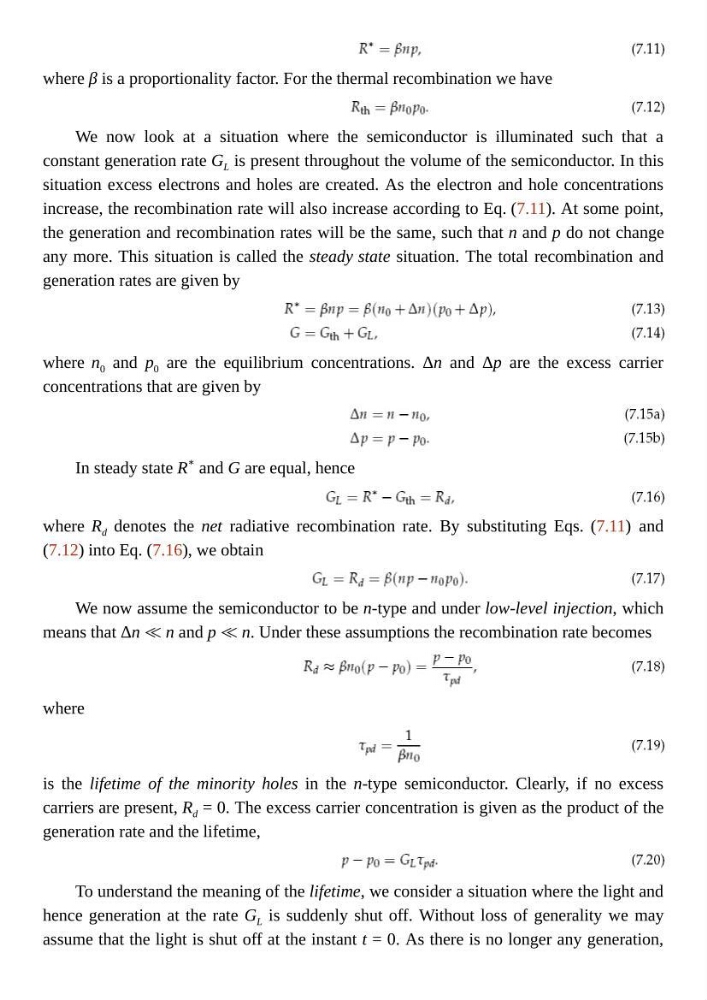
where β is a proportionality factor. For the thermal recombination we have
We now look at a situation where the semiconductor is illuminated such that a
constant generation rate G L is present throughout the volume of the semiconductor. In this
situation excess electrons and holes are created. As the electron and hole concentrations
increase, the recombination rate will also increase according to Eq. (7.11). At some point,
the generation and recombination rates will be the same, such that n and p do not change
any more. This situation is called the steady state situation. The total recombination and
generation rates are given by
where n 0 and p 0 are the equilibrium concentrations. Δn and Δp are the excess carrier
concentrations that are given by
In steady state R
∗
and G are equal, hence
where R d denotes the net radiative recombination rate. By substituting Eqs. (7.11) and
(7.12) into Eq. (7.16), we obtain
We now assume the semiconductor to be n-type and under low-level injection, which
means that Δn ≪ n and p ≪ n. Under these assumptions the recombination rate becomes
where
is the lifetime of the minority holes in the n-type semiconductor. Clearly, if no excess
carriers are present, R d = 0. The excess carrier concentration is given as the product of the
generation rate and the lifetime,
To understand the meaning of the lifetime, we consider a situation where the light and
hence generation at the rate G L is suddenly shut off. Without loss of generality we may
assume that the light is shut off at the instant t = 0. As there is no longer any generation,
We now look at a situation where the semiconductor is illuminated such that a
constant generation rate G L is present throughout the volume of the semiconductor. In this
situation excess electrons and holes are created. As the electron and hole concentrations
increase, the recombination rate will also increase according to Eq. (7.11). At some point,
the generation and recombination rates will be the same, such that n and p do not change
any more. This situation is called the steady state situation. The total recombination and
generation rates are given by
where n 0 and p 0 are the equilibrium concentrations. Δn and Δp are the excess carrier
concentrations that are given by
In steady state R
∗
and G are equal, hence
where R d denotes the net radiative recombination rate. By substituting Eqs. (7.11) and
(7.12) into Eq. (7.16), we obtain
We now assume the semiconductor to be n-type and under low-level injection, which
means that Δn ≪ n and p ≪ n. Under these assumptions the recombination rate becomes
where
is the lifetime of the minority holes in the n-type semiconductor. Clearly, if no excess
carriers are present, R d = 0. The excess carrier concentration is given as the product of the
generation rate and the lifetime,
To understand the meaning of the lifetime, we consider a situation where the light and
hence generation at the rate G L is suddenly shut off. Without loss of generality we may
assume that the light is shut off at the instant t = 0. As there is no longer any generation,