

•
•
•
•
The SRH statistics are based on four processes that are involved in recombination in a
single-electron trap:
r 1 : capture of an electron from the conduction band;
r 2 : emission of an electron to the conduction band;
r 3 : capture of a hole from the valence band; and
r 4 : emission of a hole to the valence band.
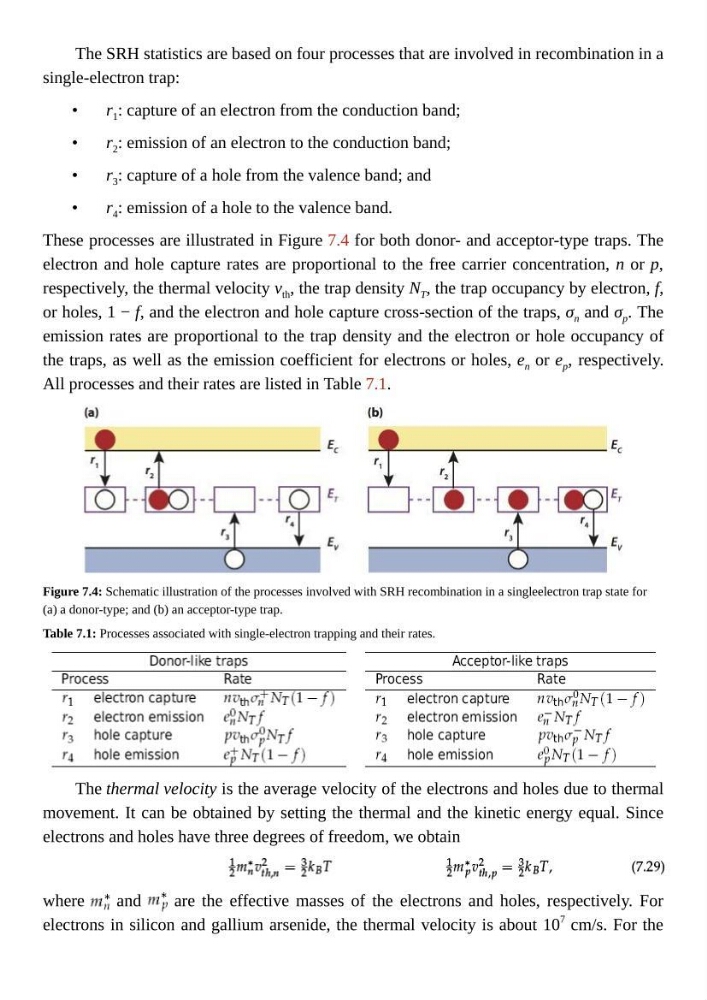
These processes are illustrated in Figure 7.4 for both donor- and acceptor-type traps. The
electron and hole capture rates are proportional to the free carrier concentration, n or p,
respectively, the thermal velocity v th , the trap density N T , the trap occupancy by electron, f,
or holes, 1 − f, and the electron and hole capture cross-section of the traps, σ n and σ p . The
emission rates are proportional to the trap density and the electron or hole occupancy of
the traps, as well as the emission coefficient for electrons or holes, e n or e p , respectively.
All processes and their rates are listed in Table 7.1.
Figure 7.4: Schematic illustration of the processes involved with SRH recombination in a singleelectron trap state for
(a) a donor-type; and (b) an acceptor-type trap.
Table 7.1: Processes associated with single-electron trapping and their rates.
The thermal velocity is the average velocity of the electrons and holes due to thermal
movement. It can be obtained by setting the thermal and the kinetic energy equal. Since
electrons and holes have three degrees of freedom, we obtain
where and are the effective masses of the electrons and holes, respectively. For
electrons in silicon and gallium arsenide, the thermal velocity is about 10
7
cm/s. For the
•
•
•
The SRH statistics are based on four processes that are involved in recombination in a
single-electron trap:
r 1 : capture of an electron from the conduction band;
r 2 : emission of an electron to the conduction band;
r 3 : capture of a hole from the valence band; and
r 4 : emission of a hole to the valence band.
These processes are illustrated in Figure 7.4 for both donor- and acceptor-type traps. The
electron and hole capture rates are proportional to the free carrier concentration, n or p,
respectively, the thermal velocity v th , the trap density N T , the trap occupancy by electron, f,
or holes, 1 − f, and the electron and hole capture cross-section of the traps, σ n and σ p . The
emission rates are proportional to the trap density and the electron or hole occupancy of
the traps, as well as the emission coefficient for electrons or holes, e n or e p , respectively.
All processes and their rates are listed in Table 7.1.
Figure 7.4: Schematic illustration of the processes involved with SRH recombination in a singleelectron trap state for
(a) a donor-type; and (b) an acceptor-type trap.
Table 7.1: Processes associated with single-electron trapping and their rates.
The thermal velocity is the average velocity of the electrons and holes due to thermal
movement. It can be obtained by setting the thermal and the kinetic energy equal. Since
electrons and holes have three degrees of freedom, we obtain
where and are the effective masses of the electrons and holes, respectively. For
electrons in silicon and gallium arsenide, the thermal velocity is about 10
7
cm/s. For the