

following derivation we assume that v th is the same for electrons and holes.
The electron capture cross–section σ n describes the effectiveness of the trap state to
capture an electron. It is a measure of how close an electron has to come to the trap to be
captured. It has the unit of area, cm
2
. Similarly, σ p describes the effectiveness of a trap
state to capture a hole.
The derivation of the recombination efficacy, below, is valid for both donor- and
acceptorlike traps. Therefore, the capture cross-section and emission coefficients in Table
7.1 are generalized by omitting their charge state. Depending on the type of trap
considered, the appropriate cross-sections and emission coefficients need to be substituted.
According to the Fermi–Dirac statistics, the carrier distribution in a semiconductor in
thermal equilibrium depends on the chemical potential of the carriers, which is referred to
as the Fermi level E F . When the device is illuminated or a bias voltage is applied, the
carriers on either side of the band gap are no longer in equilibrium. Yet, they do relax to a
state of quasi-equilibrium with their respective bands. This leads to the definition of the
quasi-Fermi levels for electrons and holes, E Fn and E Fp , which determine the carrier
concentrations under non-equilibrium conditions. Note that in thermal equilibrium E Fn =
E Fp = E F . General expressions for the free electron and hole concentrations n and p,
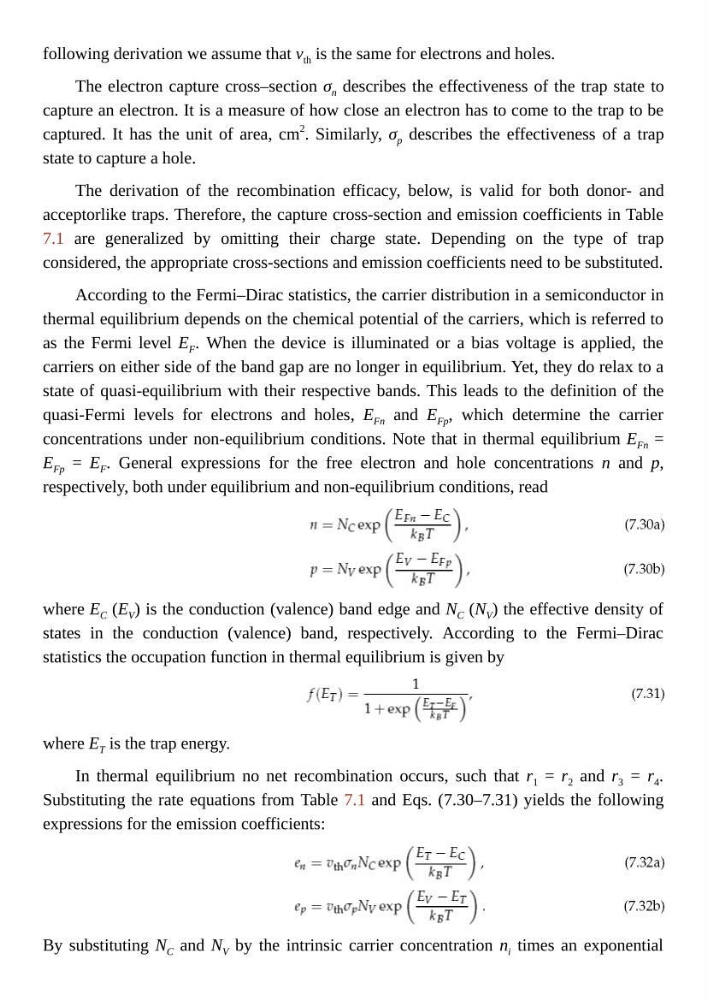
respectively, both under equilibrium and non-equilibrium conditions, read
where E C (E V ) is the conduction (valence) band edge and N C (N V ) the effective density of
states in the conduction (valence) band, respectively. According to the Fermi–Dirac
statistics the occupation function in thermal equilibrium is given by
where E T is the trap energy.
In thermal equilibrium no net recombination occurs, such that r 1 = r 2 and r 3 = r 4 .
Substituting the rate equations from Table 7.1 and Eqs. (7.30–7.31) yields the following
expressions for the emission coefficients:
By substituting N C and N V by the intrinsic carrier concentration n i times an exponential
The electron capture cross–section σ n describes the effectiveness of the trap state to
capture an electron. It is a measure of how close an electron has to come to the trap to be
captured. It has the unit of area, cm
2
. Similarly, σ p describes the effectiveness of a trap
state to capture a hole.
The derivation of the recombination efficacy, below, is valid for both donor- and
acceptorlike traps. Therefore, the capture cross-section and emission coefficients in Table
7.1 are generalized by omitting their charge state. Depending on the type of trap
considered, the appropriate cross-sections and emission coefficients need to be substituted.
According to the Fermi–Dirac statistics, the carrier distribution in a semiconductor in
thermal equilibrium depends on the chemical potential of the carriers, which is referred to
as the Fermi level E F . When the device is illuminated or a bias voltage is applied, the
carriers on either side of the band gap are no longer in equilibrium. Yet, they do relax to a
state of quasi-equilibrium with their respective bands. This leads to the definition of the
quasi-Fermi levels for electrons and holes, E Fn and E Fp , which determine the carrier
concentrations under non-equilibrium conditions. Note that in thermal equilibrium E Fn =
E Fp = E F . General expressions for the free electron and hole concentrations n and p,
respectively, both under equilibrium and non-equilibrium conditions, read
where E C (E V ) is the conduction (valence) band edge and N C (N V ) the effective density of
states in the conduction (valence) band, respectively. According to the Fermi–Dirac
statistics the occupation function in thermal equilibrium is given by
where E T is the trap energy.
In thermal equilibrium no net recombination occurs, such that r 1 = r 2 and r 3 = r 4 .
Substituting the rate equations from Table 7.1 and Eqs. (7.30–7.31) yields the following
expressions for the emission coefficients:
By substituting N C and N V by the intrinsic carrier concentration n i times an exponential