

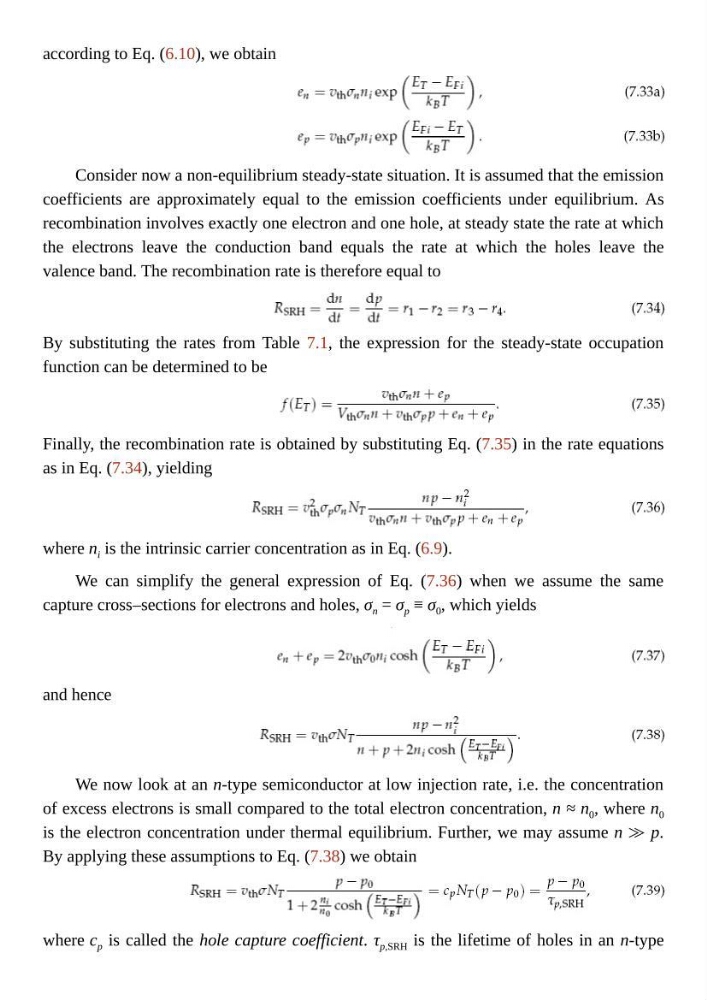
according to Eq. (6.10), we obtain
Consider now a non-equilibrium steady-state situation. It is assumed that the emission
coefficients are approximately equal to the emission coefficients under equilibrium. As
recombination involves exactly one electron and one hole, at steady state the rate at which
the electrons leave the conduction band equals the rate at which the holes leave the
valence band. The recombination rate is therefore equal to
By substituting the rates from Table 7.1, the expression for the steady-state occupation
function can be determined to be
Finally, the recombination rate is obtained by substituting Eq. (7.35) in the rate equations
as in Eq. (7.34), yielding
where n i is the intrinsic carrier concentration as in Eq. (6.9).
We can simplify the general expression of Eq. (7.36) when we assume the same
capture cross–sections for electrons and holes, σ n = σ p ≡ σ 0 , which yields
and hence
We now look at an n-type semiconductor at low injection rate, i.e. the concentration
of excess electrons is small compared to the total electron concentration, n ≈ n 0 , where n 0
is the electron concentration under thermal equilibrium. Further, we may assume n ≫ p.
By applying these assumptions to Eq. (7.38) we obtain
where c p is called the hole capture coefficient. τ p,SRH is the lifetime of holes in an n-type
Consider now a non-equilibrium steady-state situation. It is assumed that the emission
coefficients are approximately equal to the emission coefficients under equilibrium. As
recombination involves exactly one electron and one hole, at steady state the rate at which
the electrons leave the conduction band equals the rate at which the holes leave the
valence band. The recombination rate is therefore equal to
By substituting the rates from Table 7.1, the expression for the steady-state occupation
function can be determined to be
Finally, the recombination rate is obtained by substituting Eq. (7.35) in the rate equations
as in Eq. (7.34), yielding
where n i is the intrinsic carrier concentration as in Eq. (6.9).
We can simplify the general expression of Eq. (7.36) when we assume the same
capture cross–sections for electrons and holes, σ n = σ p ≡ σ 0 , which yields
and hence
We now look at an n-type semiconductor at low injection rate, i.e. the concentration
of excess electrons is small compared to the total electron concentration, n ≈ n 0 , where n 0
is the electron concentration under thermal equilibrium. Further, we may assume n ≫ p.
By applying these assumptions to Eq. (7.38) we obtain
where c p is called the hole capture coefficient. τ p,SRH is the lifetime of holes in an n-type