

shown. This momentum is also called the crystal momentum, and is related to the wave
vector k of the electron. It is important to realize that the position of the valence and
conduction band may differ in different directions of the lattice coordination. We can
understand this by realizing that the crystal can look very different if we look at it from
different directions. Hence, the energy levels in which electrons and holes can propagate
across the crystal depend on the direction. The dispersion diagram of silicon is discussed
in more detail in Chapter 12.
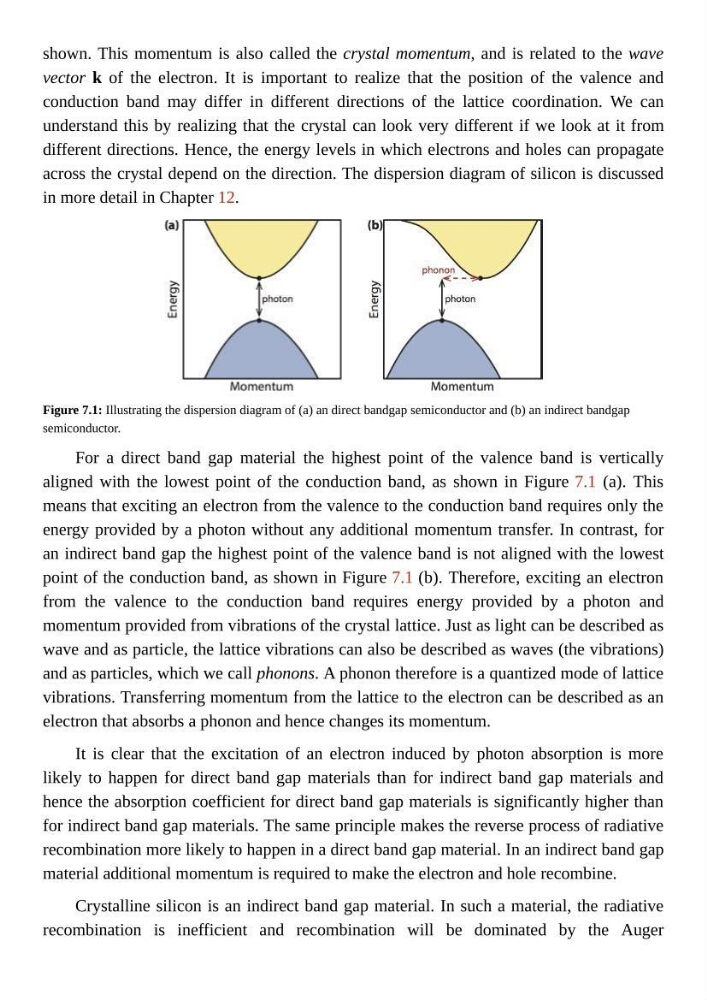
Figure 7.1: Illustrating the dispersion diagram of (a) an direct bandgap semiconductor and (b) an indirect bandgap
semiconductor.
For a direct band gap material the highest point of the valence band is vertically
aligned with the lowest point of the conduction band, as shown in Figure 7.1 (a). This
means that exciting an electron from the valence to the conduction band requires only the
energy provided by a photon without any additional momentum transfer. In contrast, for
an indirect band gap the highest point of the valence band is not aligned with the lowest
point of the conduction band, as shown in Figure 7.1 (b). Therefore, exciting an electron
from the valence to the conduction band requires energy provided by a photon and
momentum provided from vibrations of the crystal lattice. Just as light can be described as
wave and as particle, the lattice vibrations can also be described as waves (the vibrations)
and as particles, which we call phonons. A phonon therefore is a quantized mode of lattice
vibrations. Transferring momentum from the lattice to the electron can be described as an
electron that absorbs a phonon and hence changes its momentum.
It is clear that the excitation of an electron induced by photon absorption is more
likely to happen for direct band gap materials than for indirect band gap materials and
hence the absorption coefficient for direct band gap materials is significantly higher than
for indirect band gap materials. The same principle makes the reverse process of radiative
recombination more likely to happen in a direct band gap material. In an indirect band gap
material additional momentum is required to make the electron and hole recombine.
Crystalline silicon is an indirect band gap material. In such a material, the radiative
recombination is inefficient and recombination will be dominated by the Auger
vector k of the electron. It is important to realize that the position of the valence and
conduction band may differ in different directions of the lattice coordination. We can
understand this by realizing that the crystal can look very different if we look at it from
different directions. Hence, the energy levels in which electrons and holes can propagate
across the crystal depend on the direction. The dispersion diagram of silicon is discussed
in more detail in Chapter 12.
Figure 7.1: Illustrating the dispersion diagram of (a) an direct bandgap semiconductor and (b) an indirect bandgap
semiconductor.
For a direct band gap material the highest point of the valence band is vertically
aligned with the lowest point of the conduction band, as shown in Figure 7.1 (a). This
means that exciting an electron from the valence to the conduction band requires only the
energy provided by a photon without any additional momentum transfer. In contrast, for
an indirect band gap the highest point of the valence band is not aligned with the lowest
point of the conduction band, as shown in Figure 7.1 (b). Therefore, exciting an electron
from the valence to the conduction band requires energy provided by a photon and
momentum provided from vibrations of the crystal lattice. Just as light can be described as
wave and as particle, the lattice vibrations can also be described as waves (the vibrations)
and as particles, which we call phonons. A phonon therefore is a quantized mode of lattice
vibrations. Transferring momentum from the lattice to the electron can be described as an
electron that absorbs a phonon and hence changes its momentum.
It is clear that the excitation of an electron induced by photon absorption is more
likely to happen for direct band gap materials than for indirect band gap materials and
hence the absorption coefficient for direct band gap materials is significantly higher than
for indirect band gap materials. The same principle makes the reverse process of radiative
recombination more likely to happen in a direct band gap material. In an indirect band gap
material additional momentum is required to make the electron and hole recombine.
Crystalline silicon is an indirect band gap material. In such a material, the radiative
recombination is inefficient and recombination will be dominated by the Auger