

7.1
7
Generation and recombination of
electron-hole pairs
Introduction
Assume that a piece of a semiconductor is illuminated by a light pulse, which leads to
excitations of electrons from the valence band to the conduction band and consequently to
the creation of holes in the valence band. This illumination will disturb the semiconductor
from the state of thermal equilibrium. In the valence band an excess concentration of holes
p > p 0 is present, where p 0 denotes the equilibrium concentration. Similarly, in the
conduction band the electron concentration is larger than the equilibrium concentration, n
> n 0 , which means that excess carriers are present. It is clear that in this non-equilibrium
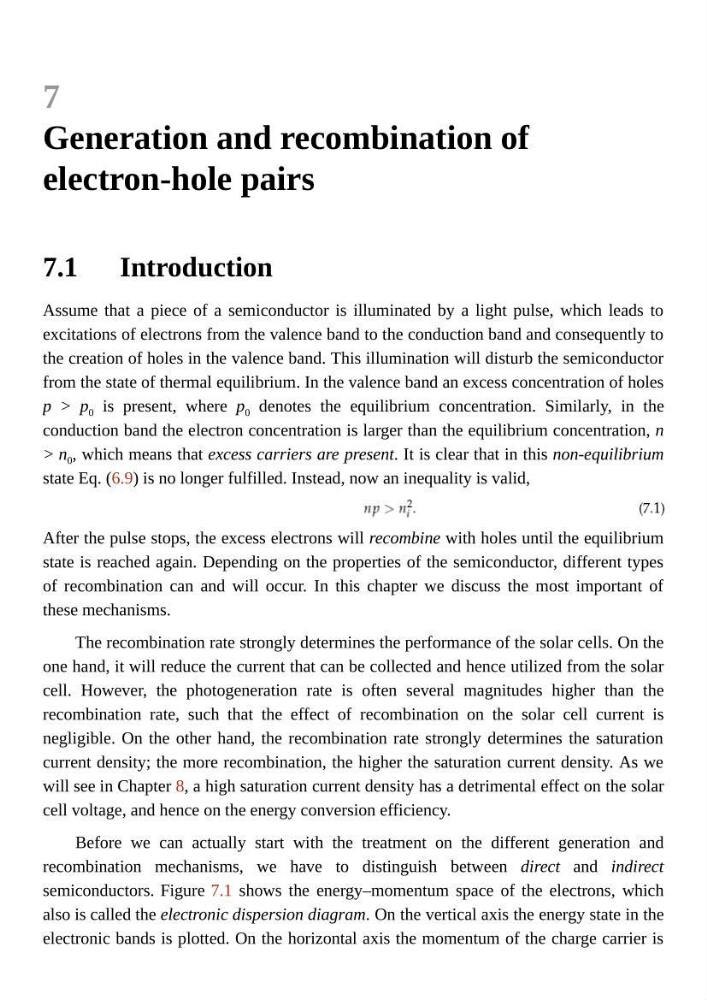
state Eq. (6.9) is no longer fulfilled. Instead, now an inequality is valid,
After the pulse stops, the excess electrons will recombine with holes until the equilibrium
state is reached again. Depending on the properties of the semiconductor, different types
of recombination can and will occur. In this chapter we discuss the most important of
these mechanisms.
The recombination rate strongly determines the performance of the solar cells. On the
one hand, it will reduce the current that can be collected and hence utilized from the solar
cell. However, the photogeneration rate is often several magnitudes higher than the
recombination rate, such that the effect of recombination on the solar cell current is
negligible. On the other hand, the recombination rate strongly determines the saturation
current density; the more recombination, the higher the saturation current density. As we
will see in Chapter 8, a high saturation current density has a detrimental effect on the solar
cell voltage, and hence on the energy conversion efficiency.
Before we can actually start with the treatment on the different generation and
recombination mechanisms, we have to distinguish between direct and indirect
semiconductors. Figure 7.1 shows the energy–momentum space of the electrons, which
also is called the electronic dispersion diagram. On the vertical axis the energy state in the
electronic bands is plotted. On the horizontal axis the momentum of the charge carrier is
7
Generation and recombination of
electron-hole pairs
Introduction
Assume that a piece of a semiconductor is illuminated by a light pulse, which leads to
excitations of electrons from the valence band to the conduction band and consequently to
the creation of holes in the valence band. This illumination will disturb the semiconductor
from the state of thermal equilibrium. In the valence band an excess concentration of holes
p > p 0 is present, where p 0 denotes the equilibrium concentration. Similarly, in the
conduction band the electron concentration is larger than the equilibrium concentration, n
> n 0 , which means that excess carriers are present. It is clear that in this non-equilibrium
state Eq. (6.9) is no longer fulfilled. Instead, now an inequality is valid,
After the pulse stops, the excess electrons will recombine with holes until the equilibrium
state is reached again. Depending on the properties of the semiconductor, different types
of recombination can and will occur. In this chapter we discuss the most important of
these mechanisms.
The recombination rate strongly determines the performance of the solar cells. On the
one hand, it will reduce the current that can be collected and hence utilized from the solar
cell. However, the photogeneration rate is often several magnitudes higher than the
recombination rate, such that the effect of recombination on the solar cell current is
negligible. On the other hand, the recombination rate strongly determines the saturation
current density; the more recombination, the higher the saturation current density. As we
will see in Chapter 8, a high saturation current density has a detrimental effect on the solar
cell voltage, and hence on the energy conversion efficiency.
Before we can actually start with the treatment on the different generation and
recombination mechanisms, we have to distinguish between direct and indirect
semiconductors. Figure 7.1 shows the energy–momentum space of the electrons, which
also is called the electronic dispersion diagram. On the vertical axis the energy state in the
electronic bands is plotted. On the horizontal axis the momentum of the charge carrier is