

7.2
7.2.1
recombination mechanism discussed in Section 7.4. For direct band gap materials such as
gallium arsenide under moderate illumination conditions, radiative recombination will be
the dominant loss mechanism of charge carriers. For very high illumination conditions,
Auger recombination starts to play a role as well. Gallium arsenide based solar cells are
discussed in Chapter 13.
Bandgap-to-bandgap processes
Generation and recombination processes that happen from bandgap to bandgap are also
called direct generation and recombination. They are much more likely to happen in direct
bandgap materials, as no change in momentum is required for an electron that is excited
into the conduction band. These processes are most usually radiative, which means that a
photon is absorbed when an electron-hole pair is created, and a photon is emitted if
electron-hole pairs recombine directly. In this section, we will also introduce important
concepts for generation and recombination, such as the minority carrier lifetime.
Radiative generation
When light penetrates into a material it will be (partially) absorbed as it propagates
through the material. If the photon energy is higher than the bandgap energy of the
semiconductor, it is sufficient to break bonds and to excite a valence electron into the
conduction band, leaving a hole behind in the valance band; hence electron-hole pairs are
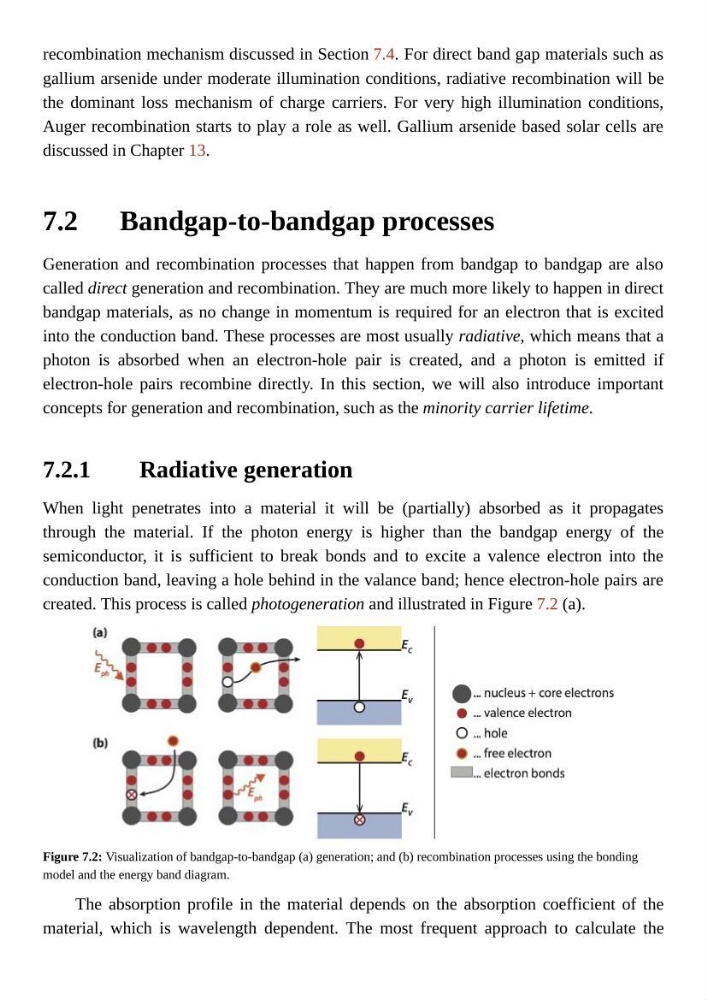
created. This process is called photogeneration and illustrated in Figure 7.2 (a).
Figure 7.2: Visualization of bandgap-to-bandgap (a) generation; and (b) recombination processes using the bonding
model and the energy band diagram.
The absorption profile in the material depends on the absorption coefficient of the
material, which is wavelength dependent. The most frequent approach to calculate the
7.2.1
recombination mechanism discussed in Section 7.4. For direct band gap materials such as
gallium arsenide under moderate illumination conditions, radiative recombination will be
the dominant loss mechanism of charge carriers. For very high illumination conditions,
Auger recombination starts to play a role as well. Gallium arsenide based solar cells are
discussed in Chapter 13.
Bandgap-to-bandgap processes
Generation and recombination processes that happen from bandgap to bandgap are also
called direct generation and recombination. They are much more likely to happen in direct
bandgap materials, as no change in momentum is required for an electron that is excited
into the conduction band. These processes are most usually radiative, which means that a
photon is absorbed when an electron-hole pair is created, and a photon is emitted if
electron-hole pairs recombine directly. In this section, we will also introduce important
concepts for generation and recombination, such as the minority carrier lifetime.
Radiative generation
When light penetrates into a material it will be (partially) absorbed as it propagates
through the material. If the photon energy is higher than the bandgap energy of the
semiconductor, it is sufficient to break bonds and to excite a valence electron into the
conduction band, leaving a hole behind in the valance band; hence electron-hole pairs are
created. This process is called photogeneration and illustrated in Figure 7.2 (a).
Figure 7.2: Visualization of bandgap-to-bandgap (a) generation; and (b) recombination processes using the bonding
model and the energy band diagram.
The absorption profile in the material depends on the absorption coefficient of the
material, which is wavelength dependent. The most frequent approach to calculate the