

6.4.2
When the requirement that the Fermi level lies in the band gap more than 3 k B T from
either band edge is satisfied, the semiconductor is referred to as a nondegenerate
semiconductor.
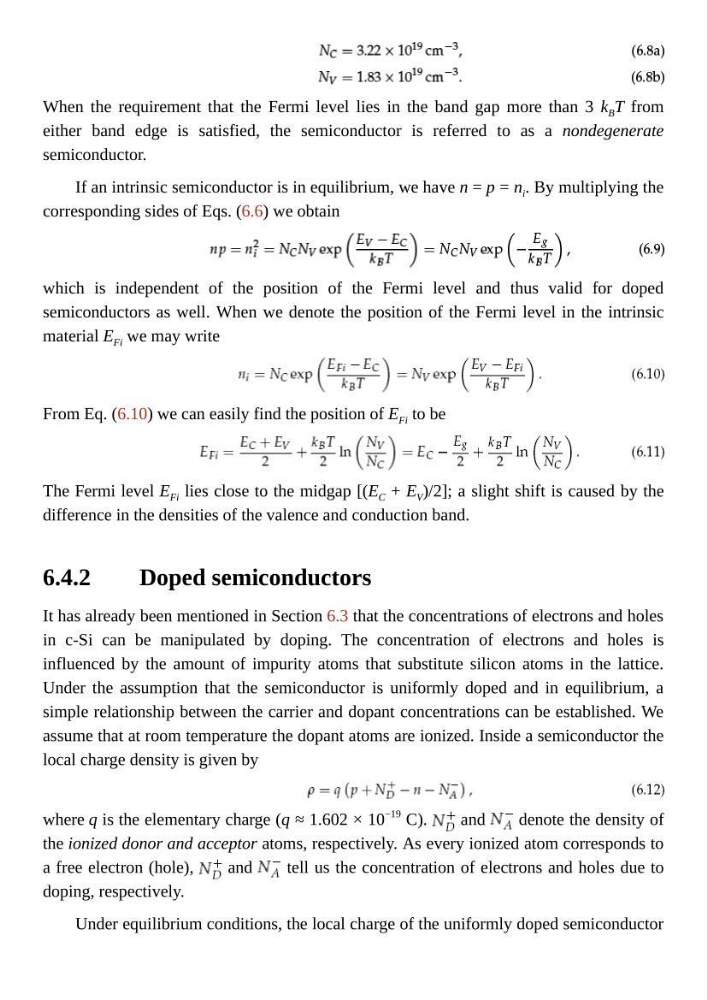
If an intrinsic semiconductor is in equilibrium, we have n = p = n i . By multiplying the
corresponding sides of Eqs. (6.6) we obtain
which is independent of the position of the Fermi level and thus valid for doped
semiconductors as well. When we denote the position of the Fermi level in the intrinsic
material E Fi we may write
From Eq. (6.10) we can easily find the position of E Fi to be
The Fermi level E Fi lies close to the midgap [(E C + E V )/2]; a slight shift is caused by the
difference in the densities of the valence and conduction band.
Doped semiconductors
It has already been mentioned in Section 6.3 that the concentrations of electrons and holes
in c-Si can be manipulated by doping. The concentration of electrons and holes is
influenced by the amount of impurity atoms that substitute silicon atoms in the lattice.
Under the assumption that the semiconductor is uniformly doped and in equilibrium, a
simple relationship between the carrier and dopant concentrations can be established. We
assume that at room temperature the dopant atoms are ionized. Inside a semiconductor the
local charge density is given by
where q is the elementary charge (q ≈ 1.602 × 10
−19 C). and denote the density of
the ionized donor and acceptor atoms, respectively. As every ionized atom corresponds to
a free electron (hole), and tell us the concentration of electrons and holes due to
doping, respectively.
Under equilibrium conditions, the local charge of the uniformly doped semiconductor
When the requirement that the Fermi level lies in the band gap more than 3 k B T from
either band edge is satisfied, the semiconductor is referred to as a nondegenerate
semiconductor.
If an intrinsic semiconductor is in equilibrium, we have n = p = n i . By multiplying the
corresponding sides of Eqs. (6.6) we obtain
which is independent of the position of the Fermi level and thus valid for doped
semiconductors as well. When we denote the position of the Fermi level in the intrinsic
material E Fi we may write
From Eq. (6.10) we can easily find the position of E Fi to be
The Fermi level E Fi lies close to the midgap [(E C + E V )/2]; a slight shift is caused by the
difference in the densities of the valence and conduction band.
Doped semiconductors
It has already been mentioned in Section 6.3 that the concentrations of electrons and holes
in c-Si can be manipulated by doping. The concentration of electrons and holes is
influenced by the amount of impurity atoms that substitute silicon atoms in the lattice.
Under the assumption that the semiconductor is uniformly doped and in equilibrium, a
simple relationship between the carrier and dopant concentrations can be established. We
assume that at room temperature the dopant atoms are ionized. Inside a semiconductor the
local charge density is given by
where q is the elementary charge (q ≈ 1.602 × 10
−19 C). and denote the density of
the ionized donor and acceptor atoms, respectively. As every ionized atom corresponds to
a free electron (hole), and tell us the concentration of electrons and holes due to
doping, respectively.
Under equilibrium conditions, the local charge of the uniformly doped semiconductor