

5.2 Radiometric properties
Radiometry is the branch of optics concerned with the measurement of light. Since
photovoltaics deals with sunlight that is converted into electricity it is very important to
discuss how the “amount of energy” of the light can be expressed physically and
mathematically.
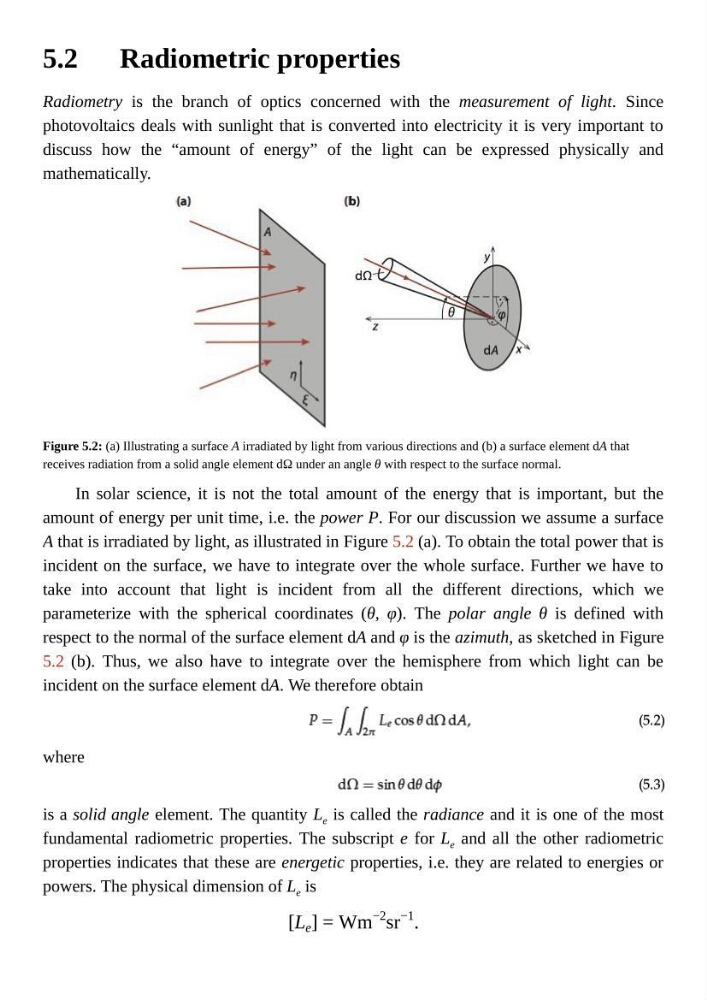
Figure 5.2: (a) Illustrating a surface A irradiated by light from various directions and (b) a surface element dA that
receives radiation from a solid angle element dΩ under an angle θ with respect to the surface normal.
In solar science, it is not the total amount of the energy that is important, but the
amount of energy per unit time, i.e. the power P. For our discussion we assume a surface
A that is irradiated by light, as illustrated in Figure 5.2 (a). To obtain the total power that is
incident on the surface, we have to integrate over the whole surface. Further we have to
take into account that light is incident from all the different directions, which we
parameterize with the spherical coordinates (θ, φ). The polar angle θ is defined with
respect to the normal of the surface element dA and φ is the azimuth, as sketched in Figure
5.2 (b). Thus, we also have to integrate over the hemisphere from which light can be
incident on the surface element dA. We therefore obtain
where
is a solid angle element. The quantity L e is called the radiance and it is one of the most
fundamental radiometric properties. The subscript e for L e and all the other radiometric
properties indicates that these are energetic properties, i.e. they are related to energies or
powers. The physical dimension of L e is
[L e ] = Wm
−2
sr
−1 .
Radiometry is the branch of optics concerned with the measurement of light. Since
photovoltaics deals with sunlight that is converted into electricity it is very important to
discuss how the “amount of energy” of the light can be expressed physically and
mathematically.
Figure 5.2: (a) Illustrating a surface A irradiated by light from various directions and (b) a surface element dA that
receives radiation from a solid angle element dΩ under an angle θ with respect to the surface normal.
In solar science, it is not the total amount of the energy that is important, but the
amount of energy per unit time, i.e. the power P. For our discussion we assume a surface
A that is irradiated by light, as illustrated in Figure 5.2 (a). To obtain the total power that is
incident on the surface, we have to integrate over the whole surface. Further we have to
take into account that light is incident from all the different directions, which we
parameterize with the spherical coordinates (θ, φ). The polar angle θ is defined with
respect to the normal of the surface element dA and φ is the azimuth, as sketched in Figure
5.2 (b). Thus, we also have to integrate over the hemisphere from which light can be
incident on the surface element dA. We therefore obtain
where
is a solid angle element. The quantity L e is called the radiance and it is one of the most
fundamental radiometric properties. The subscript e for L e and all the other radiometric
properties indicates that these are energetic properties, i.e. they are related to energies or
powers. The physical dimension of L e is
[L e ] = Wm
−2
sr
−1 .