

Density (at its centre)
>10 5 kg m −3 (over 100 × that of water)
Pressure (at its centre)
over 1 billion atmospheres
Temperature (at its centre)
about 15,000,000 K
Temperature (at the surface)
6,000 K
Energy radiation
3.8 × 10 26 W
The Earth receives
1.7 × 10 18 W
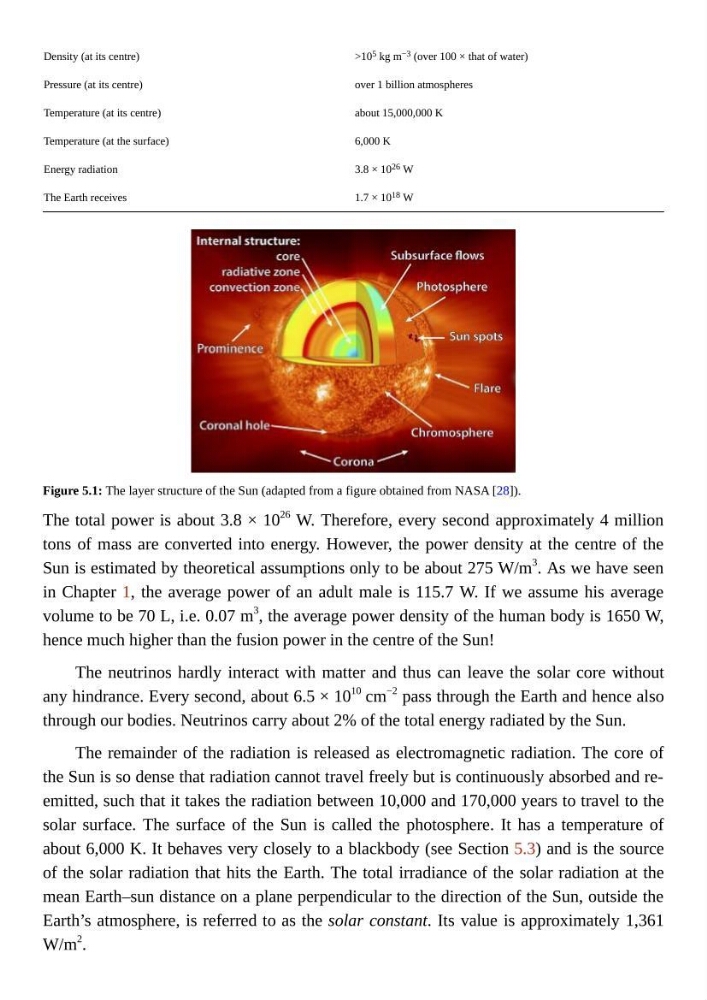
Figure 5.1: The layer structure of the Sun (adapted from a figure obtained from NASA [28]).
The total power is about 3.8 × 10
26
W. Therefore, every second approximately 4 million
tons of mass are converted into energy. However, the power density at the centre of the
Sun is estimated by theoretical assumptions only to be about 275 W/m
3 . As we have seen
in Chapter 1, the average power of an adult male is 115.7 W. If we assume his average
volume to be 70 L, i.e. 0.07 m
3 , the average power density of the human body is 1650 W,
hence much higher than the fusion power in the centre of the Sun!
The neutrinos hardly interact with matter and thus can leave the solar core without
any hindrance. Every second, about 6.5 × 10
10 cm
−2 pass through the Earth and hence also
through our bodies. Neutrinos carry about 2% of the total energy radiated by the Sun.
The remainder of the radiation is released as electromagnetic radiation. The core of
the Sun is so dense that radiation cannot travel freely but is continuously absorbed and reemitted, such that it takes the radiation between 10,000 and 170,000 years to travel to the
solar surface. The surface of the Sun is called the photosphere. It has a temperature of
about 6,000 K. It behaves very closely to a blackbody (see Section 5.3) and is the source
of the solar radiation that hits the Earth. The total irradiance of the solar radiation at the
mean Earth–sun distance on a plane perpendicular to the direction of the Sun, outside the
Earth’s atmosphere, is referred to as the solar constant. Its value is approximately 1,361
W/m
2 .
>10 5 kg m −3 (over 100 × that of water)
Pressure (at its centre)
over 1 billion atmospheres
Temperature (at its centre)
about 15,000,000 K
Temperature (at the surface)
6,000 K
Energy radiation
3.8 × 10 26 W
The Earth receives
1.7 × 10 18 W
Figure 5.1: The layer structure of the Sun (adapted from a figure obtained from NASA [28]).
The total power is about 3.8 × 10
26
W. Therefore, every second approximately 4 million
tons of mass are converted into energy. However, the power density at the centre of the
Sun is estimated by theoretical assumptions only to be about 275 W/m
3 . As we have seen
in Chapter 1, the average power of an adult male is 115.7 W. If we assume his average
volume to be 70 L, i.e. 0.07 m
3 , the average power density of the human body is 1650 W,
hence much higher than the fusion power in the centre of the Sun!
The neutrinos hardly interact with matter and thus can leave the solar core without
any hindrance. Every second, about 6.5 × 10
10 cm
−2 pass through the Earth and hence also
through our bodies. Neutrinos carry about 2% of the total energy radiated by the Sun.
The remainder of the radiation is released as electromagnetic radiation. The core of
the Sun is so dense that radiation cannot travel freely but is continuously absorbed and reemitted, such that it takes the radiation between 10,000 and 170,000 years to travel to the
solar surface. The surface of the Sun is called the photosphere. It has a temperature of
about 6,000 K. It behaves very closely to a blackbody (see Section 5.3) and is the source
of the solar radiation that hits the Earth. The total irradiance of the solar radiation at the
mean Earth–sun distance on a plane perpendicular to the direction of the Sun, outside the
Earth’s atmosphere, is referred to as the solar constant. Its value is approximately 1,361
W/m
2 .