

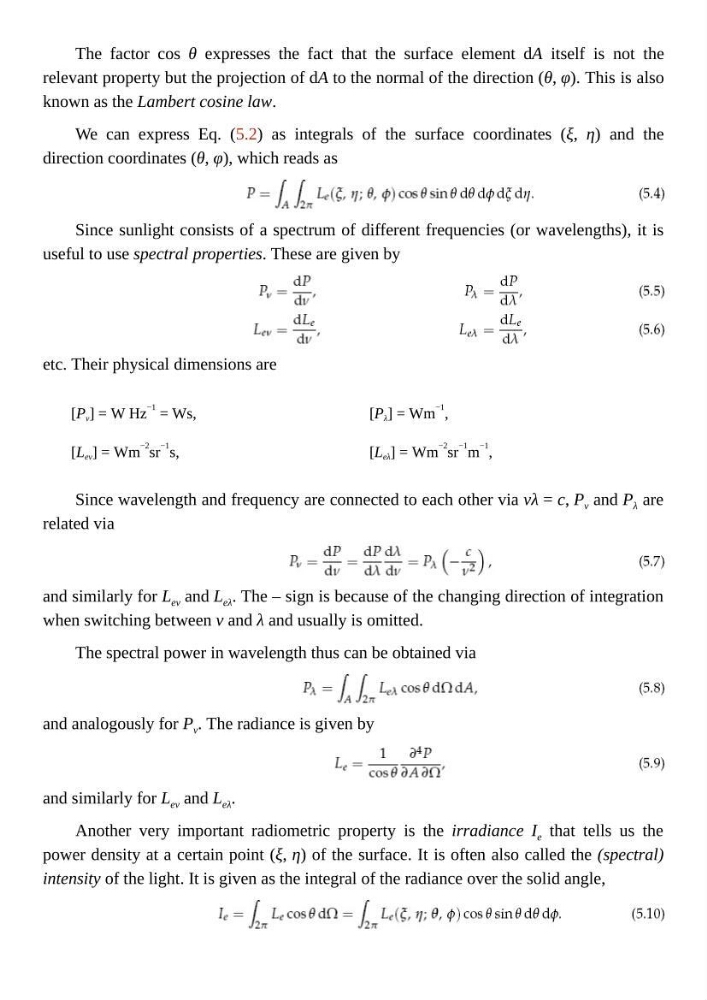
The factor cos θ expresses the fact that the surface element dA itself is not the
relevant property but the projection of dA to the normal of the direction (θ, φ). This is also
known as the Lambert cosine law.
We can express Eq. (5.2) as integrals of the surface coordinates (ξ, η) and the
direction coordinates (θ, φ), which reads as
Since sunlight consists of a spectrum of different frequencies (or wavelengths), it is
useful to use spectral properties. These are given by
etc. Their physical dimensions are
[P ν ] = W Hz
−1 = Ws,
[P λ ] = Wm
−1 ,
[L eν ] = Wm
−2 sr
−1 s,
[L eλ ] = Wm
−2
sr
−1
m
−1
,
Since wavelength and frequency are connected to each other via νλ = c, P ν and P λ are
related via
and similarly for L eν and L eλ . The – sign is because of the changing direction of integration
when switching between ν and λ and usually is omitted.
The spectral power in wavelength thus can be obtained via
and analogously for P ν . The radiance is given by
and similarly for L eν and L eλ .
Another very important radiometric property is the irradiance I e that tells us the
power density at a certain point (ξ, η) of the surface. It is often also called the (spectral)
intensity of the light. It is given as the integral of the radiance over the solid angle,
relevant property but the projection of dA to the normal of the direction (θ, φ). This is also
known as the Lambert cosine law.
We can express Eq. (5.2) as integrals of the surface coordinates (ξ, η) and the
direction coordinates (θ, φ), which reads as
Since sunlight consists of a spectrum of different frequencies (or wavelengths), it is
useful to use spectral properties. These are given by
etc. Their physical dimensions are
[P ν ] = W Hz
−1 = Ws,
[P λ ] = Wm
−1 ,
[L eν ] = Wm
−2 sr
−1 s,
[L eλ ] = Wm
−2
sr
−1
m
−1
,
Since wavelength and frequency are connected to each other via νλ = c, P ν and P λ are
related via
and similarly for L eν and L eλ . The – sign is because of the changing direction of integration
when switching between ν and λ and usually is omitted.
The spectral power in wavelength thus can be obtained via
and analogously for P ν . The radiance is given by
and similarly for L eν and L eλ .
Another very important radiometric property is the irradiance I e that tells us the
power density at a certain point (ξ, η) of the surface. It is often also called the (spectral)
intensity of the light. It is given as the integral of the radiance over the solid angle,