

4.5
4.5.1
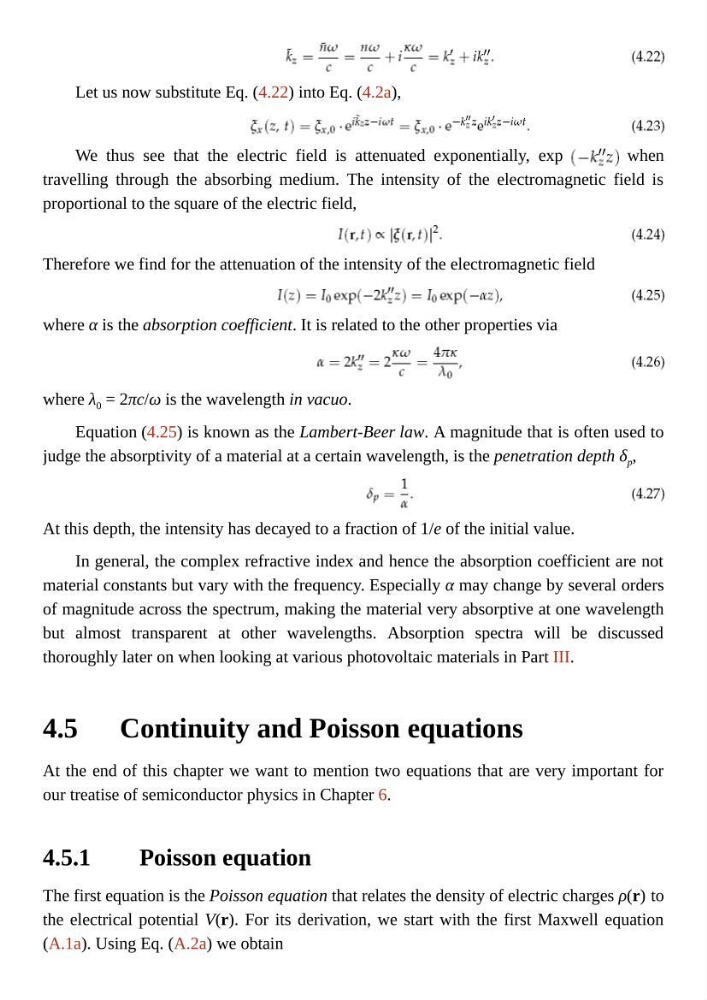
Let us now substitute Eq. (4.22) into Eq. (4.2a),
We thus see that the electric field is attenuated exponentially, exp
when
travelling through the absorbing medium. The intensity of the electromagnetic field is
proportional to the square of the electric field,
Therefore we find for the attenuation of the intensity of the electromagnetic field
where α is the absorption coefficient. It is related to the other properties via
where λ 0 = 2πc/ω is the wavelength in vacuo.
Equation (4.25) is known as the Lambert-Beer law. A magnitude that is often used to
judge the absorptivity of a material at a certain wavelength, is the penetration depth δ p ,
At this depth, the intensity has decayed to a fraction of 1/e of the initial value.
In general, the complex refractive index and hence the absorption coefficient are not
material constants but vary with the frequency. Especially α may change by several orders
of magnitude across the spectrum, making the material very absorptive at one wavelength
but almost transparent at other wavelengths. Absorption spectra will be discussed
thoroughly later on when looking at various photovoltaic materials in Part III.
Continuity and Poisson equations
At the end of this chapter we want to mention two equations that are very important for
our treatise of semiconductor physics in Chapter 6.
Poisson equation
The first equation is the Poisson equation that relates the density of electric charges ρ(r) to
the electrical potential V(r). For its derivation, we start with the first Maxwell equation
(A.1a). Using Eq. (A.2a) we obtain
4.5.1
Let us now substitute Eq. (4.22) into Eq. (4.2a),
We thus see that the electric field is attenuated exponentially, exp
when
travelling through the absorbing medium. The intensity of the electromagnetic field is
proportional to the square of the electric field,
Therefore we find for the attenuation of the intensity of the electromagnetic field
where α is the absorption coefficient. It is related to the other properties via
where λ 0 = 2πc/ω is the wavelength in vacuo.
Equation (4.25) is known as the Lambert-Beer law. A magnitude that is often used to
judge the absorptivity of a material at a certain wavelength, is the penetration depth δ p ,
At this depth, the intensity has decayed to a fraction of 1/e of the initial value.
In general, the complex refractive index and hence the absorption coefficient are not
material constants but vary with the frequency. Especially α may change by several orders
of magnitude across the spectrum, making the material very absorptive at one wavelength
but almost transparent at other wavelengths. Absorption spectra will be discussed
thoroughly later on when looking at various photovoltaic materials in Part III.
Continuity and Poisson equations
At the end of this chapter we want to mention two equations that are very important for
our treatise of semiconductor physics in Chapter 6.
Poisson equation
The first equation is the Poisson equation that relates the density of electric charges ρ(r) to
the electrical potential V(r). For its derivation, we start with the first Maxwell equation
(A.1a). Using Eq. (A.2a) we obtain