

4.4
which leads to
for normal incidence.
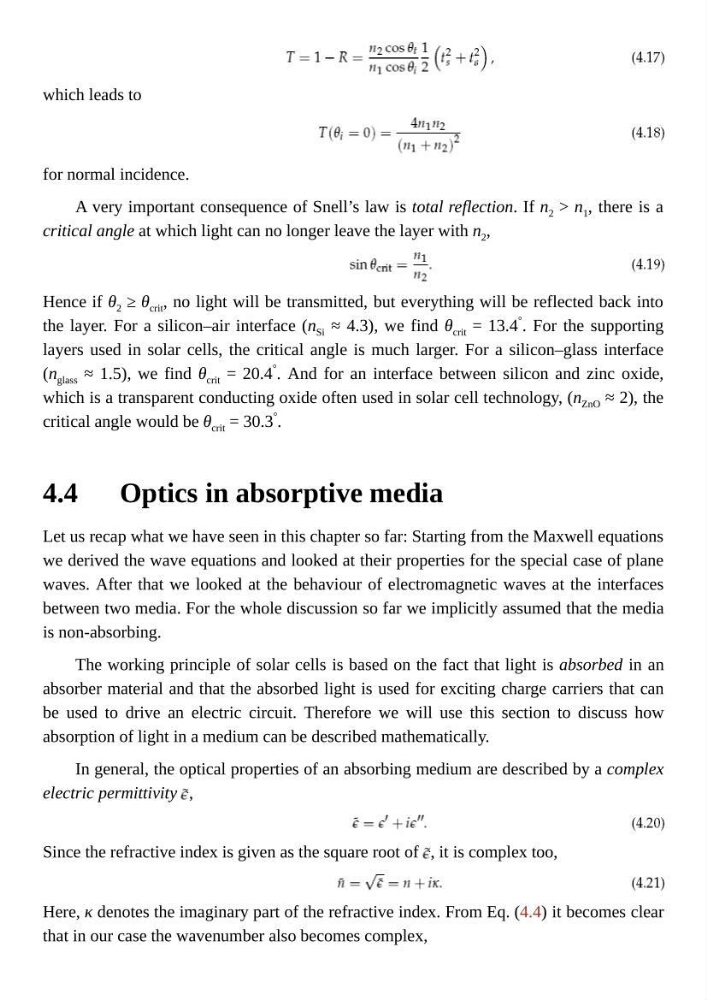
A very important consequence of Snell’s law is total reflection. If n 2 > n 1 , there is a
critical angle at which light can no longer leave the layer with n 2 ,
Hence if θ 2 ≥ θ crit , no light will be transmitted, but everything will be reflected back into
the layer. For a silicon–air interface (n Si ≈ 4.3), we find θ crit = 13.4
°
. For the supporting
layers used in solar cells, the critical angle is much larger. For a silicon–glass interface
(n glass ≈ 1.5), we find θ crit = 20.4
°
. And for an interface between silicon and zinc oxide,
which is a transparent conducting oxide often used in solar cell technology, (n ZnO ≈ 2), the
critical angle would be θ crit = 30.3
°
.
Optics in absorptive media
Let us recap what we have seen in this chapter so far: Starting from the Maxwell equations
we derived the wave equations and looked at their properties for the special case of plane
waves. After that we looked at the behaviour of electromagnetic waves at the interfaces
between two media. For the whole discussion so far we implicitly assumed that the media
is non-absorbing.
The working principle of solar cells is based on the fact that light is absorbed in an
absorber material and that the absorbed light is used for exciting charge carriers that can
be used to drive an electric circuit. Therefore we will use this section to discuss how
absorption of light in a medium can be described mathematically.
In general, the optical properties of an absorbing medium are described by a complex
electric permittivity ,
Since the refractive index is given as the square root of , it is complex too,
Here, κ denotes the imaginary part of the refractive index. From Eq. (4.4) it becomes clear
that in our case the wavenumber also becomes complex,
which leads to
for normal incidence.
A very important consequence of Snell’s law is total reflection. If n 2 > n 1 , there is a
critical angle at which light can no longer leave the layer with n 2 ,
Hence if θ 2 ≥ θ crit , no light will be transmitted, but everything will be reflected back into
the layer. For a silicon–air interface (n Si ≈ 4.3), we find θ crit = 13.4
°
. For the supporting
layers used in solar cells, the critical angle is much larger. For a silicon–glass interface
(n glass ≈ 1.5), we find θ crit = 20.4
°
. And for an interface between silicon and zinc oxide,
which is a transparent conducting oxide often used in solar cell technology, (n ZnO ≈ 2), the
critical angle would be θ crit = 30.3
°
.
Optics in absorptive media
Let us recap what we have seen in this chapter so far: Starting from the Maxwell equations
we derived the wave equations and looked at their properties for the special case of plane
waves. After that we looked at the behaviour of electromagnetic waves at the interfaces
between two media. For the whole discussion so far we implicitly assumed that the media
is non-absorbing.
The working principle of solar cells is based on the fact that light is absorbed in an
absorber material and that the absorbed light is used for exciting charge carriers that can
be used to drive an electric circuit. Therefore we will use this section to discuss how
absorption of light in a medium can be described mathematically.
In general, the optical properties of an absorbing medium are described by a complex
electric permittivity ,
Since the refractive index is given as the square root of , it is complex too,
Here, κ denotes the imaginary part of the refractive index. From Eq. (4.4) it becomes clear
that in our case the wavenumber also becomes complex,