

G.3.2
G.3.3
G.4
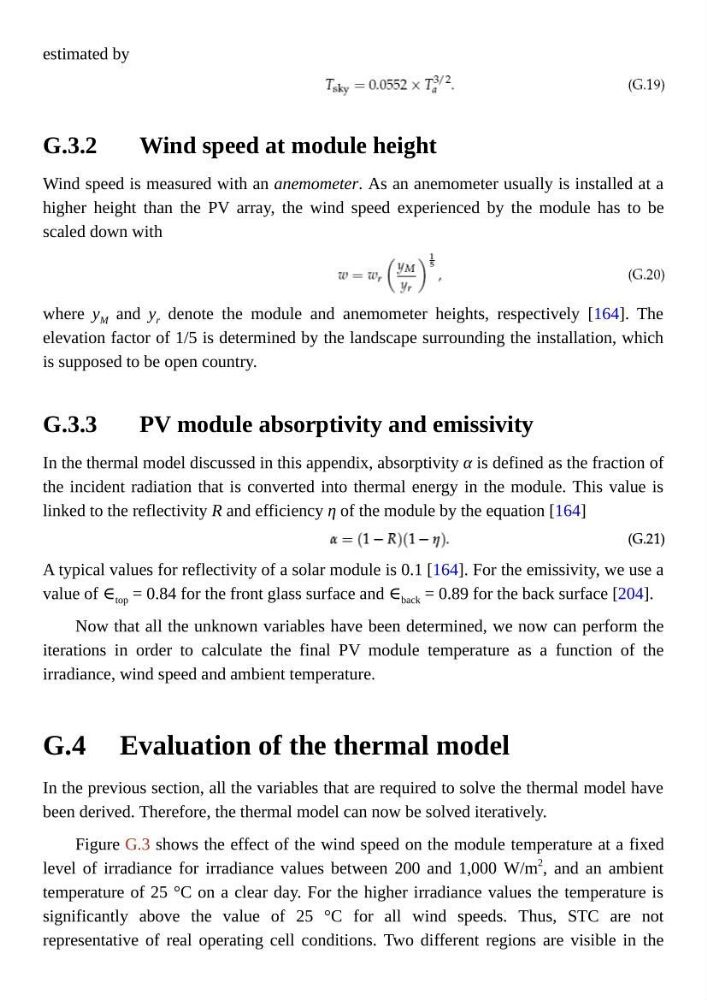
estimated by
Wind speed at module height
Wind speed is measured with an anemometer. As an anemometer usually is installed at a
higher height than the PV array, the wind speed experienced by the module has to be
scaled down with
where y M and y r denote the module and anemometer heights, respectively [164]. The
elevation factor of 1/5 is determined by the landscape surrounding the installation, which
is supposed to be open country.
PV module absorptivity and emissivity
In the thermal model discussed in this appendix, absorptivity α is defined as the fraction of
the incident radiation that is converted into thermal energy in the module. This value is
linked to the reflectivity R and efficiency η of the module by the equation [164]
A typical values for reflectivity of a solar module is 0.1 [164]. For the emissivity, we use a
value of ∈ top = 0.84 for the front glass surface and ∈ back = 0.89 for the back surface [204].
Now that all the unknown variables have been determined, we now can perform the
iterations in order to calculate the final PV module temperature as a function of the
irradiance, wind speed and ambient temperature.
Evaluation of the thermal model
In the previous section, all the variables that are required to solve the thermal model have
been derived. Therefore, the thermal model can now be solved iteratively.
Figure G.3 shows the effect of the wind speed on the module temperature at a fixed
level of irradiance for irradiance values between 200 and 1,000 W/m
2
, and an ambient
temperature of 25 °C on a clear day. For the higher irradiance values the temperature is
significantly above the value of 25 °C for all wind speeds. Thus, STC are not
representative of real operating cell conditions. Two different regions are visible in the
G.3.3
G.4
estimated by
Wind speed at module height
Wind speed is measured with an anemometer. As an anemometer usually is installed at a
higher height than the PV array, the wind speed experienced by the module has to be
scaled down with
where y M and y r denote the module and anemometer heights, respectively [164]. The
elevation factor of 1/5 is determined by the landscape surrounding the installation, which
is supposed to be open country.
PV module absorptivity and emissivity
In the thermal model discussed in this appendix, absorptivity α is defined as the fraction of
the incident radiation that is converted into thermal energy in the module. This value is
linked to the reflectivity R and efficiency η of the module by the equation [164]
A typical values for reflectivity of a solar module is 0.1 [164]. For the emissivity, we use a
value of ∈ top = 0.84 for the front glass surface and ∈ back = 0.89 for the back surface [204].
Now that all the unknown variables have been determined, we now can perform the
iterations in order to calculate the final PV module temperature as a function of the
irradiance, wind speed and ambient temperature.
Evaluation of the thermal model
In the previous section, all the variables that are required to solve the thermal model have
been derived. Therefore, the thermal model can now be solved iteratively.
Figure G.3 shows the effect of the wind speed on the module temperature at a fixed
level of irradiance for irradiance values between 200 and 1,000 W/m
2
, and an ambient
temperature of 25 °C on a clear day. For the higher irradiance values the temperature is
significantly above the value of 25 °C for all wind speeds. Thus, STC are not
representative of real operating cell conditions. Two different regions are visible in the