

G.2.2
G.3
G.3.1
mixed heat convective mass transfer coefficient using Eq. (G.6):
Convective heat transfer on the rear surface
Convection on the back side of the module will be lower than on the top because of the
mounting structure and the relative vicinity to the ground. For example, a rack mount
configuration, which is approximately installed at 1 m height, will achieve a larger heat
exchange rate than a standoff mounted array that is mounted only 20 cm above ground.
We model the effect of the different mounting configurations by scaling the convection
coefficient obtained for the top of the module. We determine the scaling factor by
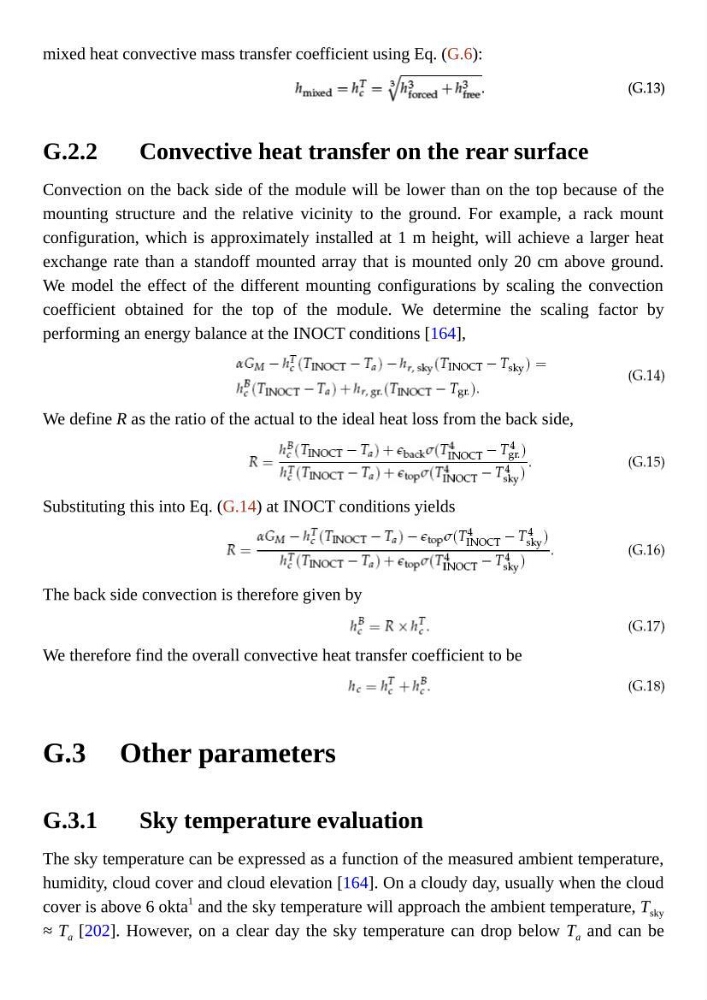
performing an energy balance at the INOCT conditions [164],
We define R as the ratio of the actual to the ideal heat loss from the back side,
Substituting this into Eq. (G.14) at INOCT conditions yields
The back side convection is therefore given by
We therefore find the overall convective heat transfer coefficient to be
Other parameters
Sky temperature evaluation
The sky temperature can be expressed as a function of the measured ambient temperature,
humidity, cloud cover and cloud elevation [164]. On a cloudy day, usually when the cloud
cover is above 6 okta
1
and the sky temperature will approach the ambient temperature, T sky
≈ T a [202]. However, on a clear day the sky temperature can drop below T a and can be
G.3
G.3.1
mixed heat convective mass transfer coefficient using Eq. (G.6):
Convective heat transfer on the rear surface
Convection on the back side of the module will be lower than on the top because of the
mounting structure and the relative vicinity to the ground. For example, a rack mount
configuration, which is approximately installed at 1 m height, will achieve a larger heat
exchange rate than a standoff mounted array that is mounted only 20 cm above ground.
We model the effect of the different mounting configurations by scaling the convection
coefficient obtained for the top of the module. We determine the scaling factor by
performing an energy balance at the INOCT conditions [164],
We define R as the ratio of the actual to the ideal heat loss from the back side,
Substituting this into Eq. (G.14) at INOCT conditions yields
The back side convection is therefore given by
We therefore find the overall convective heat transfer coefficient to be
Other parameters
Sky temperature evaluation
The sky temperature can be expressed as a function of the measured ambient temperature,
humidity, cloud cover and cloud elevation [164]. On a cloudy day, usually when the cloud
cover is above 6 okta
1
and the sky temperature will approach the ambient temperature, T sky
≈ T a [202]. However, on a clear day the sky temperature can drop below T a and can be