

W, and thus of the PV module, is given as
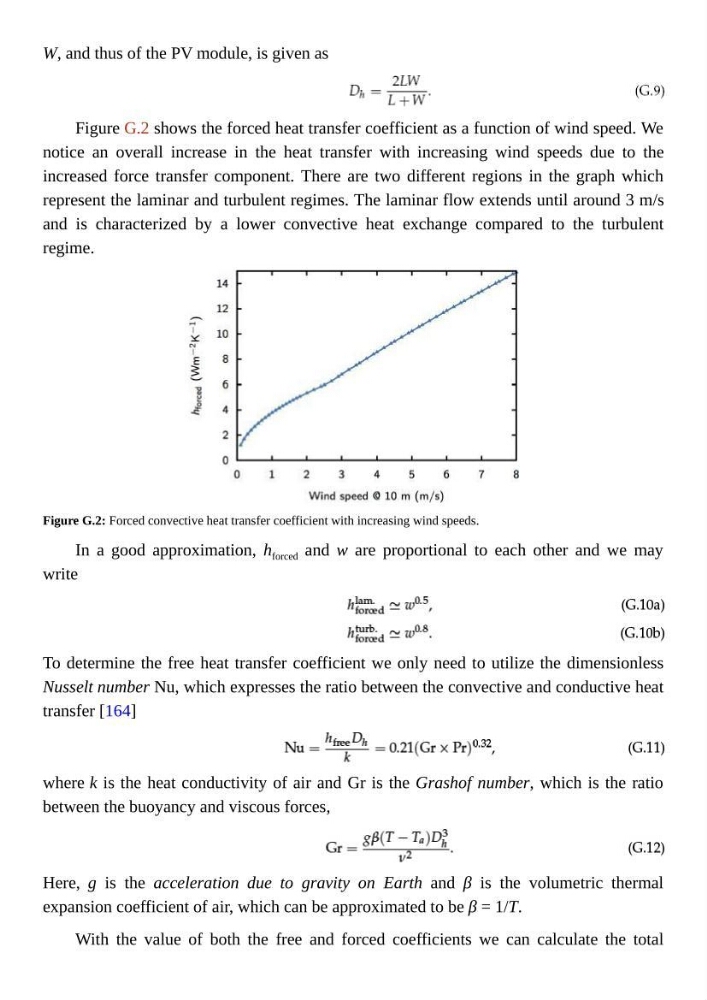
Figure G.2 shows the forced heat transfer coefficient as a function of wind speed. We
notice an overall increase in the heat transfer with increasing wind speeds due to the
increased force transfer component. There are two different regions in the graph which
represent the laminar and turbulent regimes. The laminar flow extends until around 3 m/s
and is characterized by a lower convective heat exchange compared to the turbulent
regime.
Figure G.2: Forced convective heat transfer coefficient with increasing wind speeds.
In a good approximation, h forced and w are proportional to each other and we may
write
To determine the free heat transfer coefficient we only need to utilize the dimensionless
Nusselt number Nu, which expresses the ratio between the convective and conductive heat
transfer [164]
where k is the heat conductivity of air and Gr is the Grashof number, which is the ratio
between the buoyancy and viscous forces,
Here, g is the acceleration due to gravity on Earth and β is the volumetric thermal
expansion coefficient of air, which can be approximated to be β = 1/T.
With the value of both the free and forced coefficients we can calculate the total
Figure G.2 shows the forced heat transfer coefficient as a function of wind speed. We
notice an overall increase in the heat transfer with increasing wind speeds due to the
increased force transfer component. There are two different regions in the graph which
represent the laminar and turbulent regimes. The laminar flow extends until around 3 m/s
and is characterized by a lower convective heat exchange compared to the turbulent
regime.
Figure G.2: Forced convective heat transfer coefficient with increasing wind speeds.
In a good approximation, h forced and w are proportional to each other and we may
write
To determine the free heat transfer coefficient we only need to utilize the dimensionless
Nusselt number Nu, which expresses the ratio between the convective and conductive heat
transfer [164]
where k is the heat conductivity of air and Gr is the Grashof number, which is the ratio
between the buoyancy and viscous forces,
Here, g is the acceleration due to gravity on Earth and β is the volumetric thermal
expansion coefficient of air, which can be approximated to be β = 1/T.
With the value of both the free and forced coefficients we can calculate the total