

graph, which correspond to laminar and turbulent flow.
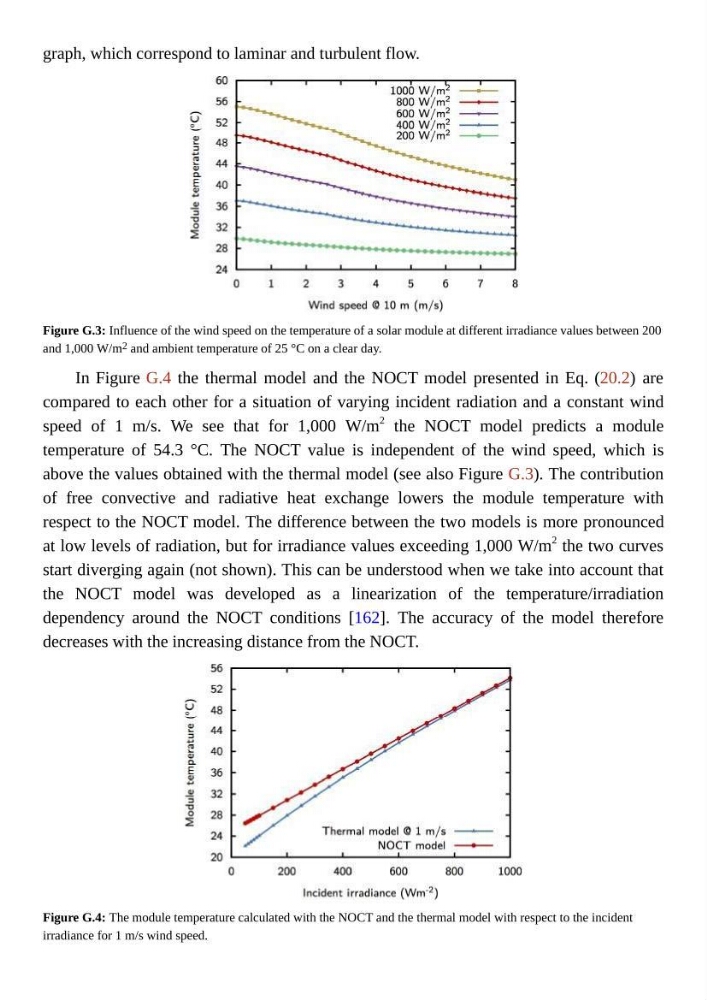
Figure G.3: Influence of the wind speed on the temperature of a solar module at different irradiance values between 200
and 1,000 W/m 2 and ambient temperature of 25 °C on a clear day.
In Figure G.4 the thermal model and the NOCT model presented in Eq. (20.2) are
compared to each other for a situation of varying incident radiation and a constant wind
speed of 1 m/s. We see that for 1,000 W/m
2
the NOCT model predicts a module
temperature of 54.3 °C. The NOCT value is independent of the wind speed, which is
above the values obtained with the thermal model (see also Figure G.3). The contribution
of free convective and radiative heat exchange lowers the module temperature with
respect to the NOCT model. The difference between the two models is more pronounced
at low levels of radiation, but for irradiance values exceeding 1,000 W/m
2
the two curves
start diverging again (not shown). This can be understood when we take into account that
the NOCT model was developed as a linearization of the temperature/irradiation
dependency around the NOCT conditions [162]. The accuracy of the model therefore
decreases with the increasing distance from the NOCT.
Figure G.4: The module temperature calculated with the NOCT and the thermal model with respect to the incident
irradiance for 1 m/s wind speed.
Figure G.3: Influence of the wind speed on the temperature of a solar module at different irradiance values between 200
and 1,000 W/m 2 and ambient temperature of 25 °C on a clear day.
In Figure G.4 the thermal model and the NOCT model presented in Eq. (20.2) are
compared to each other for a situation of varying incident radiation and a constant wind
speed of 1 m/s. We see that for 1,000 W/m
2
the NOCT model predicts a module
temperature of 54.3 °C. The NOCT value is independent of the wind speed, which is
above the values obtained with the thermal model (see also Figure G.3). The contribution
of free convective and radiative heat exchange lowers the module temperature with
respect to the NOCT model. The difference between the two models is more pronounced
at low levels of radiation, but for irradiance values exceeding 1,000 W/m
2
the two curves
start diverging again (not shown). This can be understood when we take into account that
the NOCT model was developed as a linearization of the temperature/irradiation
dependency around the NOCT conditions [162]. The accuracy of the model therefore
decreases with the increasing distance from the NOCT.
Figure G.4: The module temperature calculated with the NOCT and the thermal model with respect to the incident
irradiance for 1 m/s wind speed.