

•
where the emissivity of the back is assumed to be ∈ back = 0.89.
Conductive heat transfer between the module and the mounting structure.
Because of the small area of the contact points, we may neglect this contribution
[202].
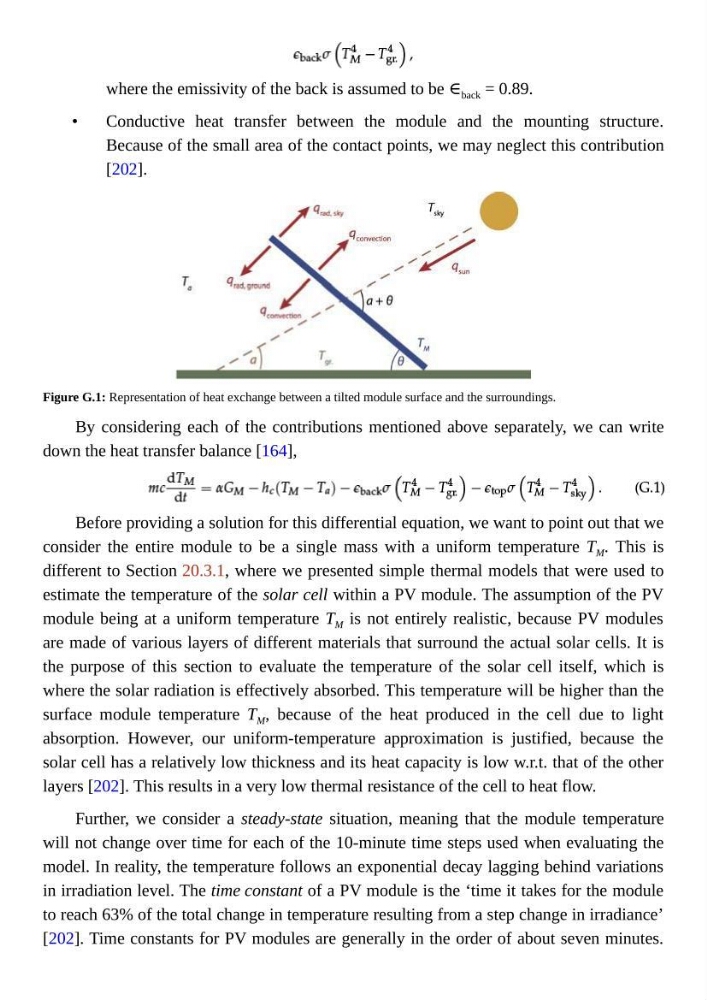
Figure G.1: Representation of heat exchange between a tilted module surface and the surroundings.
By considering each of the contributions mentioned above separately, we can write
down the heat transfer balance [164],
Before providing a solution for this differential equation, we want to point out that we
consider the entire module to be a single mass with a uniform temperature T M . This is
different to Section 20.3.1, where we presented simple thermal models that were used to
estimate the temperature of the solar cell within a PV module. The assumption of the PV
module being at a uniform temperature T M is not entirely realistic, because PV modules
are made of various layers of different materials that surround the actual solar cells. It is
the purpose of this section to evaluate the temperature of the solar cell itself, which is
where the solar radiation is effectively absorbed. This temperature will be higher than the
surface module temperature T M , because of the heat produced in the cell due to light
absorption. However, our uniform-temperature approximation is justified, because the
solar cell has a relatively low thickness and its heat capacity is low w.r.t. that of the other
layers [202]. This results in a very low thermal resistance of the cell to heat flow.
Further, we consider a steady-state situation, meaning that the module temperature
will not change over time for each of the 10-minute time steps used when evaluating the
model. In reality, the temperature follows an exponential decay lagging behind variations
in irradiation level. The time constant of a PV module is the ‘time it takes for the module
to reach 63% of the total change in temperature resulting from a step change in irradiance’
[202]. Time constants for PV modules are generally in the order of about seven minutes.
where the emissivity of the back is assumed to be ∈ back = 0.89.
Conductive heat transfer between the module and the mounting structure.
Because of the small area of the contact points, we may neglect this contribution
[202].
Figure G.1: Representation of heat exchange between a tilted module surface and the surroundings.
By considering each of the contributions mentioned above separately, we can write
down the heat transfer balance [164],
Before providing a solution for this differential equation, we want to point out that we
consider the entire module to be a single mass with a uniform temperature T M . This is
different to Section 20.3.1, where we presented simple thermal models that were used to
estimate the temperature of the solar cell within a PV module. The assumption of the PV
module being at a uniform temperature T M is not entirely realistic, because PV modules
are made of various layers of different materials that surround the actual solar cells. It is
the purpose of this section to evaluate the temperature of the solar cell itself, which is
where the solar radiation is effectively absorbed. This temperature will be higher than the
surface module temperature T M , because of the heat produced in the cell due to light
absorption. However, our uniform-temperature approximation is justified, because the
solar cell has a relatively low thickness and its heat capacity is low w.r.t. that of the other
layers [202]. This results in a very low thermal resistance of the cell to heat flow.
Further, we consider a steady-state situation, meaning that the module temperature
will not change over time for each of the 10-minute time steps used when evaluating the
model. In reality, the temperature follows an exponential decay lagging behind variations
in irradiation level. The time constant of a PV module is the ‘time it takes for the module
to reach 63% of the total change in temperature resulting from a step change in irradiance’
[202]. Time constants for PV modules are generally in the order of about seven minutes.