

G.1
•
•
•
G
Fluid-dynamic model
As we have seen in Section 20.3, it is very important to develop an accurate thermal
model of the solar module, which evaluates the effects of the major meteorological
parameters on the final temperature of a solar module.
In this appendix, we will develop an accurate fluid-dynamic (FD) model for
estimating the PV module working temperature T M as a function of various meteorological
parameters. The model is based on a detailed energy balance between the module itself
and the surrounding environment. Both the installed configuration of the array together
with external parameters such as direct incident solar irradiance on the panels, wind speed
and cloud cover will be taken into account. The model presented here is mostly based on
the work by Fuentes [164].
Framework of the fluid-dynamic model
We consider three types of heat transfer, which we already discussed in Section 22.1,
between the PV module and the surroundings: conduction, convection and radiation. They
are illustrated in Figure G.1. In the FD model, the following contributions are considered:
Heat received from the Sun in the form of irradiance αG M , where α is the
absorptivity of the module.
Convective heat exchange with the surrounding air from the front and rear sides
of the module
h c (T M − T a ),
where h c denotes the overall convective heat transfer coefficient of the module.
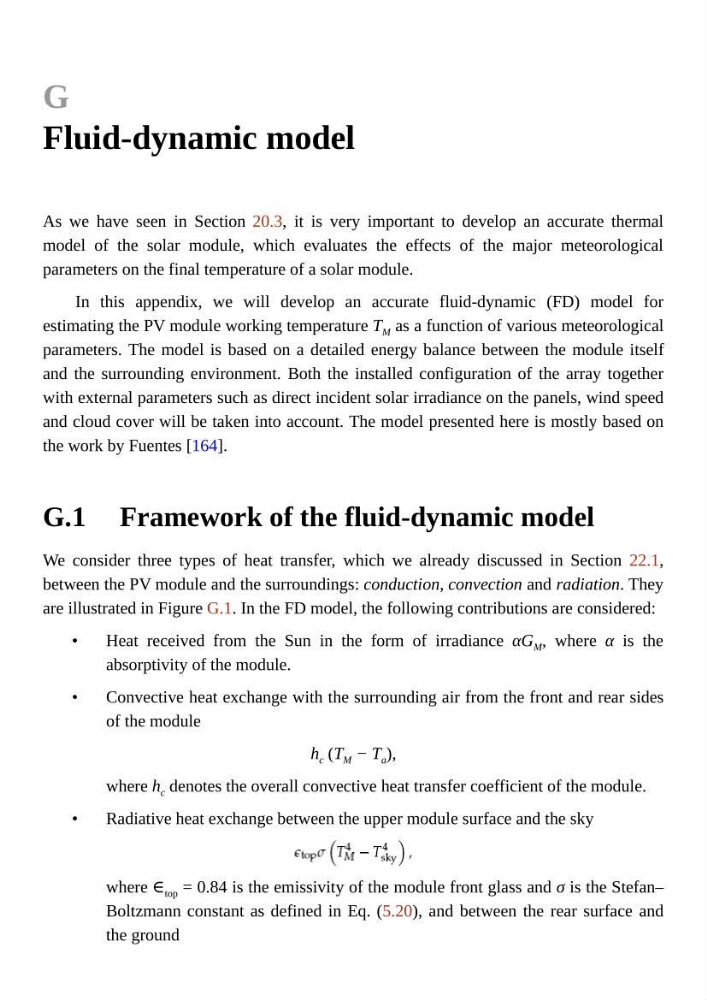
Radiative heat exchange between the upper module surface and the sky
where ∈ top = 0.84 is the emissivity of the module front glass and σ is the Stefan–
Boltzmann constant as defined in Eq. (5.20), and between the rear surface and
the ground
•
•
•
G
Fluid-dynamic model
As we have seen in Section 20.3, it is very important to develop an accurate thermal
model of the solar module, which evaluates the effects of the major meteorological
parameters on the final temperature of a solar module.
In this appendix, we will develop an accurate fluid-dynamic (FD) model for
estimating the PV module working temperature T M as a function of various meteorological
parameters. The model is based on a detailed energy balance between the module itself
and the surrounding environment. Both the installed configuration of the array together
with external parameters such as direct incident solar irradiance on the panels, wind speed
and cloud cover will be taken into account. The model presented here is mostly based on
the work by Fuentes [164].
Framework of the fluid-dynamic model
We consider three types of heat transfer, which we already discussed in Section 22.1,
between the PV module and the surroundings: conduction, convection and radiation. They
are illustrated in Figure G.1. In the FD model, the following contributions are considered:
Heat received from the Sun in the form of irradiance αG M , where α is the
absorptivity of the module.
Convective heat exchange with the surrounding air from the front and rear sides
of the module
h c (T M − T a ),
where h c denotes the overall convective heat transfer coefficient of the module.
Radiative heat exchange between the upper module surface and the sky
where ∈ top = 0.84 is the emissivity of the module front glass and σ is the Stefan–
Boltzmann constant as defined in Eq. (5.20), and between the rear surface and
the ground