

G.2
For time steps exceeding the time constant, as it is in our case, the module can be
approximated to be in a steady-state condition. Under this assumption, the term on the
left-hand side of Eq. (G.1) vanishes.
It is now possible to proceed with the solution of the thermal energy balance
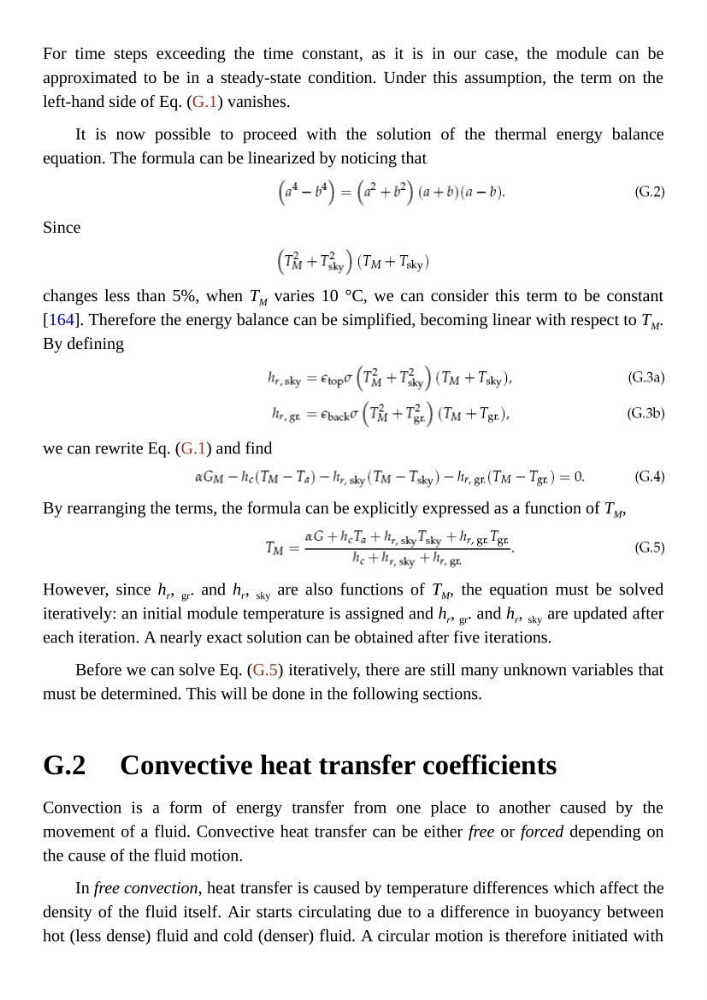
equation. The formula can be linearized by noticing that
Since
changes less than 5%, when T M varies 10 °C, we can consider this term to be constant
[164]. Therefore the energy balance can be simplified, becoming linear with respect to T M .
By defining
we can rewrite Eq. (G.1) and find
By rearranging the terms, the formula can be explicitly expressed as a function of T M ,
However, since h r , gr . and h r , sky are also functions of T M , the equation must be solved
iteratively: an initial module temperature is assigned and h r , gr . and h r , sky are updated after
each iteration. A nearly exact solution can be obtained after five iterations.
Before we can solve Eq. (G.5) iteratively, there are still many unknown variables that
must be determined. This will be done in the following sections.
Convective heat transfer coefficients
Convection is a form of energy transfer from one place to another caused by the
movement of a fluid. Convective heat transfer can be either free or forced depending on
the cause of the fluid motion.
In free convection, heat transfer is caused by temperature differences which affect the
density of the fluid itself. Air starts circulating due to a difference in buoyancy between
hot (less dense) fluid and cold (denser) fluid. A circular motion is therefore initiated with
For time steps exceeding the time constant, as it is in our case, the module can be
approximated to be in a steady-state condition. Under this assumption, the term on the
left-hand side of Eq. (G.1) vanishes.
It is now possible to proceed with the solution of the thermal energy balance
equation. The formula can be linearized by noticing that
Since
changes less than 5%, when T M varies 10 °C, we can consider this term to be constant
[164]. Therefore the energy balance can be simplified, becoming linear with respect to T M .
By defining
we can rewrite Eq. (G.1) and find
By rearranging the terms, the formula can be explicitly expressed as a function of T M ,
However, since h r , gr . and h r , sky are also functions of T M , the equation must be solved
iteratively: an initial module temperature is assigned and h r , gr . and h r , sky are updated after
each iteration. A nearly exact solution can be obtained after five iterations.
Before we can solve Eq. (G.5) iteratively, there are still many unknown variables that
must be determined. This will be done in the following sections.
Convective heat transfer coefficients
Convection is a form of energy transfer from one place to another caused by the
movement of a fluid. Convective heat transfer can be either free or forced depending on
the cause of the fluid motion.
In free convection, heat transfer is caused by temperature differences which affect the
density of the fluid itself. Air starts circulating due to a difference in buoyancy between
hot (less dense) fluid and cold (denser) fluid. A circular motion is therefore initiated with