

E.2
g = 357.529° + 0.98560028°D = 99.28246073°,
where the values were normalized to [0°, 360°). From Eq. (E.4) we thus obtain for the latitude of the Sun in
ecliptic coordinates
λ S = q + 1.915° sin g + 0.020° sin 2g = 24.34162696°.
For the axial tilt ∈ of the Earth we obtain from Eq. (E.7)
∈ = 23.429° – 0.00000036° D = 23.42712193°.
The Greewich mean sidereal time (GMST) is given by Eq. (E.10),
GMST = 18.697374558 h + 24.06570982441908 h × D + 0.000026 h × T 2 = 22.49731535 h,
where we used T = D/36525 and normalized to [0h, 24h). We then find for the local
mean sidereal time θ L
Now we have all the variables required to calculate the solar position. From Eqs. (E.18) and (E.19) we thus find
sin a
S
= cos
ϕ 0 cos θ L cos λ S + (cos ϕ 0 sin θ L cos ∈ + sin ϕ 0 sin ∈) sin λ S = 0.589415473,
which leads to the solar altitude a S = 36.1° and the solar azimuth A S = 127.2°.
The equation of time
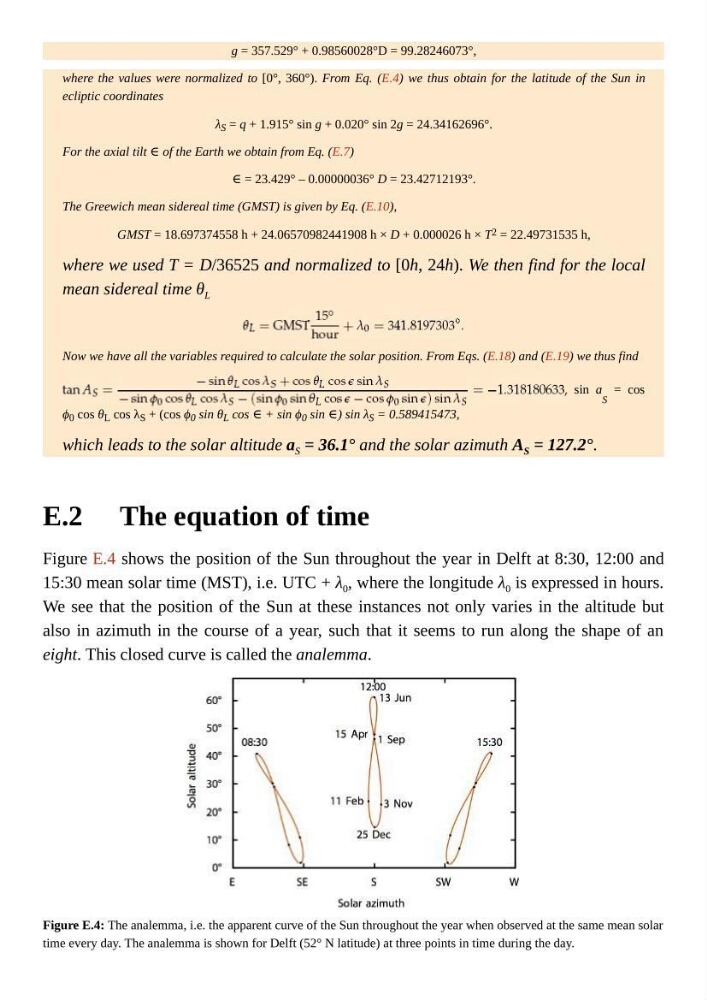
Figure E.4 shows the position of the Sun throughout the year in Delft at 8:30, 12:00 and
15:30 mean solar time (MST), i.e. UTC + λ 0 , where the longitude λ 0 is expressed in hours.
We see that the position of the Sun at these instances not only varies in the altitude but
also in azimuth in the course of a year, such that it seems to run along the shape of an
eight. This closed curve is called the analemma.
Figure E.4: The analemma, i.e. the apparent curve of the Sun throughout the year when observed at the same mean solar
time every day. The analemma is shown for Delft (52° N latitude) at three points in time during the day.
g = 357.529° + 0.98560028°D = 99.28246073°,
where the values were normalized to [0°, 360°). From Eq. (E.4) we thus obtain for the latitude of the Sun in
ecliptic coordinates
λ S = q + 1.915° sin g + 0.020° sin 2g = 24.34162696°.
For the axial tilt ∈ of the Earth we obtain from Eq. (E.7)
∈ = 23.429° – 0.00000036° D = 23.42712193°.
The Greewich mean sidereal time (GMST) is given by Eq. (E.10),
GMST = 18.697374558 h + 24.06570982441908 h × D + 0.000026 h × T 2 = 22.49731535 h,
where we used T = D/36525 and normalized to [0h, 24h). We then find for the local
mean sidereal time θ L
Now we have all the variables required to calculate the solar position. From Eqs. (E.18) and (E.19) we thus find
sin a
S
= cos
ϕ 0 cos θ L cos λ S + (cos ϕ 0 sin θ L cos ∈ + sin ϕ 0 sin ∈) sin λ S = 0.589415473,
which leads to the solar altitude a S = 36.1° and the solar azimuth A S = 127.2°.
The equation of time
Figure E.4 shows the position of the Sun throughout the year in Delft at 8:30, 12:00 and
15:30 mean solar time (MST), i.e. UTC + λ 0 , where the longitude λ 0 is expressed in hours.
We see that the position of the Sun at these instances not only varies in the altitude but
also in azimuth in the course of a year, such that it seems to run along the shape of an
eight. This closed curve is called the analemma.
Figure E.4: The analemma, i.e. the apparent curve of the Sun throughout the year when observed at the same mean solar
time every day. The analemma is shown for Delft (52° N latitude) at three points in time during the day.