

The difference between the apparent solar time (AST), i.e. the timescale where the
Sun really is highest at noon every day, and the mean solar time is described by the socalled equation of time (EoT), which is defined as
The equation of time is given as the difference between the mean longitude q, as defined
in Eq. (E.2), and the right ascension α S of the Sun in the equatorial coordinate system,
The right ascension is connected to the ecliptic longitude of the Sun λ S , as given in Eq.
(E.4) via
and ∈ is the axial tilt as given in Eq. (E.7).
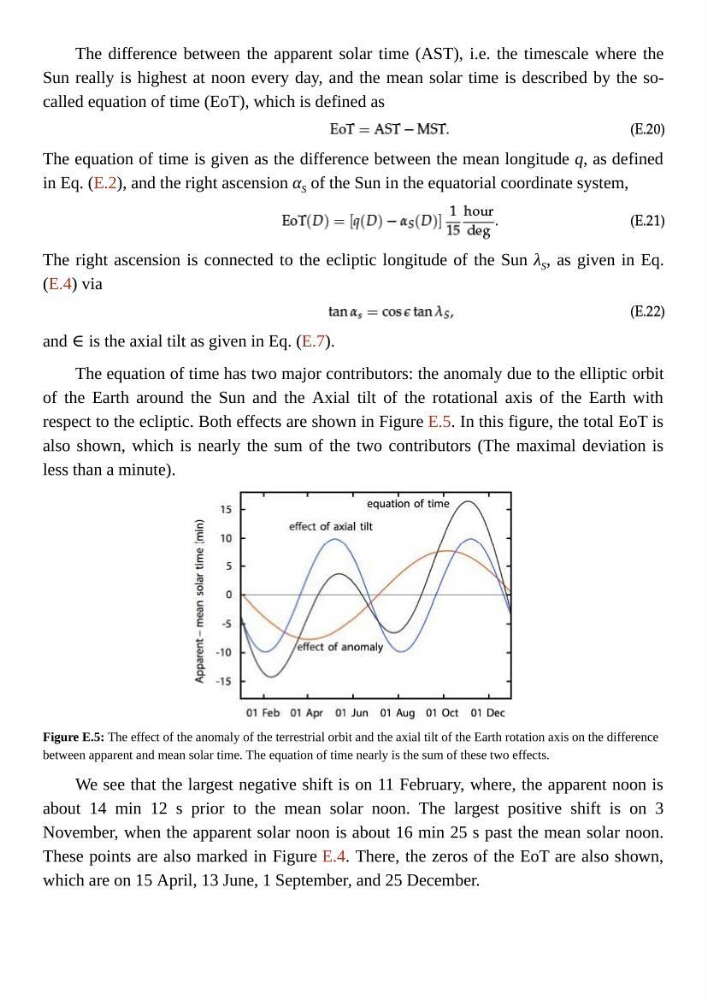
The equation of time has two major contributors: the anomaly due to the elliptic orbit
of the Earth around the Sun and the Axial tilt of the rotational axis of the Earth with
respect to the ecliptic. Both effects are shown in Figure E.5. In this figure, the total EoT is
also shown, which is nearly the sum of the two contributors (The maximal deviation is
less than a minute).
Figure E.5: The effect of the anomaly of the terrestrial orbit and the axial tilt of the Earth rotation axis on the difference
between apparent and mean solar time. The equation of time nearly is the sum of these two effects.
We see that the largest negative shift is on 11 February, where, the apparent noon is
about 14 min 12 s prior to the mean solar noon. The largest positive shift is on 3
November, when the apparent solar noon is about 16 min 25 s past the mean solar noon.
These points are also marked in Figure E.4. There, the zeros of the EoT are also shown,
which are on 15 April, 13 June, 1 September, and 25 December.
Sun really is highest at noon every day, and the mean solar time is described by the socalled equation of time (EoT), which is defined as
The equation of time is given as the difference between the mean longitude q, as defined
in Eq. (E.2), and the right ascension α S of the Sun in the equatorial coordinate system,
The right ascension is connected to the ecliptic longitude of the Sun λ S , as given in Eq.
(E.4) via
and ∈ is the axial tilt as given in Eq. (E.7).
The equation of time has two major contributors: the anomaly due to the elliptic orbit
of the Earth around the Sun and the Axial tilt of the rotational axis of the Earth with
respect to the ecliptic. Both effects are shown in Figure E.5. In this figure, the total EoT is
also shown, which is nearly the sum of the two contributors (The maximal deviation is
less than a minute).
Figure E.5: The effect of the anomaly of the terrestrial orbit and the axial tilt of the Earth rotation axis on the difference
between apparent and mean solar time. The equation of time nearly is the sum of these two effects.
We see that the largest negative shift is on 11 February, where, the apparent noon is
about 14 min 12 s prior to the mean solar noon. The largest positive shift is on 3
November, when the apparent solar noon is about 16 min 25 s past the mean solar noon.
These points are also marked in Figure E.4. There, the zeros of the EoT are also shown,
which are on 15 April, 13 June, 1 September, and 25 December.