

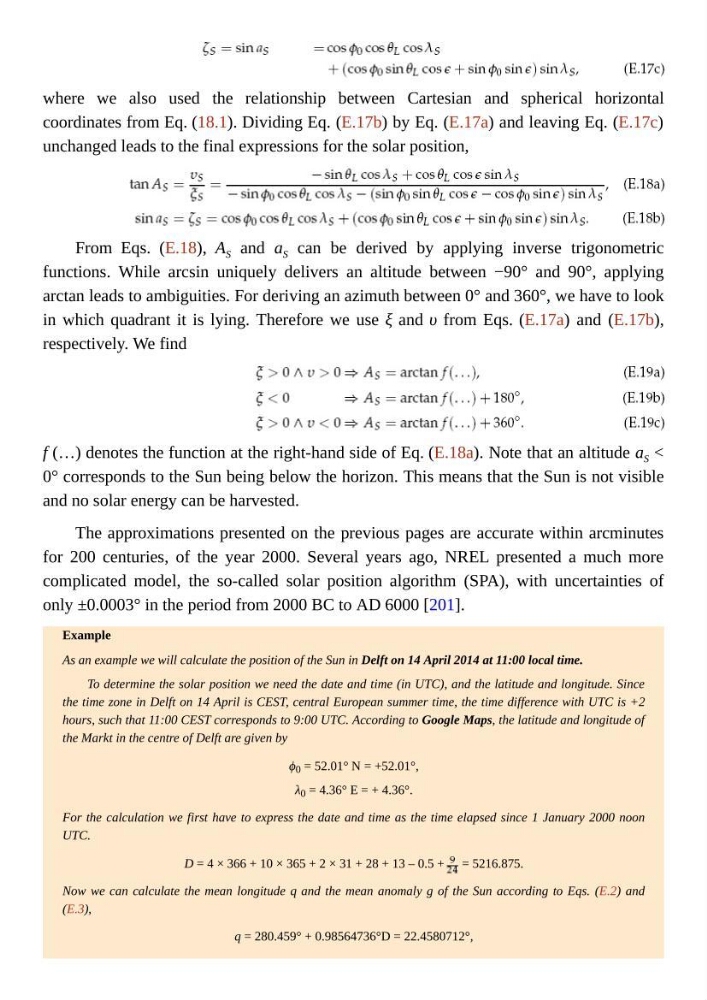
where we also used the relationship between Cartesian and spherical horizontal
coordinates from Eq. (18.1). Dividing Eq. (E.17b) by Eq. (E.17a) and leaving Eq. (E.17c)
unchanged leads to the final expressions for the solar position,
From Eqs. (E.18), A S and a S can be derived by applying inverse trigonometric
functions. While arcsin uniquely delivers an altitude between −90° and 90°, applying
arctan leads to ambiguities. For deriving an azimuth between 0° and 360°, we have to look
in which quadrant it is lying. Therefore we use ξ and υ from Eqs. (E.17a) and (E.17b),
respectively. We find
f (…) denotes the function at the right-hand side of Eq. (E.18a). Note that an altitude a S <
0° corresponds to the Sun being below the horizon. This means that the Sun is not visible
and no solar energy can be harvested.
The approximations presented on the previous pages are accurate within arcminutes
for 200 centuries, of the year 2000. Several years ago, NREL presented a much more
complicated model, the so-called solar position algorithm (SPA), with uncertainties of
only ±0.0003° in the period from 2000 BC to AD 6000 [201].
Example
As an example we will calculate the position of the Sun in Delft on 14 April 2014 at 11:00 local time.
To determine the solar position we need the date and time (in UTC), and the latitude and longitude. Since
the time zone in Delft on 14 April is CEST, central European summer time, the time difference with UTC is +2
hours, such that 11:00 CEST corresponds to 9:00 UTC. According to Google Maps, the latitude and longitude of
the Markt in the centre of Delft are given by
ϕ 0 = 52.01° N = +52.01°,
λ 0 = 4.36° E = + 4.36°.
For the calculation we first have to express the date and time as the time elapsed since 1 January 2000 noon
UTC.
D = 4 × 366 + 10 × 365 + 2 × 31 + 28 + 13 – 0.5 + = 5216.875.
Now we can calculate the mean longitude q and the mean anomaly g of the Sun according to Eqs. (E.2) and
(E.3),
q = 280.459° + 0.98564736°D = 22.4580712°,
coordinates from Eq. (18.1). Dividing Eq. (E.17b) by Eq. (E.17a) and leaving Eq. (E.17c)
unchanged leads to the final expressions for the solar position,
From Eqs. (E.18), A S and a S can be derived by applying inverse trigonometric
functions. While arcsin uniquely delivers an altitude between −90° and 90°, applying
arctan leads to ambiguities. For deriving an azimuth between 0° and 360°, we have to look
in which quadrant it is lying. Therefore we use ξ and υ from Eqs. (E.17a) and (E.17b),
respectively. We find
f (…) denotes the function at the right-hand side of Eq. (E.18a). Note that an altitude a S <
0° corresponds to the Sun being below the horizon. This means that the Sun is not visible
and no solar energy can be harvested.
The approximations presented on the previous pages are accurate within arcminutes
for 200 centuries, of the year 2000. Several years ago, NREL presented a much more
complicated model, the so-called solar position algorithm (SPA), with uncertainties of
only ±0.0003° in the period from 2000 BC to AD 6000 [201].
Example
As an example we will calculate the position of the Sun in Delft on 14 April 2014 at 11:00 local time.
To determine the solar position we need the date and time (in UTC), and the latitude and longitude. Since
the time zone in Delft on 14 April is CEST, central European summer time, the time difference with UTC is +2
hours, such that 11:00 CEST corresponds to 9:00 UTC. According to Google Maps, the latitude and longitude of
the Markt in the centre of Delft are given by
ϕ 0 = 52.01° N = +52.01°,
λ 0 = 4.36° E = + 4.36°.
For the calculation we first have to express the date and time as the time elapsed since 1 January 2000 noon
UTC.
D = 4 × 366 + 10 × 365 + 2 × 31 + 28 + 13 – 0.5 + = 5216.875.
Now we can calculate the mean longitude q and the mean anomaly g of the Sun according to Eqs. (E.2) and
(E.3),
q = 280.459° + 0.98564736°D = 22.4580712°,