

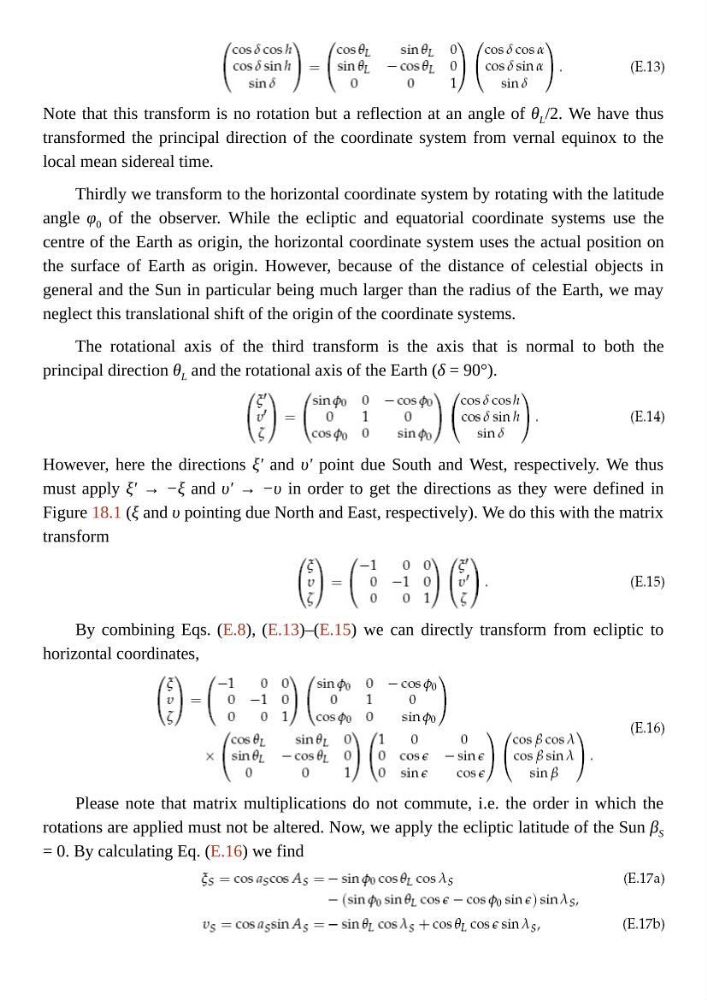
Note that this transform is no rotation but a reflection at an angle of θ L /2. We have thus
transformed the principal direction of the coordinate system from vernal equinox to the
local mean sidereal time.
Thirdly we transform to the horizontal coordinate system by rotating with the latitude
angle φ 0 of the observer. While the ecliptic and equatorial coordinate systems use the
centre of the Earth as origin, the horizontal coordinate system uses the actual position on
the surface of Earth as origin. However, because of the distance of celestial objects in
general and the Sun in particular being much larger than the radius of the Earth, we may
neglect this translational shift of the origin of the coordinate systems.
The rotational axis of the third transform is the axis that is normal to both the
principal direction θ L and the rotational axis of the Earth (δ = 90°).
However, here the directions ξ′ and υ′ point due South and West, respectively. We thus
must apply ξ′ → −ξ and υ′ → −υ in order to get the directions as they were defined in
Figure 18.1 (ξ and υ pointing due North and East, respectively). We do this with the matrix
transform
By combining Eqs. (E.8), (E.13)–(E.15) we can directly transform from ecliptic to
horizontal coordinates,
Please note that matrix multiplications do not commute, i.e. the order in which the
rotations are applied must not be altered. Now, we apply the ecliptic latitude of the Sun β S
= 0. By calculating Eq. (E.16) we find
transformed the principal direction of the coordinate system from vernal equinox to the
local mean sidereal time.
Thirdly we transform to the horizontal coordinate system by rotating with the latitude
angle φ 0 of the observer. While the ecliptic and equatorial coordinate systems use the
centre of the Earth as origin, the horizontal coordinate system uses the actual position on
the surface of Earth as origin. However, because of the distance of celestial objects in
general and the Sun in particular being much larger than the radius of the Earth, we may
neglect this translational shift of the origin of the coordinate systems.
The rotational axis of the third transform is the axis that is normal to both the
principal direction θ L and the rotational axis of the Earth (δ = 90°).
However, here the directions ξ′ and υ′ point due South and West, respectively. We thus
must apply ξ′ → −ξ and υ′ → −υ in order to get the directions as they were defined in
Figure 18.1 (ξ and υ pointing due North and East, respectively). We do this with the matrix
transform
By combining Eqs. (E.8), (E.13)–(E.15) we can directly transform from ecliptic to
horizontal coordinates,
Please note that matrix multiplications do not commute, i.e. the order in which the
rotations are applied must not be altered. Now, we apply the ecliptic latitude of the Sun β S
= 0. By calculating Eq. (E.16) we find