

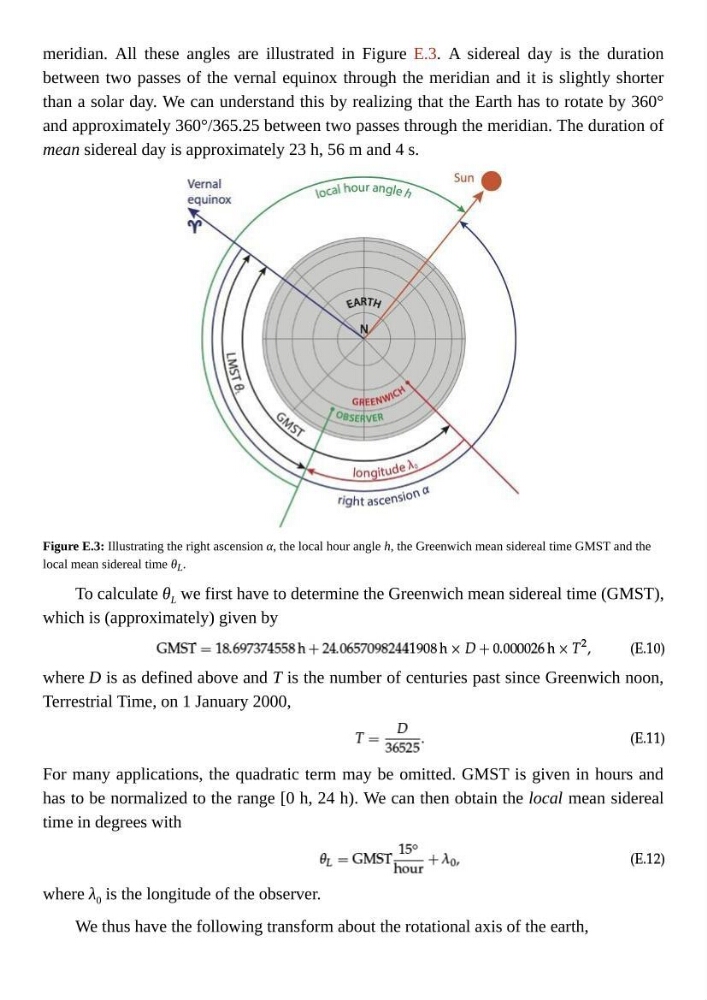
meridian. All these angles are illustrated in Figure E.3. A sidereal day is the duration
between two passes of the vernal equinox through the meridian and it is slightly shorter
than a solar day. We can understand this by realizing that the Earth has to rotate by 360°
and approximately 360°/365.25 between two passes through the meridian. The duration of
mean sidereal day is approximately 23 h, 56 m and 4 s.
Figure E.3: Illustrating the right ascension α, the local hour angle h, the Greenwich mean sidereal time GMST and the
local mean sidereal time θ L .
To calculate θ L we first have to determine the Greenwich mean sidereal time (GMST),
which is (approximately) given by
where D is as defined above and T is the number of centuries past since Greenwich noon,
Terrestrial Time, on 1 January 2000,
For many applications, the quadratic term may be omitted. GMST is given in hours and
has to be normalized to the range [0 h, 24 h). We can then obtain the local mean sidereal
time in degrees with
where λ 0 is the longitude of the observer.
We thus have the following transform about the rotational axis of the earth,
between two passes of the vernal equinox through the meridian and it is slightly shorter
than a solar day. We can understand this by realizing that the Earth has to rotate by 360°
and approximately 360°/365.25 between two passes through the meridian. The duration of
mean sidereal day is approximately 23 h, 56 m and 4 s.
Figure E.3: Illustrating the right ascension α, the local hour angle h, the Greenwich mean sidereal time GMST and the
local mean sidereal time θ L .
To calculate θ L we first have to determine the Greenwich mean sidereal time (GMST),
which is (approximately) given by
where D is as defined above and T is the number of centuries past since Greenwich noon,
Terrestrial Time, on 1 January 2000,
For many applications, the quadratic term may be omitted. GMST is given in hours and
has to be normalized to the range [0 h, 24 h). We can then obtain the local mean sidereal
time in degrees with
where λ 0 is the longitude of the observer.
We thus have the following transform about the rotational axis of the earth,