

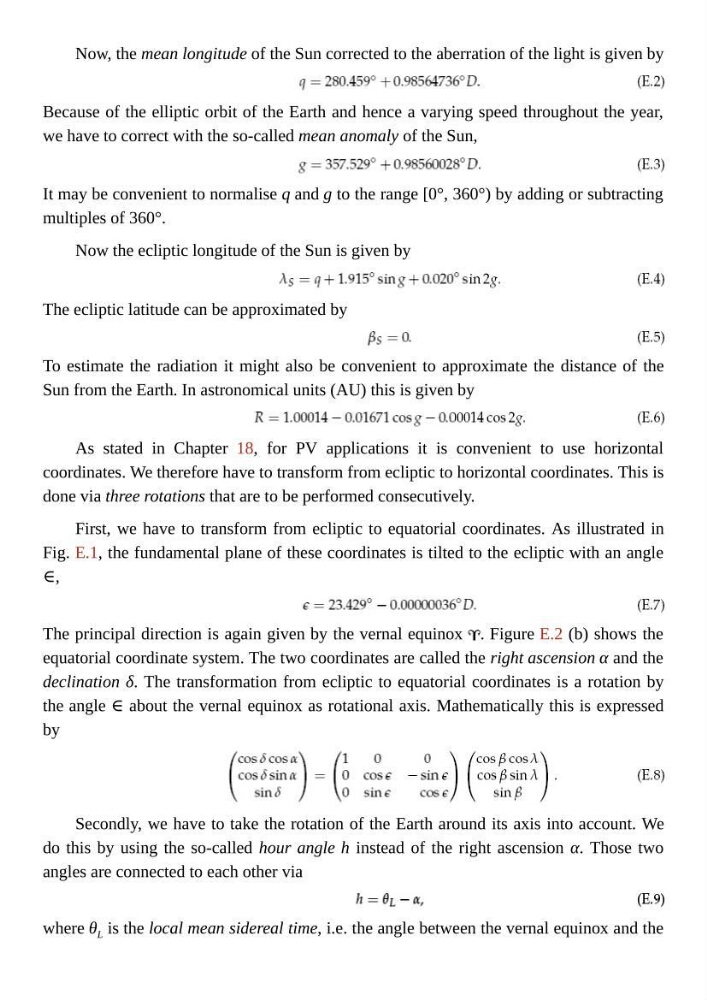
Now, the mean longitude of the Sun corrected to the aberration of the light is given by
Because of the elliptic orbit of the Earth and hence a varying speed throughout the year,
we have to correct with the so-called mean anomaly of the Sun,
It may be convenient to normalise q and g to the range [0°, 360°) by adding or subtracting
multiples of 360°.
Now the ecliptic longitude of the Sun is given by
The ecliptic latitude can be approximated by
To estimate the radiation it might also be convenient to approximate the distance of the
Sun from the Earth. In astronomical units (AU) this is given by
As stated in Chapter 18, for PV applications it is convenient to use horizontal
coordinates. We therefore have to transform from ecliptic to horizontal coordinates. This is
done via three rotations that are to be performed consecutively.
First, we have to transform from ecliptic to equatorial coordinates. As illustrated in
Fig. E.1, the fundamental plane of these coordinates is tilted to the ecliptic with an angle
∈,
The principal direction is again given by the vernal equinox . Figure E.2 (b) shows the
equatorial coordinate system. The two coordinates are called the right ascension α and the
declination δ. The transformation from ecliptic to equatorial coordinates is a rotation by
the angle ∈ about the vernal equinox as rotational axis. Mathematically this is expressed
by
Secondly, we have to take the rotation of the Earth around its axis into account. We
do this by using the so-called hour angle h instead of the right ascension α. Those two
angles are connected to each other via
where θ L is the local mean sidereal time, i.e. the angle between the vernal equinox and the
Because of the elliptic orbit of the Earth and hence a varying speed throughout the year,
we have to correct with the so-called mean anomaly of the Sun,
It may be convenient to normalise q and g to the range [0°, 360°) by adding or subtracting
multiples of 360°.
Now the ecliptic longitude of the Sun is given by
The ecliptic latitude can be approximated by
To estimate the radiation it might also be convenient to approximate the distance of the
Sun from the Earth. In astronomical units (AU) this is given by
As stated in Chapter 18, for PV applications it is convenient to use horizontal
coordinates. We therefore have to transform from ecliptic to horizontal coordinates. This is
done via three rotations that are to be performed consecutively.
First, we have to transform from ecliptic to equatorial coordinates. As illustrated in
Fig. E.1, the fundamental plane of these coordinates is tilted to the ecliptic with an angle
∈,
The principal direction is again given by the vernal equinox . Figure E.2 (b) shows the
equatorial coordinate system. The two coordinates are called the right ascension α and the
declination δ. The transformation from ecliptic to equatorial coordinates is a rotation by
the angle ∈ about the vernal equinox as rotational axis. Mathematically this is expressed
by
Secondly, we have to take the rotation of the Earth around its axis into account. We
do this by using the so-called hour angle h instead of the right ascension α. Those two
angles are connected to each other via
where θ L is the local mean sidereal time, i.e. the angle between the vernal equinox and the