

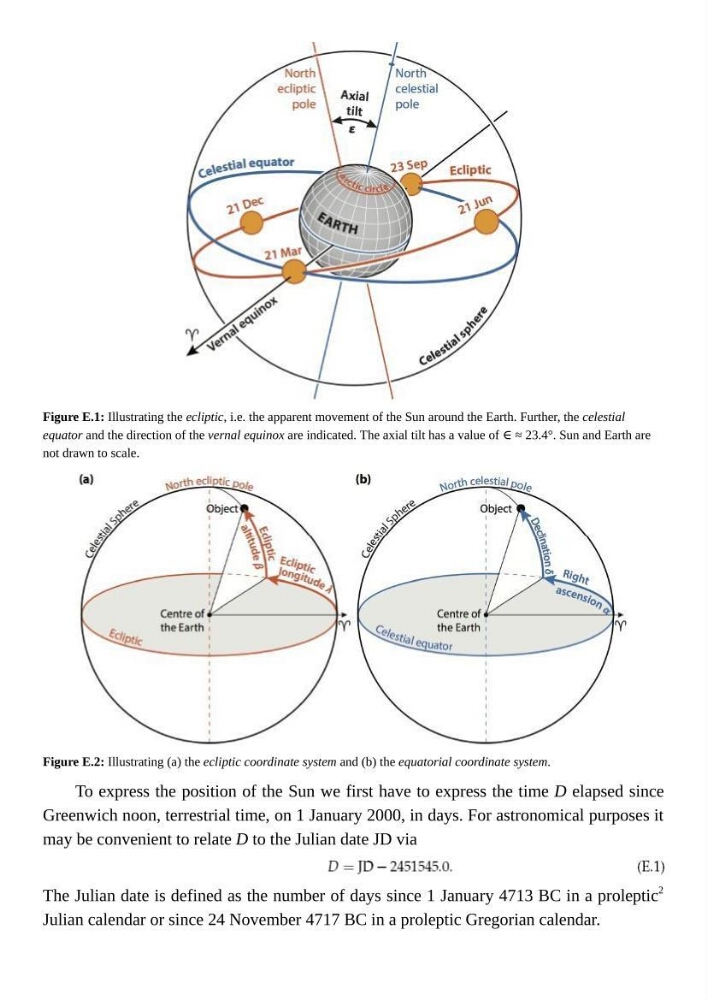
Figure E.1: Illustrating the ecliptic, i.e. the apparent movement of the Sun around the Earth. Further, the celestial
equator and the direction of the vernal equinox are indicated. The axial tilt has a value of ∈ ≈ 23.4°. Sun and Earth are
not drawn to scale.
Figure E.2: Illustrating (a) the ecliptic coordinate system and (b) the equatorial coordinate system.
To express the position of the Sun we first have to express the time D elapsed since
Greenwich noon, terrestrial time, on 1 January 2000, in days. For astronomical purposes it
may be convenient to relate D to the Julian date JD via
The Julian date is defined as the number of days since 1 January 4713 BC in a proleptic
2
Julian calendar or since 24 November 4717 BC in a proleptic Gregorian calendar.
equator and the direction of the vernal equinox are indicated. The axial tilt has a value of ∈ ≈ 23.4°. Sun and Earth are
not drawn to scale.
Figure E.2: Illustrating (a) the ecliptic coordinate system and (b) the equatorial coordinate system.
To express the position of the Sun we first have to express the time D elapsed since
Greenwich noon, terrestrial time, on 1 January 2000, in days. For astronomical purposes it
may be convenient to relate D to the Julian date JD via
The Julian date is defined as the number of days since 1 January 4713 BC in a proleptic
2
Julian calendar or since 24 November 4717 BC in a proleptic Gregorian calendar.