

23.3
23.1
(a)
(b)
(c)
23.2
(a)
(b)
(c)
i.
ii.
iii.
iv.
v.
23.3
Exercises
We assess the efficiency of two methods of chemical energy storage.
First, we store the energy as natural gas (methane, CH 4 ) and utilize it via combustion. We assume the
following efficiencies: electrolysis 70%, water-gas shift reaction 75%, natural gas storage and
circulation 80%, Fischer–Tropsch reaction 80%, combustion 75%. Based on these efficiencies, calculate
the efficiency of the total process.
Secondly, we want to store the energy as hydrogen and utilize it via a fuel cell. We assume the
following efficiencies: electrolysis 70%, hydrogen storage and circulation 70%, fuel cell 50%. Calculate
the efficiency of the total process.
Which of the two methods would you choose to use the hydrogen produced during electrolysis?
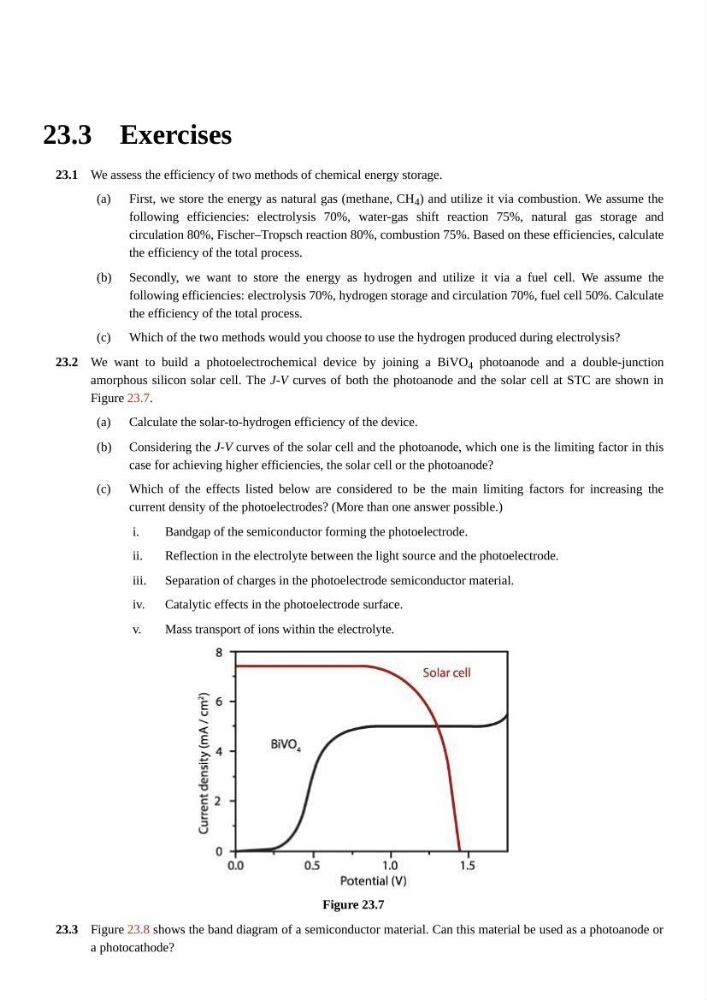
We want to build a photoelectrochemical device by joining a BiVO 4 photoanode and a double-junction
amorphous silicon solar cell. The J-V curves of both the photoanode and the solar cell at STC are shown in
Figure 23.7.
Calculate the solar-to-hydrogen efficiency of the device.
Considering the J-V curves of the solar cell and the photoanode, which one is the limiting factor in this
case for achieving higher efficiencies, the solar cell or the photoanode?
Which of the effects listed below are considered to be the main limiting factors for increasing the
current density of the photoelectrodes? (More than one answer possible.)
Bandgap of the semiconductor forming the photoelectrode.
Reflection in the electrolyte between the light source and the photoelectrode.
Separation of charges in the photoelectrode semiconductor material.
Catalytic effects in the photoelectrode surface.
Mass transport of ions within the electrolyte.
Figure 23.7
Figure 23.8 shows the band diagram of a semiconductor material. Can this material be used as a photoanode or
a photocathode?
23.1
(a)
(b)
(c)
23.2
(a)
(b)
(c)
i.
ii.
iii.
iv.
v.
23.3
Exercises
We assess the efficiency of two methods of chemical energy storage.
First, we store the energy as natural gas (methane, CH 4 ) and utilize it via combustion. We assume the
following efficiencies: electrolysis 70%, water-gas shift reaction 75%, natural gas storage and
circulation 80%, Fischer–Tropsch reaction 80%, combustion 75%. Based on these efficiencies, calculate
the efficiency of the total process.
Secondly, we want to store the energy as hydrogen and utilize it via a fuel cell. We assume the
following efficiencies: electrolysis 70%, hydrogen storage and circulation 70%, fuel cell 50%. Calculate
the efficiency of the total process.
Which of the two methods would you choose to use the hydrogen produced during electrolysis?
We want to build a photoelectrochemical device by joining a BiVO 4 photoanode and a double-junction
amorphous silicon solar cell. The J-V curves of both the photoanode and the solar cell at STC are shown in
Figure 23.7.
Calculate the solar-to-hydrogen efficiency of the device.
Considering the J-V curves of the solar cell and the photoanode, which one is the limiting factor in this
case for achieving higher efficiencies, the solar cell or the photoanode?
Which of the effects listed below are considered to be the main limiting factors for increasing the
current density of the photoelectrodes? (More than one answer possible.)
Bandgap of the semiconductor forming the photoelectrode.
Reflection in the electrolyte between the light source and the photoelectrode.
Separation of charges in the photoelectrode semiconductor material.
Catalytic effects in the photoelectrode surface.
Mass transport of ions within the electrolyte.
Figure 23.7
Figure 23.8 shows the band diagram of a semiconductor material. Can this material be used as a photoanode or
a photocathode?