

23.4
(a)
(b)
(c)
(d)
23.5
(a)
(b)
(c)
(d)
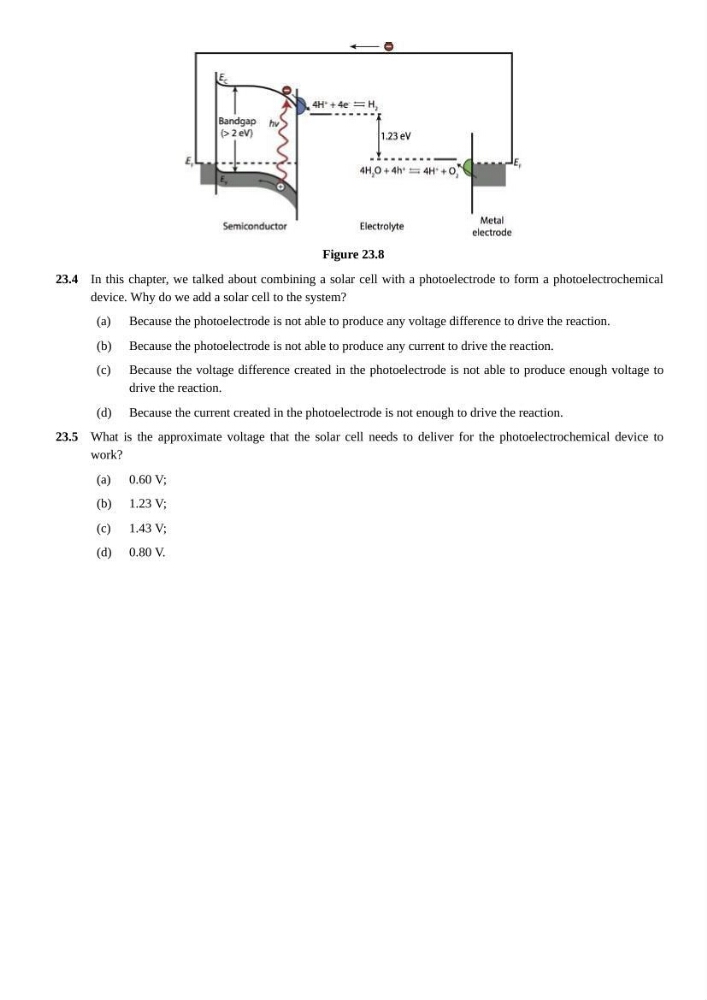
Figure 23.8
In this chapter, we talked about combining a solar cell with a photoelectrode to form a photoelectrochemical
device. Why do we add a solar cell to the system?
Because the photoelectrode is not able to produce any voltage difference to drive the reaction.
Because the photoelectrode is not able to produce any current to drive the reaction.
Because the voltage difference created in the photoelectrode is not able to produce enough voltage to
drive the reaction.
Because the current created in the photoelectrode is not enough to drive the reaction.
What is the approximate voltage that the solar cell needs to deliver for the photoelectrochemical device to
work?
0.60 V;
1.23 V;
1.43 V;
0.80 V.
(a)
(b)
(c)
(d)
23.5
(a)
(b)
(c)
(d)
Figure 23.8
In this chapter, we talked about combining a solar cell with a photoelectrode to form a photoelectrochemical
device. Why do we add a solar cell to the system?
Because the photoelectrode is not able to produce any voltage difference to drive the reaction.
Because the photoelectrode is not able to produce any current to drive the reaction.
Because the voltage difference created in the photoelectrode is not able to produce enough voltage to
drive the reaction.
Because the current created in the photoelectrode is not enough to drive the reaction.
What is the approximate voltage that the solar cell needs to deliver for the photoelectrochemical device to
work?
0.60 V;
1.23 V;
1.43 V;
0.80 V.