

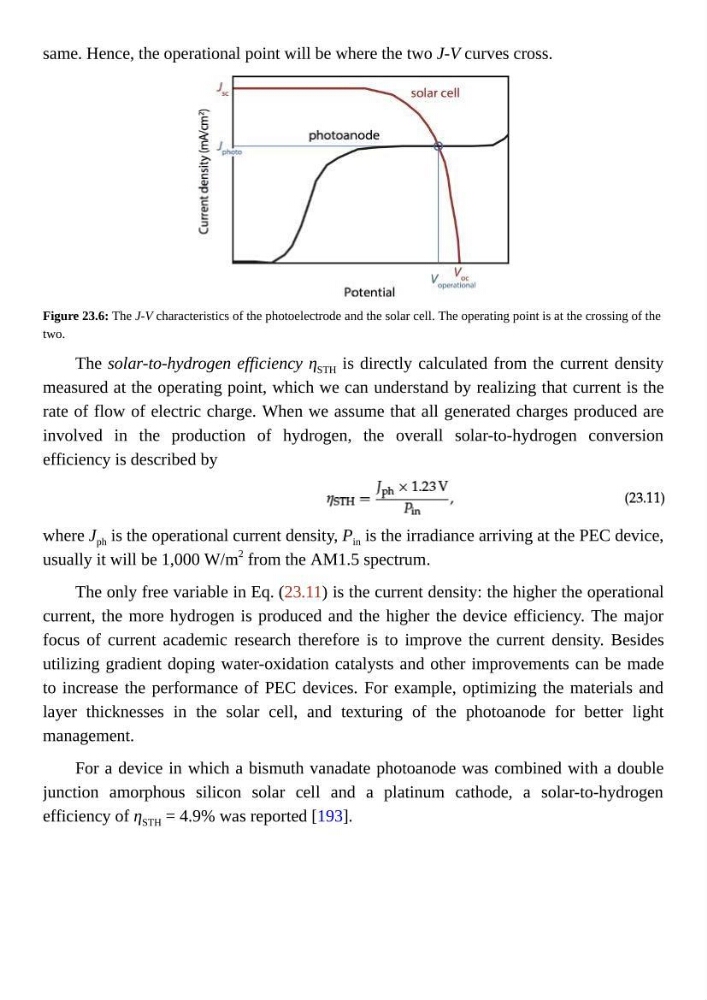
same. Hence, the operational point will be where the two J-V curves cross.
Figure 23.6: The J-V characteristics of the photoelectrode and the solar cell. The operating point is at the crossing of the
two.
The solar-to-hydrogen efficiency η STH is directly calculated from the current density
measured at the operating point, which we can understand by realizing that current is the
rate of flow of electric charge. When we assume that all generated charges produced are
involved in the production of hydrogen, the overall solar-to-hydrogen conversion
efficiency is described by
where J ph is the operational current density, P in is the irradiance arriving at the PEC device,
usually it will be 1,000 W/m
2
from the AM1.5 spectrum.
The only free variable in Eq. (23.11) is the current density: the higher the operational
current, the more hydrogen is produced and the higher the device efficiency. The major
focus of current academic research therefore is to improve the current density. Besides
utilizing gradient doping water-oxidation catalysts and other improvements can be made
to increase the performance of PEC devices. For example, optimizing the materials and
layer thicknesses in the solar cell, and texturing of the photoanode for better light
management.
For a device in which a bismuth vanadate photoanode was combined with a double
junction amorphous silicon solar cell and a platinum cathode, a solar-to-hydrogen
efficiency of η STH = 4.9% was reported [193].
Figure 23.6: The J-V characteristics of the photoelectrode and the solar cell. The operating point is at the crossing of the
two.
The solar-to-hydrogen efficiency η STH is directly calculated from the current density
measured at the operating point, which we can understand by realizing that current is the
rate of flow of electric charge. When we assume that all generated charges produced are
involved in the production of hydrogen, the overall solar-to-hydrogen conversion
efficiency is described by
where J ph is the operational current density, P in is the irradiance arriving at the PEC device,
usually it will be 1,000 W/m
2
from the AM1.5 spectrum.
The only free variable in Eq. (23.11) is the current density: the higher the operational
current, the more hydrogen is produced and the higher the device efficiency. The major
focus of current academic research therefore is to improve the current density. Besides
utilizing gradient doping water-oxidation catalysts and other improvements can be made
to increase the performance of PEC devices. For example, optimizing the materials and
layer thicknesses in the solar cell, and texturing of the photoanode for better light
management.
For a device in which a bismuth vanadate photoanode was combined with a double
junction amorphous silicon solar cell and a platinum cathode, a solar-to-hydrogen
efficiency of η STH = 4.9% was reported [193].