

22.2.3
material to store the heat. A fluid, usually air, is circulated through the bed to add or
remove energy. A variety of solids can be used, rock being the most common. In
operation, flow is maintained through the bed in one direction during the addition of heat
and in the opposite direction during removal. The bed is in general heated during the day
with hot air from the collector. In the evening and during night, energy is removed with air
temperatures around 20 °C flowing upward.
Another way to store heat in buildings is to use their solid walls and roofs as a storage
material. A case of particular interest is the collector storage wall, which is arranged such
that the solar radiation is transmitted through a glazing and absorbed in one side of the
wall. As a result, the temperature of the wall increases and the energy can be transferred
from the wall to the room by radiation and convection. Some of these walls are vented to
transfer more energy to the room via forced convection.
The last method that we will discuss to store heat is to use phase change materials
(PCM). While in all the storage methods discussed so far energy is stored as sensible heat,
in PCM storage takes place as latent heat, which is used for a phase change without any
change in the material temperature. PCM used for energy storage must have a high
specific latent heat L, such that a large amount of energy can be stored. In addition, the
phase change must be reversible, and survive cycles without significant degradation. The
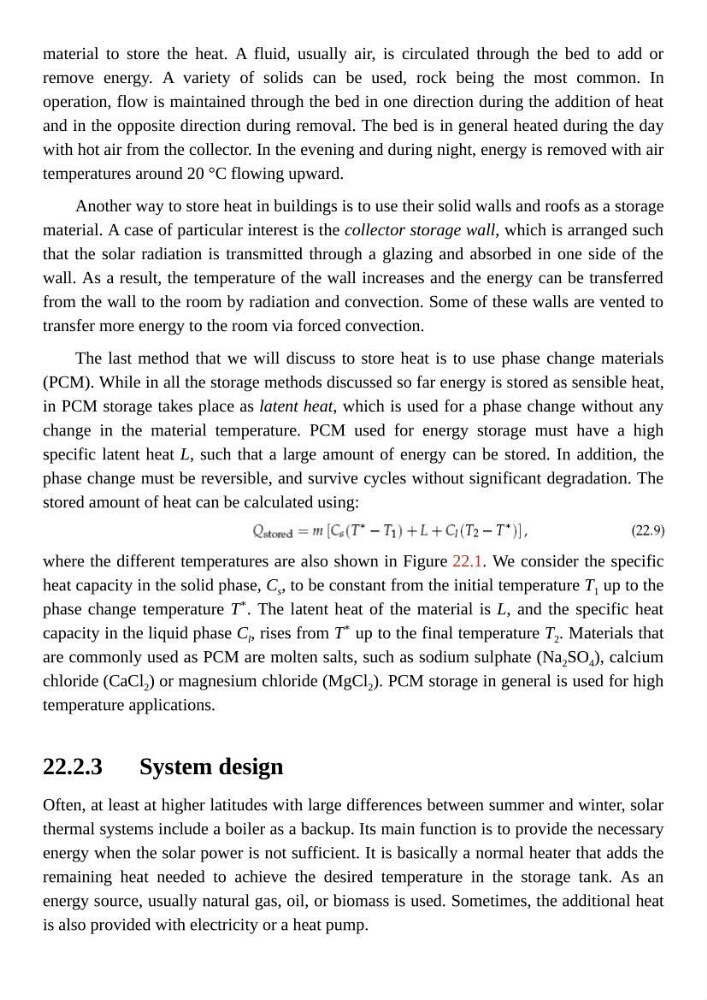
stored amount of heat can be calculated using:
where the different temperatures are also shown in Figure 22.1. We consider the specific
heat capacity in the solid phase, C s , to be constant from the initial temperature T 1 up to the
phase change temperature T
∗
. The latent heat of the material is L, and the specific heat
capacity in the liquid phase C l , rises from T
∗
up to the final temperature T 2 . Materials that
are commonly used as PCM are molten salts, such as sodium sulphate (Na 2 SO 4 ), calcium
chloride (CaCl 2 ) or magnesium chloride (MgCl 2 ). PCM storage in general is used for high
temperature applications.
System design
Often, at least at higher latitudes with large differences between summer and winter, solar
thermal systems include a boiler as a backup. Its main function is to provide the necessary
energy when the solar power is not sufficient. It is basically a normal heater that adds the
remaining heat needed to achieve the desired temperature in the storage tank. As an
energy source, usually natural gas, oil, or biomass is used. Sometimes, the additional heat
is also provided with electricity or a heat pump.
material to store the heat. A fluid, usually air, is circulated through the bed to add or
remove energy. A variety of solids can be used, rock being the most common. In
operation, flow is maintained through the bed in one direction during the addition of heat
and in the opposite direction during removal. The bed is in general heated during the day
with hot air from the collector. In the evening and during night, energy is removed with air
temperatures around 20 °C flowing upward.
Another way to store heat in buildings is to use their solid walls and roofs as a storage
material. A case of particular interest is the collector storage wall, which is arranged such
that the solar radiation is transmitted through a glazing and absorbed in one side of the
wall. As a result, the temperature of the wall increases and the energy can be transferred
from the wall to the room by radiation and convection. Some of these walls are vented to
transfer more energy to the room via forced convection.
The last method that we will discuss to store heat is to use phase change materials
(PCM). While in all the storage methods discussed so far energy is stored as sensible heat,
in PCM storage takes place as latent heat, which is used for a phase change without any
change in the material temperature. PCM used for energy storage must have a high
specific latent heat L, such that a large amount of energy can be stored. In addition, the
phase change must be reversible, and survive cycles without significant degradation. The
stored amount of heat can be calculated using:
where the different temperatures are also shown in Figure 22.1. We consider the specific
heat capacity in the solid phase, C s , to be constant from the initial temperature T 1 up to the
phase change temperature T
∗
. The latent heat of the material is L, and the specific heat
capacity in the liquid phase C l , rises from T
∗
up to the final temperature T 2 . Materials that
are commonly used as PCM are molten salts, such as sodium sulphate (Na 2 SO 4 ), calcium
chloride (CaCl 2 ) or magnesium chloride (MgCl 2 ). PCM storage in general is used for high
temperature applications.
System design
Often, at least at higher latitudes with large differences between summer and winter, solar
thermal systems include a boiler as a backup. Its main function is to provide the necessary
energy when the solar power is not sufficient. It is basically a normal heater that adds the
remaining heat needed to achieve the desired temperature in the storage tank. As an
energy source, usually natural gas, oil, or biomass is used. Sometimes, the additional heat
is also provided with electricity or a heat pump.