

22.2.4
Up to now we have discussed how to collect and store the energy, but have not
considered how to transport it from the collector to the storage system. The transport of
heat is done with a collector circuit, usually using either a liquid or gas. If a liquid is used,
it is important that it neither freezes nor boils, even at the most extreme operating
conditions. Further, the medium should have a large specific heat capacity, a low viscosity,
and it should be non-toxic, cheap and abundant. The most common fluids are water, oils or
air.
As mentioned above, the flux can be caused either naturally by the temperature
gradients, forced by a pump, or by a heat pipe in which the fluid is allowed to boil and
condense again. The optimal choice will depend on the specific system design. Further,
heat losses in the collector circuit must be taken into account, especially when the pipes
are very long. During the planning phase it is therefore important to minimize the circuit
length.
In systems with a pump, often a controller is present that regulates the fluxes of fluid
through collector, storage, and boiler, such that the heat transport from collector to storage
and boiler is maximized. This can for example be done by calculating the optimal flux
with respect to the fluid temperatures at the collectors and in the storage.
Solar cooling
Another interesting application is solar cooling (also called solar air conditioning), which
seems a bit contradictory first sight. Before we start with the actual discussion on solar air
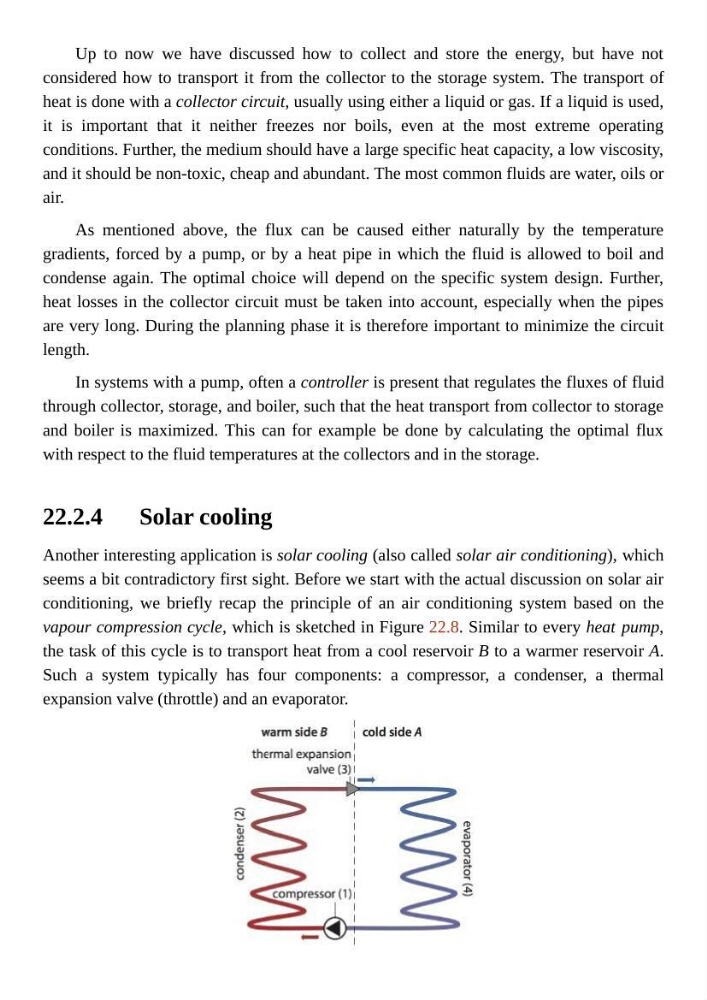
conditioning, we briefly recap the principle of an air conditioning system based on the
vapour compression cycle, which is sketched in Figure 22.8. Similar to every heat pump,
the task of this cycle is to transport heat from a cool reservoir B to a warmer reservoir A.
Such a system typically has four components: a compressor, a condenser, a thermal
expansion valve (throttle) and an evaporator.
Up to now we have discussed how to collect and store the energy, but have not
considered how to transport it from the collector to the storage system. The transport of
heat is done with a collector circuit, usually using either a liquid or gas. If a liquid is used,
it is important that it neither freezes nor boils, even at the most extreme operating
conditions. Further, the medium should have a large specific heat capacity, a low viscosity,
and it should be non-toxic, cheap and abundant. The most common fluids are water, oils or
air.
As mentioned above, the flux can be caused either naturally by the temperature
gradients, forced by a pump, or by a heat pipe in which the fluid is allowed to boil and
condense again. The optimal choice will depend on the specific system design. Further,
heat losses in the collector circuit must be taken into account, especially when the pipes
are very long. During the planning phase it is therefore important to minimize the circuit
length.
In systems with a pump, often a controller is present that regulates the fluxes of fluid
through collector, storage, and boiler, such that the heat transport from collector to storage
and boiler is maximized. This can for example be done by calculating the optimal flux
with respect to the fluid temperatures at the collectors and in the storage.
Solar cooling
Another interesting application is solar cooling (also called solar air conditioning), which
seems a bit contradictory first sight. Before we start with the actual discussion on solar air
conditioning, we briefly recap the principle of an air conditioning system based on the
vapour compression cycle, which is sketched in Figure 22.8. Similar to every heat pump,
the task of this cycle is to transport heat from a cool reservoir B to a warmer reservoir A.
Such a system typically has four components: a compressor, a condenser, a thermal
expansion valve (throttle) and an evaporator.