

Now we will discuss the heat storage, which is an extremely important component as it
has an enormous influence on the overall system cost, performance and reliability. Its
design affects the other basic elements such as the collector or the thermal distribution
system. The task of the storage is twofold. First, it improves the utilization of the collected
solar energy. Secondly, it improves the system efficiency by preventing the fluid flowing
through the collectors from quickly reaching high temperatures.
Several storage technologies are available; some of them can even be combined to
cover daily and seasonal fluctuations. In general, heat can be stored in liquids, solids or
phase change materials, abbreviated as PCM. Water is the most frequently used storage
medium for liquid systems, because it is inexpensive, non-toxic, and it has a high specific
heat capacity. In addition, the energy can be transported by the storage water itself,
without the need for additional heat exchangers.
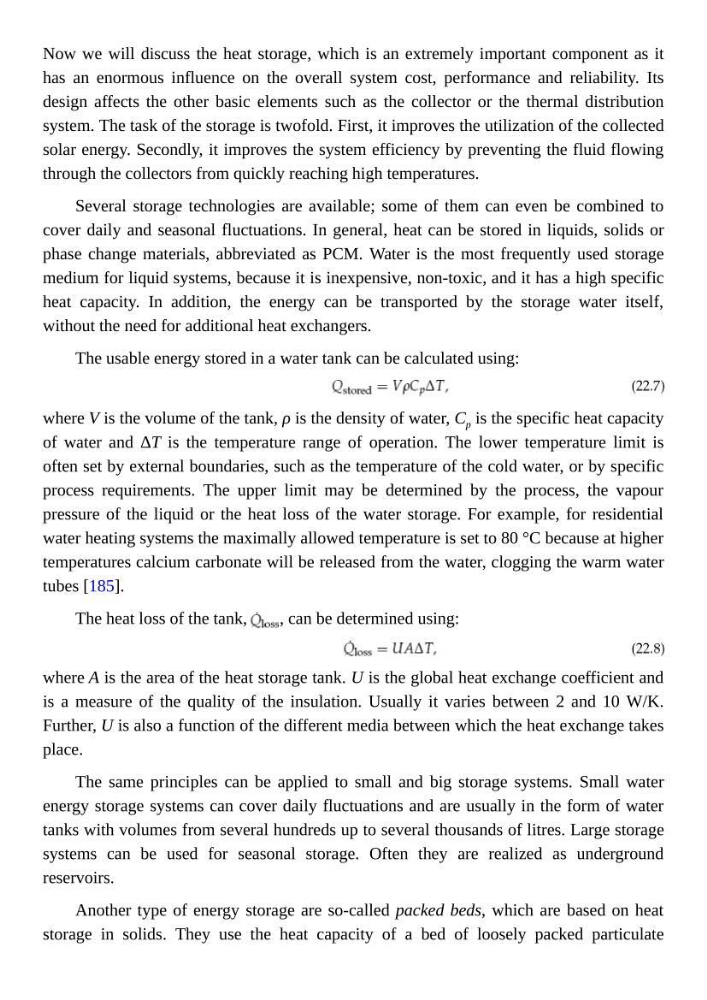
The usable energy stored in a water tank can be calculated using:
where V is the volume of the tank, ρ is the density of water, C p is the specific heat capacity
of water and ΔT is the temperature range of operation. The lower temperature limit is
often set by external boundaries, such as the temperature of the cold water, or by specific
process requirements. The upper limit may be determined by the process, the vapour
pressure of the liquid or the heat loss of the water storage. For example, for residential
water heating systems the maximally allowed temperature is set to 80 °C because at higher
temperatures calcium carbonate will be released from the water, clogging the warm water
tubes [185].
The heat loss of the tank,
, can be determined using:
where A is the area of the heat storage tank. U is the global heat exchange coefficient and
is a measure of the quality of the insulation. Usually it varies between 2 and 10 W/K.
Further, U is also a function of the different media between which the heat exchange takes
place.
The same principles can be applied to small and big storage systems. Small water
energy storage systems can cover daily fluctuations and are usually in the form of water
tanks with volumes from several hundreds up to several thousands of litres. Large storage
systems can be used for seasonal storage. Often they are realized as underground
reservoirs.
Another type of energy storage are so-called packed beds, which are based on heat
storage in solids. They use the heat capacity of a bed of loosely packed particulate
has an enormous influence on the overall system cost, performance and reliability. Its
design affects the other basic elements such as the collector or the thermal distribution
system. The task of the storage is twofold. First, it improves the utilization of the collected
solar energy. Secondly, it improves the system efficiency by preventing the fluid flowing
through the collectors from quickly reaching high temperatures.
Several storage technologies are available; some of them can even be combined to
cover daily and seasonal fluctuations. In general, heat can be stored in liquids, solids or
phase change materials, abbreviated as PCM. Water is the most frequently used storage
medium for liquid systems, because it is inexpensive, non-toxic, and it has a high specific
heat capacity. In addition, the energy can be transported by the storage water itself,
without the need for additional heat exchangers.
The usable energy stored in a water tank can be calculated using:
where V is the volume of the tank, ρ is the density of water, C p is the specific heat capacity
of water and ΔT is the temperature range of operation. The lower temperature limit is
often set by external boundaries, such as the temperature of the cold water, or by specific
process requirements. The upper limit may be determined by the process, the vapour
pressure of the liquid or the heat loss of the water storage. For example, for residential
water heating systems the maximally allowed temperature is set to 80 °C because at higher
temperatures calcium carbonate will be released from the water, clogging the warm water
tubes [185].
The heat loss of the tank,
, can be determined using:
where A is the area of the heat storage tank. U is the global heat exchange coefficient and
is a measure of the quality of the insulation. Usually it varies between 2 and 10 W/K.
Further, U is also a function of the different media between which the heat exchange takes
place.
The same principles can be applied to small and big storage systems. Small water
energy storage systems can cover daily fluctuations and are usually in the form of water
tanks with volumes from several hundreds up to several thousands of litres. Large storage
systems can be used for seasonal storage. Often they are realized as underground
reservoirs.
Another type of energy storage are so-called packed beds, which are based on heat
storage in solids. They use the heat capacity of a bed of loosely packed particulate