

22.2.2
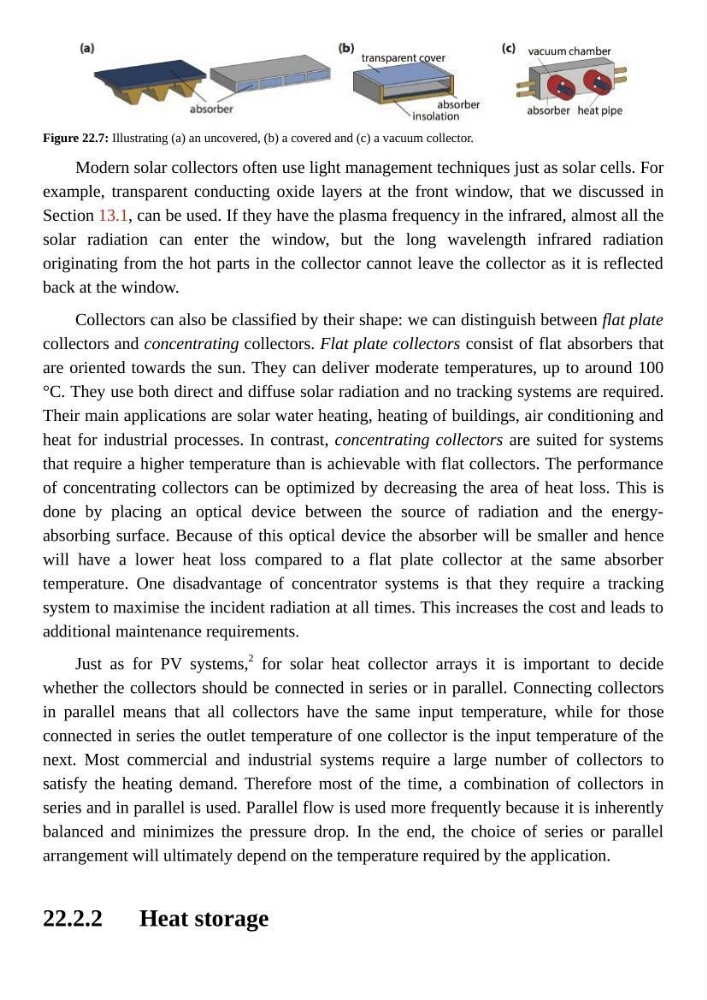
Figure 22.7: Illustrating (a) an uncovered, (b) a covered and (c) a vacuum collector.
Modern solar collectors often use light management techniques just as solar cells. For
example, transparent conducting oxide layers at the front window, that we discussed in
Section 13.1, can be used. If they have the plasma frequency in the infrared, almost all the
solar radiation can enter the window, but the long wavelength infrared radiation
originating from the hot parts in the collector cannot leave the collector as it is reflected
back at the window.
Collectors can also be classified by their shape: we can distinguish between flat plate
collectors and concentrating collectors. Flat plate collectors consist of flat absorbers that
are oriented towards the sun. They can deliver moderate temperatures, up to around 100
°C. They use both direct and diffuse solar radiation and no tracking systems are required.
Their main applications are solar water heating, heating of buildings, air conditioning and
heat for industrial processes. In contrast, concentrating collectors are suited for systems
that require a higher temperature than is achievable with flat collectors. The performance
of concentrating collectors can be optimized by decreasing the area of heat loss. This is
done by placing an optical device between the source of radiation and the energyabsorbing surface. Because of this optical device the absorber will be smaller and hence
will have a lower heat loss compared to a flat plate collector at the same absorber
temperature. One disadvantage of concentrator systems is that they require a tracking
system to maximise the incident radiation at all times. This increases the cost and leads to
additional maintenance requirements.
Just as for PV systems,
2
for solar heat collector arrays it is important to decide
whether the collectors should be connected in series or in parallel. Connecting collectors
in parallel means that all collectors have the same input temperature, while for those
connected in series the outlet temperature of one collector is the input temperature of the
next. Most commercial and industrial systems require a large number of collectors to
satisfy the heating demand. Therefore most of the time, a combination of collectors in
series and in parallel is used. Parallel flow is used more frequently because it is inherently
balanced and minimizes the pressure drop. In the end, the choice of series or parallel
arrangement will ultimately depend on the temperature required by the application.
Heat storage
Figure 22.7: Illustrating (a) an uncovered, (b) a covered and (c) a vacuum collector.
Modern solar collectors often use light management techniques just as solar cells. For
example, transparent conducting oxide layers at the front window, that we discussed in
Section 13.1, can be used. If they have the plasma frequency in the infrared, almost all the
solar radiation can enter the window, but the long wavelength infrared radiation
originating from the hot parts in the collector cannot leave the collector as it is reflected
back at the window.
Collectors can also be classified by their shape: we can distinguish between flat plate
collectors and concentrating collectors. Flat plate collectors consist of flat absorbers that
are oriented towards the sun. They can deliver moderate temperatures, up to around 100
°C. They use both direct and diffuse solar radiation and no tracking systems are required.
Their main applications are solar water heating, heating of buildings, air conditioning and
heat for industrial processes. In contrast, concentrating collectors are suited for systems
that require a higher temperature than is achievable with flat collectors. The performance
of concentrating collectors can be optimized by decreasing the area of heat loss. This is
done by placing an optical device between the source of radiation and the energyabsorbing surface. Because of this optical device the absorber will be smaller and hence
will have a lower heat loss compared to a flat plate collector at the same absorber
temperature. One disadvantage of concentrator systems is that they require a tracking
system to maximise the incident radiation at all times. This increases the cost and leads to
additional maintenance requirements.
Just as for PV systems,
2
for solar heat collector arrays it is important to decide
whether the collectors should be connected in series or in parallel. Connecting collectors
in parallel means that all collectors have the same input temperature, while for those
connected in series the outlet temperature of one collector is the input temperature of the
next. Most commercial and industrial systems require a large number of collectors to
satisfy the heating demand. Therefore most of the time, a combination of collectors in
series and in parallel is used. Parallel flow is used more frequently because it is inherently
balanced and minimizes the pressure drop. In the end, the choice of series or parallel
arrangement will ultimately depend on the temperature required by the application.
Heat storage