

cooled and the heat transferred elsewhere.
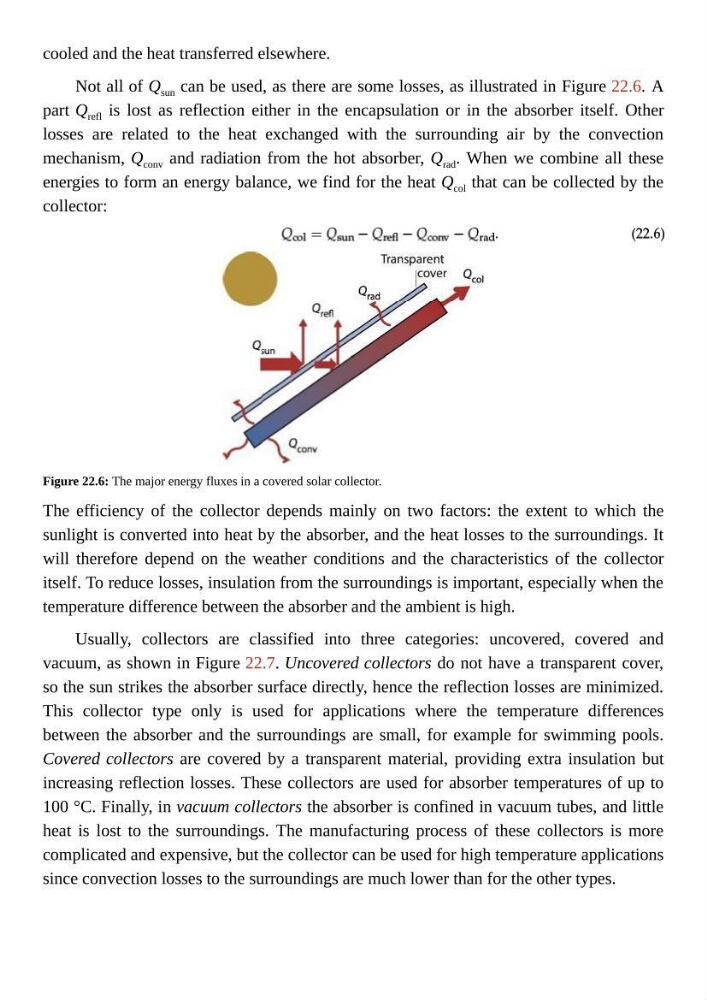
Not all of Q sun can be used, as there are some losses, as illustrated in Figure 22.6. A
part Q refl is lost as reflection either in the encapsulation or in the absorber itself. Other
losses are related to the heat exchanged with the surrounding air by the convection
mechanism, Q conv and radiation from the hot absorber, Q rad . When we combine all these
energies to form an energy balance, we find for the heat Q col that can be collected by the
collector:
Figure 22.6: The major energy fluxes in a covered solar collector.
The efficiency of the collector depends mainly on two factors: the extent to which the
sunlight is converted into heat by the absorber, and the heat losses to the surroundings. It
will therefore depend on the weather conditions and the characteristics of the collector
itself. To reduce losses, insulation from the surroundings is important, especially when the
temperature difference between the absorber and the ambient is high.
Usually, collectors are classified into three categories: uncovered, covered and
vacuum, as shown in Figure 22.7. Uncovered collectors do not have a transparent cover,
so the sun strikes the absorber surface directly, hence the reflection losses are minimized.
This collector type only is used for applications where the temperature differences
between the absorber and the surroundings are small, for example for swimming pools.
Covered collectors are covered by a transparent material, providing extra insulation but
increasing reflection losses. These collectors are used for absorber temperatures of up to
100 °C. Finally, in vacuum collectors the absorber is confined in vacuum tubes, and little
heat is lost to the surroundings. The manufacturing process of these collectors is more
complicated and expensive, but the collector can be used for high temperature applications
since convection losses to the surroundings are much lower than for the other types.
Not all of Q sun can be used, as there are some losses, as illustrated in Figure 22.6. A
part Q refl is lost as reflection either in the encapsulation or in the absorber itself. Other
losses are related to the heat exchanged with the surrounding air by the convection
mechanism, Q conv and radiation from the hot absorber, Q rad . When we combine all these
energies to form an energy balance, we find for the heat Q col that can be collected by the
collector:
Figure 22.6: The major energy fluxes in a covered solar collector.
The efficiency of the collector depends mainly on two factors: the extent to which the
sunlight is converted into heat by the absorber, and the heat losses to the surroundings. It
will therefore depend on the weather conditions and the characteristics of the collector
itself. To reduce losses, insulation from the surroundings is important, especially when the
temperature difference between the absorber and the ambient is high.
Usually, collectors are classified into three categories: uncovered, covered and
vacuum, as shown in Figure 22.7. Uncovered collectors do not have a transparent cover,
so the sun strikes the absorber surface directly, hence the reflection losses are minimized.
This collector type only is used for applications where the temperature differences
between the absorber and the surroundings are small, for example for swimming pools.
Covered collectors are covered by a transparent material, providing extra insulation but
increasing reflection losses. These collectors are used for absorber temperatures of up to
100 °C. Finally, in vacuum collectors the absorber is confined in vacuum tubes, and little
heat is lost to the surroundings. The manufacturing process of these collectors is more
complicated and expensive, but the collector can be used for high temperature applications
since convection losses to the surroundings are much lower than for the other types.