

22.2
where M is given in W/m
2
and σ ≈ 5.670 × 10
−8 W/(m
2
K
4
) is the Stefan–Boltzmann
constant. In nature, no blackbodies exist. However we can describe them as so-called
greybodies. The energy emitted by a greybody still can be described by Plank’s law [Eq.
(5.18a)] when it is multiplied with a wavelength-dependent emission coefficient ∈(λ). For
a blackbody we would have ∈(λ) ≡ 1.
Solar thermal heating
About half of the world’s energy consumption is in the form of heat. About two-thirds of
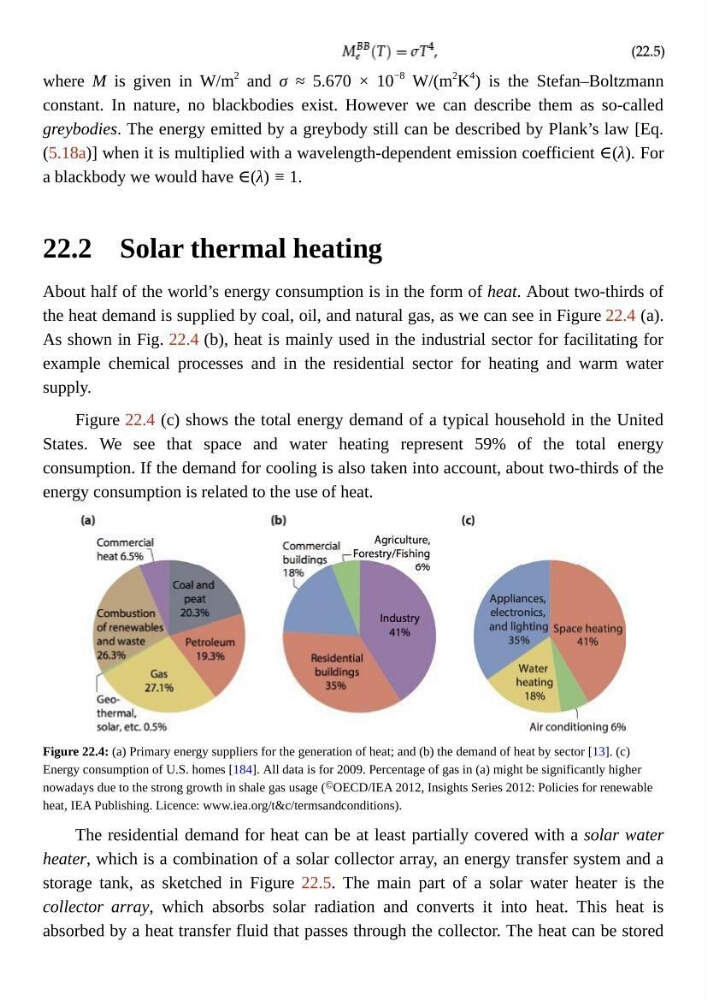
the heat demand is supplied by coal, oil, and natural gas, as we can see in Figure 22.4 (a).
As shown in Fig. 22.4 (b), heat is mainly used in the industrial sector for facilitating for
example chemical processes and in the residential sector for heating and warm water
supply.
Figure 22.4 (c) shows the total energy demand of a typical household in the United
States. We see that space and water heating represent 59% of the total energy
consumption. If the demand for cooling is also taken into account, about two-thirds of the
energy consumption is related to the use of heat.
Figure 22.4: (a) Primary energy suppliers for the generation of heat; and (b) the demand of heat by sector [13]. (c)
Energy consumption of U.S. homes [184]. All data is for 2009. Percentage of gas in (a) might be significantly higher
nowadays due to the strong growth in shale gas usage ( © OECD/IEA 2012, Insights Series 2012: Policies for renewable
heat, IEA Publishing. Licence: www.iea.org/t&c/termsandconditions).
The residential demand for heat can be at least partially covered with a solar water
heater, which is a combination of a solar collector array, an energy transfer system and a
storage tank, as sketched in Figure 22.5. The main part of a solar water heater is the
collector array, which absorbs solar radiation and converts it into heat. This heat is
absorbed by a heat transfer fluid that passes through the collector. The heat can be stored
where M is given in W/m
2
and σ ≈ 5.670 × 10
−8 W/(m
2
K
4
) is the Stefan–Boltzmann
constant. In nature, no blackbodies exist. However we can describe them as so-called
greybodies. The energy emitted by a greybody still can be described by Plank’s law [Eq.
(5.18a)] when it is multiplied with a wavelength-dependent emission coefficient ∈(λ). For
a blackbody we would have ∈(λ) ≡ 1.
Solar thermal heating
About half of the world’s energy consumption is in the form of heat. About two-thirds of
the heat demand is supplied by coal, oil, and natural gas, as we can see in Figure 22.4 (a).
As shown in Fig. 22.4 (b), heat is mainly used in the industrial sector for facilitating for
example chemical processes and in the residential sector for heating and warm water
supply.
Figure 22.4 (c) shows the total energy demand of a typical household in the United
States. We see that space and water heating represent 59% of the total energy
consumption. If the demand for cooling is also taken into account, about two-thirds of the
energy consumption is related to the use of heat.
Figure 22.4: (a) Primary energy suppliers for the generation of heat; and (b) the demand of heat by sector [13]. (c)
Energy consumption of U.S. homes [184]. All data is for 2009. Percentage of gas in (a) might be significantly higher
nowadays due to the strong growth in shale gas usage ( © OECD/IEA 2012, Insights Series 2012: Policies for renewable
heat, IEA Publishing. Licence: www.iea.org/t&c/termsandconditions).
The residential demand for heat can be at least partially covered with a solar water
heater, which is a combination of a solar collector array, an energy transfer system and a
storage tank, as sketched in Figure 22.5. The main part of a solar water heater is the
collector array, which absorbs solar radiation and converts it into heat. This heat is
absorbed by a heat transfer fluid that passes through the collector. The heat can be stored