

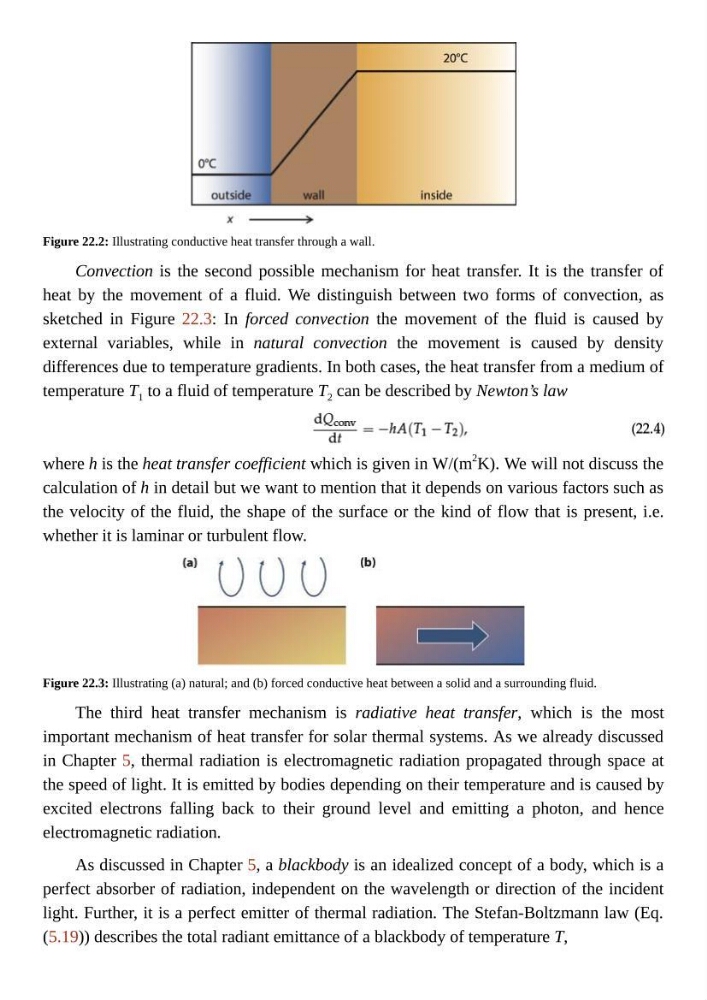
Figure 22.2: Illustrating conductive heat transfer through a wall.
Convection is the second possible mechanism for heat transfer. It is the transfer of
heat by the movement of a fluid. We distinguish between two forms of convection, as
sketched in Figure 22.3: In forced convection the movement of the fluid is caused by
external variables, while in natural convection the movement is caused by density
differences due to temperature gradients. In both cases, the heat transfer from a medium of
temperature T 1 to a fluid of temperature T 2 can be described by Newton’s law
where h is the heat transfer coefficient which is given in W/(m
2
K). We will not discuss the
calculation of h in detail but we want to mention that it depends on various factors such as
the velocity of the fluid, the shape of the surface or the kind of flow that is present, i.e.
whether it is laminar or turbulent flow.
Figure 22.3: Illustrating (a) natural; and (b) forced conductive heat between a solid and a surrounding fluid.
The third heat transfer mechanism is radiative heat transfer, which is the most
important mechanism of heat transfer for solar thermal systems. As we already discussed
in Chapter 5, thermal radiation is electromagnetic radiation propagated through space at
the speed of light. It is emitted by bodies depending on their temperature and is caused by
excited electrons falling back to their ground level and emitting a photon, and hence
electromagnetic radiation.
As discussed in Chapter 5, a blackbody is an idealized concept of a body, which is a
perfect absorber of radiation, independent on the wavelength or direction of the incident
light. Further, it is a perfect emitter of thermal radiation. The Stefan-Boltzmann law (Eq.
(5.19)) describes the total radiant emittance of a blackbody of temperature T,
Convection is the second possible mechanism for heat transfer. It is the transfer of
heat by the movement of a fluid. We distinguish between two forms of convection, as
sketched in Figure 22.3: In forced convection the movement of the fluid is caused by
external variables, while in natural convection the movement is caused by density
differences due to temperature gradients. In both cases, the heat transfer from a medium of
temperature T 1 to a fluid of temperature T 2 can be described by Newton’s law
where h is the heat transfer coefficient which is given in W/(m
2
K). We will not discuss the
calculation of h in detail but we want to mention that it depends on various factors such as
the velocity of the fluid, the shape of the surface or the kind of flow that is present, i.e.
whether it is laminar or turbulent flow.
Figure 22.3: Illustrating (a) natural; and (b) forced conductive heat between a solid and a surrounding fluid.
The third heat transfer mechanism is radiative heat transfer, which is the most
important mechanism of heat transfer for solar thermal systems. As we already discussed
in Chapter 5, thermal radiation is electromagnetic radiation propagated through space at
the speed of light. It is emitted by bodies depending on their temperature and is caused by
excited electrons falling back to their ground level and emitting a photon, and hence
electromagnetic radiation.
As discussed in Chapter 5, a blackbody is an idealized concept of a body, which is a
perfect absorber of radiation, independent on the wavelength or direction of the incident
light. Further, it is a perfect emitter of thermal radiation. The Stefan-Boltzmann law (Eq.
(5.19)) describes the total radiant emittance of a blackbody of temperature T,