

where L is the specific latent heat.
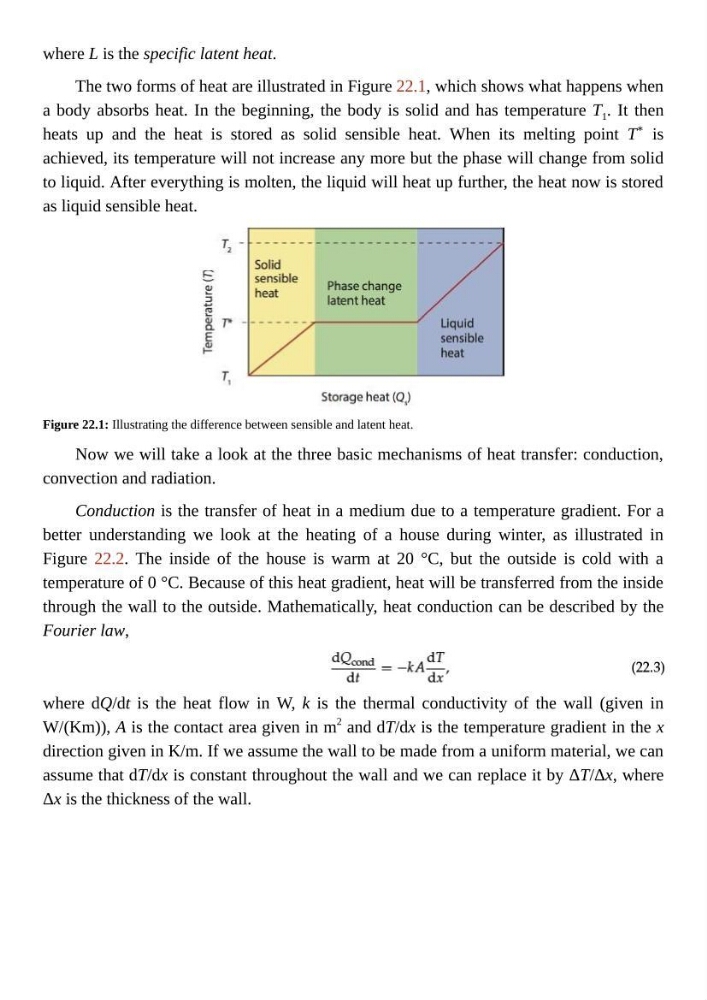
The two forms of heat are illustrated in Figure 22.1, which shows what happens when
a body absorbs heat. In the beginning, the body is solid and has temperature T 1 . It then
heats up and the heat is stored as solid sensible heat. When its melting point T
∗
is
achieved, its temperature will not increase any more but the phase will change from solid
to liquid. After everything is molten, the liquid will heat up further, the heat now is stored
as liquid sensible heat.
Figure 22.1: Illustrating the difference between sensible and latent heat.
Now we will take a look at the three basic mechanisms of heat transfer: conduction,
convection and radiation.
Conduction is the transfer of heat in a medium due to a temperature gradient. For a
better understanding we look at the heating of a house during winter, as illustrated in
Figure 22.2. The inside of the house is warm at 20 °C, but the outside is cold with a
temperature of 0 °C. Because of this heat gradient, heat will be transferred from the inside
through the wall to the outside. Mathematically, heat conduction can be described by the
Fourier law,
where dQ/dt is the heat flow in W, k is the thermal conductivity of the wall (given in
W/(Km)), A is the contact area given in m
2
and dT/dx is the temperature gradient in the x
direction given in K/m. If we assume the wall to be made from a uniform material, we can
assume that dT/dx is constant throughout the wall and we can replace it by ΔT/Δx, where
Δx is the thickness of the wall.
The two forms of heat are illustrated in Figure 22.1, which shows what happens when
a body absorbs heat. In the beginning, the body is solid and has temperature T 1 . It then
heats up and the heat is stored as solid sensible heat. When its melting point T
∗
is
achieved, its temperature will not increase any more but the phase will change from solid
to liquid. After everything is molten, the liquid will heat up further, the heat now is stored
as liquid sensible heat.
Figure 22.1: Illustrating the difference between sensible and latent heat.
Now we will take a look at the three basic mechanisms of heat transfer: conduction,
convection and radiation.
Conduction is the transfer of heat in a medium due to a temperature gradient. For a
better understanding we look at the heating of a house during winter, as illustrated in
Figure 22.2. The inside of the house is warm at 20 °C, but the outside is cold with a
temperature of 0 °C. Because of this heat gradient, heat will be transferred from the inside
through the wall to the outside. Mathematically, heat conduction can be described by the
Fourier law,
where dQ/dt is the heat flow in W, k is the thermal conductivity of the wall (given in
W/(Km)), A is the contact area given in m
2
and dT/dx is the temperature gradient in the x
direction given in K/m. If we assume the wall to be made from a uniform material, we can
assume that dT/dx is constant throughout the wall and we can replace it by ΔT/Δx, where
Δx is the thickness of the wall.