

21.3
21.1
(a)
(b)
(c)
(d)
21.2
(a)
Exercises
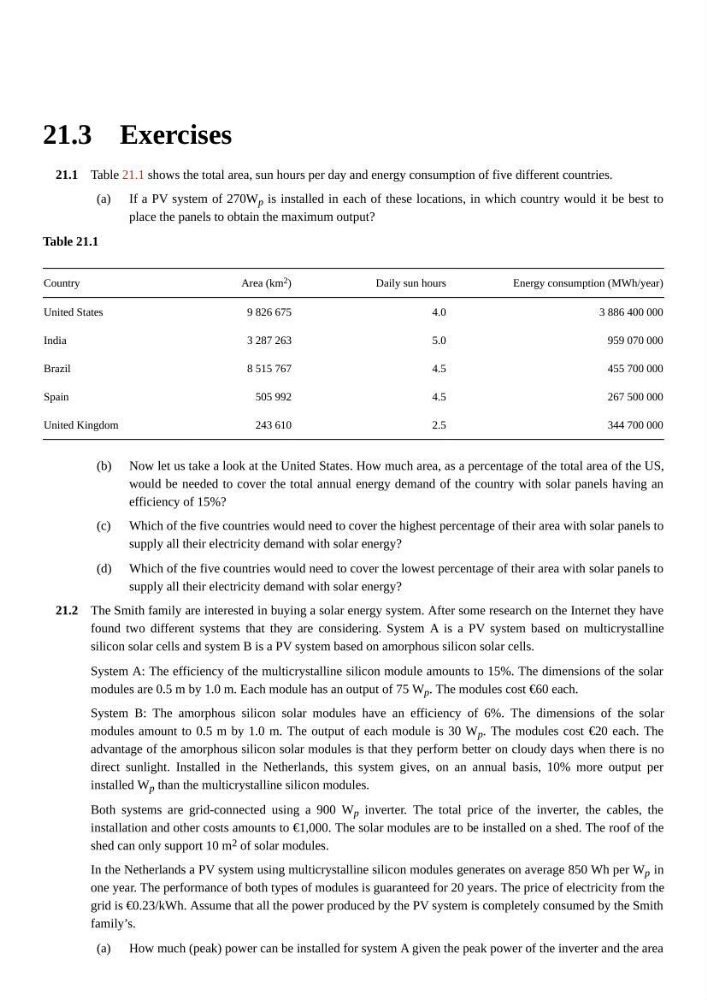
Table 21.1 shows the total area, sun hours per day and energy consumption of five different countries.
If a PV system of 270W p is installed in each of these locations, in which country would it be best to
place the panels to obtain the maximum output?
Table 21.1
Country
Area (km 2 )
Daily sun hours
Energy consumption (MWh/year)
United States
9 826 675
4.0
3 886 400 000
India
3 287 263
5.0
959 070 000
Brazil
8 515 767
4.5
455 700 000
Spain
505 992
4.5
267 500 000
United Kingdom
243 610
2.5
344 700 000
Now let us take a look at the United States. How much area, as a percentage of the total area of the US,
would be needed to cover the total annual energy demand of the country with solar panels having an
efficiency of 15%?
Which of the five countries would need to cover the highest percentage of their area with solar panels to
supply all their electricity demand with solar energy?
Which of the five countries would need to cover the lowest percentage of their area with solar panels to
supply all their electricity demand with solar energy?
The Smith family are interested in buying a solar energy system. After some research on the Internet they have
found two different systems that they are considering. System A is a PV system based on multicrystalline
silicon solar cells and system B is a PV system based on amorphous silicon solar cells.
System A: The efficiency of the multicrystalline silicon module amounts to 15%. The dimensions of the solar
modules are 0.5 m by 1.0 m. Each module has an output of 75 W p . The modules cost €60 each.
System B: The amorphous silicon solar modules have an efficiency of 6%. The dimensions of the solar
modules amount to 0.5 m by 1.0 m. The output of each module is 30 W p . The modules cost €20 each. The
advantage of the amorphous silicon solar modules is that they perform better on cloudy days when there is no
direct sunlight. Installed in the Netherlands, this system gives, on an annual basis, 10% more output per
installed W p than the multicrystalline silicon modules.
Both systems are grid-connected using a 900 W p inverter. The total price of the inverter, the cables, the
installation and other costs amounts to €1,000. The solar modules are to be installed on a shed. The roof of the
shed can only support 10 m 2 of solar modules.
In the Netherlands a PV system using multicrystalline silicon modules generates on average 850 Wh per W p in
one year. The performance of both types of modules is guaranteed for 20 years. The price of electricity from the
grid is €0.23/kWh. Assume that all the power produced by the PV system is completely consumed by the Smith
family’s.
How much (peak) power can be installed for system A given the peak power of the inverter and the area
21.1
(a)
(b)
(c)
(d)
21.2
(a)
Exercises
Table 21.1 shows the total area, sun hours per day and energy consumption of five different countries.
If a PV system of 270W p is installed in each of these locations, in which country would it be best to
place the panels to obtain the maximum output?
Table 21.1
Country
Area (km 2 )
Daily sun hours
Energy consumption (MWh/year)
United States
9 826 675
4.0
3 886 400 000
India
3 287 263
5.0
959 070 000
Brazil
8 515 767
4.5
455 700 000
Spain
505 992
4.5
267 500 000
United Kingdom
243 610
2.5
344 700 000
Now let us take a look at the United States. How much area, as a percentage of the total area of the US,
would be needed to cover the total annual energy demand of the country with solar panels having an
efficiency of 15%?
Which of the five countries would need to cover the highest percentage of their area with solar panels to
supply all their electricity demand with solar energy?
Which of the five countries would need to cover the lowest percentage of their area with solar panels to
supply all their electricity demand with solar energy?
The Smith family are interested in buying a solar energy system. After some research on the Internet they have
found two different systems that they are considering. System A is a PV system based on multicrystalline
silicon solar cells and system B is a PV system based on amorphous silicon solar cells.
System A: The efficiency of the multicrystalline silicon module amounts to 15%. The dimensions of the solar
modules are 0.5 m by 1.0 m. Each module has an output of 75 W p . The modules cost €60 each.
System B: The amorphous silicon solar modules have an efficiency of 6%. The dimensions of the solar
modules amount to 0.5 m by 1.0 m. The output of each module is 30 W p . The modules cost €20 each. The
advantage of the amorphous silicon solar modules is that they perform better on cloudy days when there is no
direct sunlight. Installed in the Netherlands, this system gives, on an annual basis, 10% more output per
installed W p than the multicrystalline silicon modules.
Both systems are grid-connected using a 900 W p inverter. The total price of the inverter, the cables, the
installation and other costs amounts to €1,000. The solar modules are to be installed on a shed. The roof of the
shed can only support 10 m 2 of solar modules.
In the Netherlands a PV system using multicrystalline silicon modules generates on average 850 Wh per W p in
one year. The performance of both types of modules is guaranteed for 20 years. The price of electricity from the
grid is €0.23/kWh. Assume that all the power produced by the PV system is completely consumed by the Smith
family’s.
How much (peak) power can be installed for system A given the peak power of the inverter and the area