

21.1.5
supplier cannot determine the electricity price independently, as it is strongly influenced
by policy factors such as feed-in tariffs, subsidies and other incentives.
Grid and socket parity
It is very important to investigate whether electricity generated with PV is competitive
when compared to electricity generated by other means. For this purpose, the concepts of
grid parity and socket parity are used. We want to warn the reader that many authors use
these two concepts interchangeably. However, only a clear distinction between the two
concepts allows a well grounded judgement of the economic viability of PV-generated
electricity.
The owners of large-scale PV power plants have to compare the LCoE of their system
to the cost of electricity production of other sources, ignoring subsidies and other
incentives. The point at which the cost of PV electricity is equal to the cost of other
electricity generation technologies is called grid parity. Of course, if the PV electricity
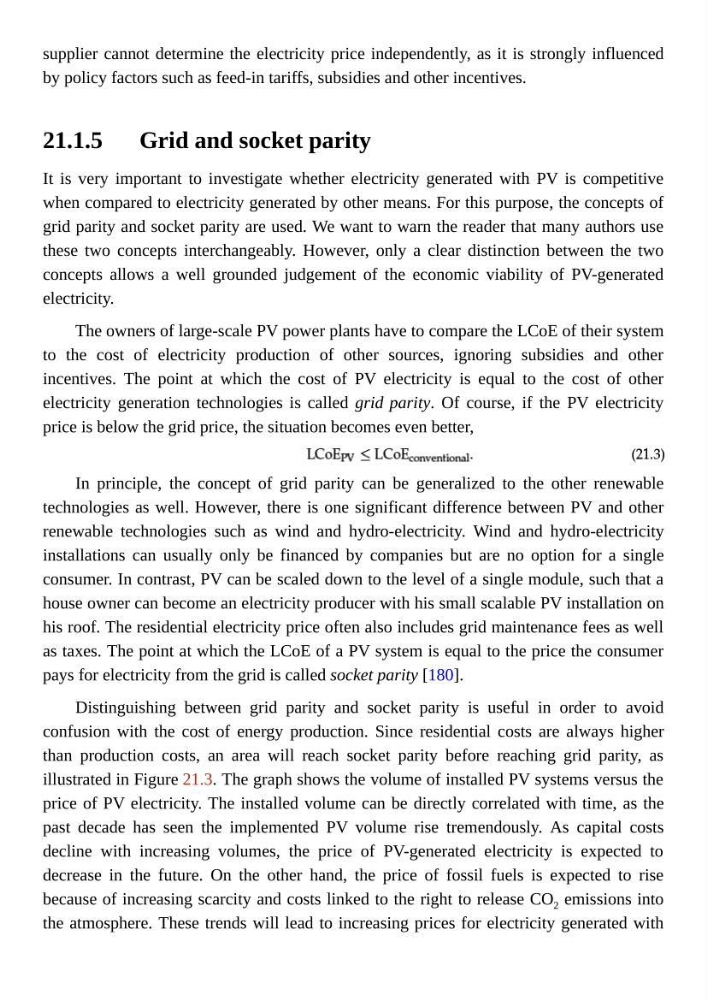
price is below the grid price, the situation becomes even better,
In principle, the concept of grid parity can be generalized to the other renewable
technologies as well. However, there is one significant difference between PV and other
renewable technologies such as wind and hydro-electricity. Wind and hydro-electricity
installations can usually only be financed by companies but are no option for a single
consumer. In contrast, PV can be scaled down to the level of a single module, such that a
house owner can become an electricity producer with his small scalable PV installation on
his roof. The residential electricity price often also includes grid maintenance fees as well
as taxes. The point at which the LCoE of a PV system is equal to the price the consumer
pays for electricity from the grid is called socket parity [180].
Distinguishing between grid parity and socket parity is useful in order to avoid
confusion with the cost of energy production. Since residential costs are always higher
than production costs, an area will reach socket parity before reaching grid parity, as
illustrated in Figure 21.3. The graph shows the volume of installed PV systems versus the
price of PV electricity. The installed volume can be directly correlated with time, as the
past decade has seen the implemented PV volume rise tremendously. As capital costs
decline with increasing volumes, the price of PV-generated electricity is expected to
decrease in the future. On the other hand, the price of fossil fuels is expected to rise
because of increasing scarcity and costs linked to the right to release CO 2 emissions into
the atmosphere. These trends will lead to increasing prices for electricity generated with
supplier cannot determine the electricity price independently, as it is strongly influenced
by policy factors such as feed-in tariffs, subsidies and other incentives.
Grid and socket parity
It is very important to investigate whether electricity generated with PV is competitive
when compared to electricity generated by other means. For this purpose, the concepts of
grid parity and socket parity are used. We want to warn the reader that many authors use
these two concepts interchangeably. However, only a clear distinction between the two
concepts allows a well grounded judgement of the economic viability of PV-generated
electricity.
The owners of large-scale PV power plants have to compare the LCoE of their system
to the cost of electricity production of other sources, ignoring subsidies and other
incentives. The point at which the cost of PV electricity is equal to the cost of other
electricity generation technologies is called grid parity. Of course, if the PV electricity
price is below the grid price, the situation becomes even better,
In principle, the concept of grid parity can be generalized to the other renewable
technologies as well. However, there is one significant difference between PV and other
renewable technologies such as wind and hydro-electricity. Wind and hydro-electricity
installations can usually only be financed by companies but are no option for a single
consumer. In contrast, PV can be scaled down to the level of a single module, such that a
house owner can become an electricity producer with his small scalable PV installation on
his roof. The residential electricity price often also includes grid maintenance fees as well
as taxes. The point at which the LCoE of a PV system is equal to the price the consumer
pays for electricity from the grid is called socket parity [180].
Distinguishing between grid parity and socket parity is useful in order to avoid
confusion with the cost of energy production. Since residential costs are always higher
than production costs, an area will reach socket parity before reaching grid parity, as
illustrated in Figure 21.3. The graph shows the volume of installed PV systems versus the
price of PV electricity. The installed volume can be directly correlated with time, as the
past decade has seen the implemented PV volume rise tremendously. As capital costs
decline with increasing volumes, the price of PV-generated electricity is expected to
decrease in the future. On the other hand, the price of fossil fuels is expected to rise
because of increasing scarcity and costs linked to the right to release CO 2 emissions into
the atmosphere. These trends will lead to increasing prices for electricity generated with