

20.5.3
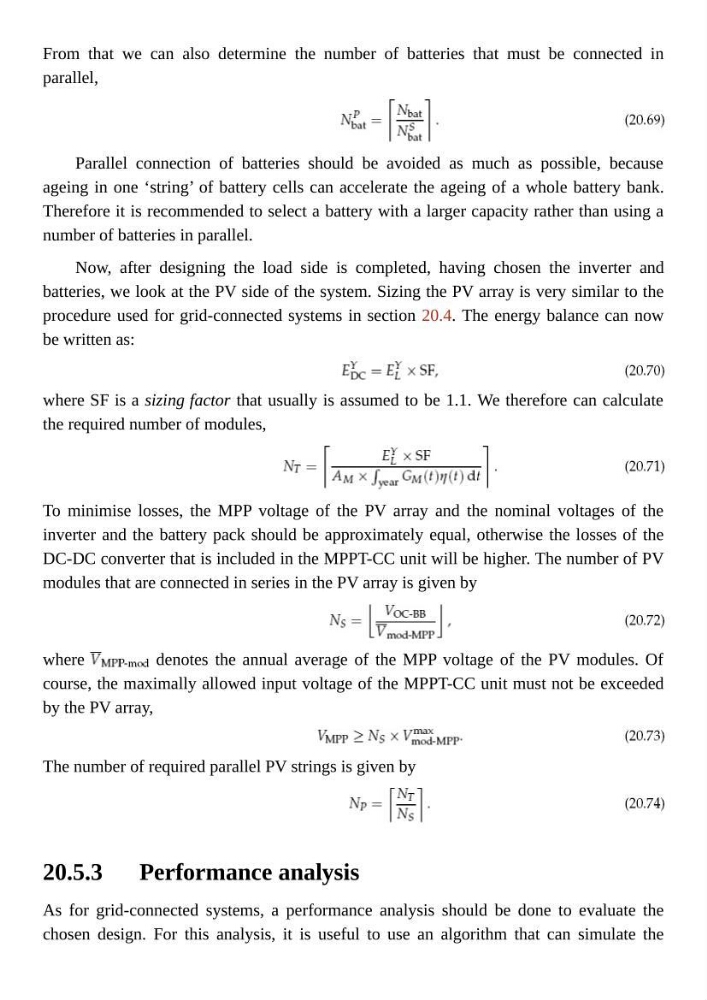
From that we can also determine the number of batteries that must be connected in
parallel,
Parallel connection of batteries should be avoided as much as possible, because
ageing in one ‘string’ of battery cells can accelerate the ageing of a whole battery bank.
Therefore it is recommended to select a battery with a larger capacity rather than using a
number of batteries in parallel.
Now, after designing the load side is completed, having chosen the inverter and
batteries, we look at the PV side of the system. Sizing the PV array is very similar to the
procedure used for grid-connected systems in section 20.4. The energy balance can now
be written as:
where SF is a sizing factor that usually is assumed to be 1.1. We therefore can calculate
the required number of modules,
To minimise losses, the MPP voltage of the PV array and the nominal voltages of the
inverter and the battery pack should be approximately equal, otherwise the losses of the
DC-DC converter that is included in the MPPT-CC unit will be higher. The number of PV
modules that are connected in series in the PV array is given by
where
denotes the annual average of the MPP voltage of the PV modules. Of
course, the maximally allowed input voltage of the MPPT-CC unit must not be exceeded
by the PV array,
The number of required parallel PV strings is given by
Performance analysis
As for grid-connected systems, a performance analysis should be done to evaluate the
chosen design. For this analysis, it is useful to use an algorithm that can simulate the
From that we can also determine the number of batteries that must be connected in
parallel,
Parallel connection of batteries should be avoided as much as possible, because
ageing in one ‘string’ of battery cells can accelerate the ageing of a whole battery bank.
Therefore it is recommended to select a battery with a larger capacity rather than using a
number of batteries in parallel.
Now, after designing the load side is completed, having chosen the inverter and
batteries, we look at the PV side of the system. Sizing the PV array is very similar to the
procedure used for grid-connected systems in section 20.4. The energy balance can now
be written as:
where SF is a sizing factor that usually is assumed to be 1.1. We therefore can calculate
the required number of modules,
To minimise losses, the MPP voltage of the PV array and the nominal voltages of the
inverter and the battery pack should be approximately equal, otherwise the losses of the
DC-DC converter that is included in the MPPT-CC unit will be higher. The number of PV
modules that are connected in series in the PV array is given by
where
denotes the annual average of the MPP voltage of the PV modules. Of
course, the maximally allowed input voltage of the MPPT-CC unit must not be exceeded
by the PV array,
The number of required parallel PV strings is given by
Performance analysis
As for grid-connected systems, a performance analysis should be done to evaluate the
chosen design. For this analysis, it is useful to use an algorithm that can simulate the