

1.
2.
•
•
3.
4.
5.
•
–
–
•
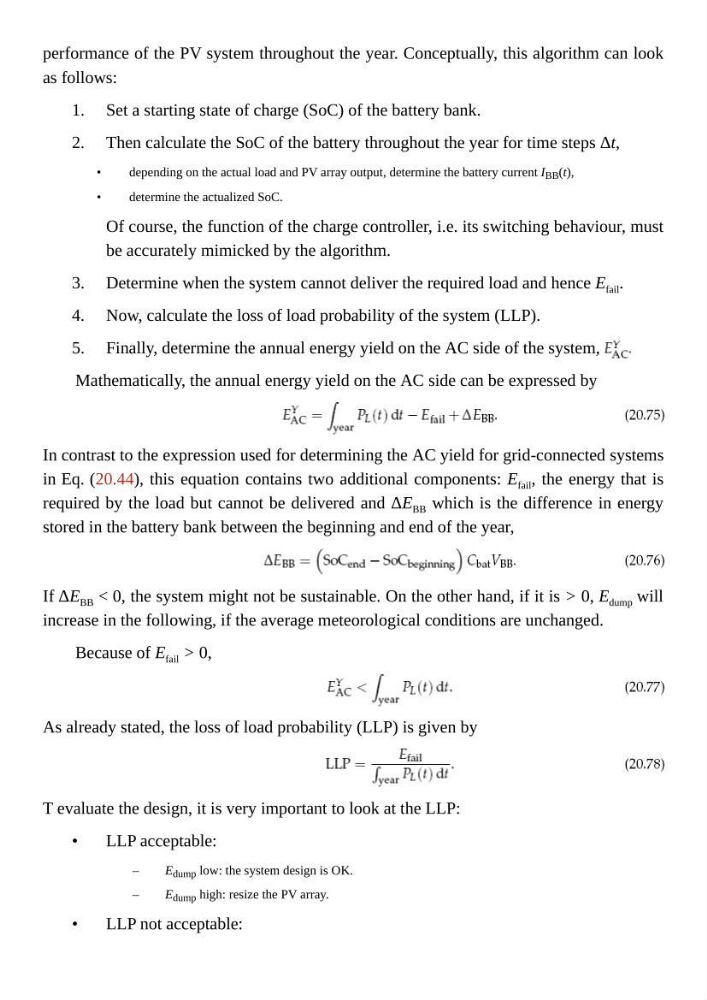
performance of the PV system throughout the year. Conceptually, this algorithm can look
as follows:
Set a starting state of charge (SoC) of the battery bank.
Then calculate the SoC of the battery throughout the year for time steps Δt,
depending on the actual load and PV array output, determine the battery current I BB (t),
determine the actualized SoC.
Of course, the function of the charge controller, i.e. its switching behaviour, must
be accurately mimicked by the algorithm.
Determine when the system cannot deliver the required load and hence E fail .
Now, calculate the loss of load probability of the system (LLP).
Finally, determine the annual energy yield on the AC side of the system,
Mathematically, the annual energy yield on the AC side can be expressed by
In contrast to the expression used for determining the AC yield for grid-connected systems
in Eq. (20.44), this equation contains two additional components: E fail , the energy that is
required by the load but cannot be delivered and ΔE BB which is the difference in energy
stored in the battery bank between the beginning and end of the year,
If ΔE BB < 0, the system might not be sustainable. On the other hand, if it is > 0, E dump will
increase in the following, if the average meteorological conditions are unchanged.
Because of E fail > 0,
As already stated, the loss of load probability (LLP) is given by
T evaluate the design, it is very important to look at the LLP:
LLP acceptable:
E dump low: the system design is OK.
E dump high: resize the PV array.
LLP not acceptable:
2.
•
•
3.
4.
5.
•
–
–
•
performance of the PV system throughout the year. Conceptually, this algorithm can look
as follows:
Set a starting state of charge (SoC) of the battery bank.
Then calculate the SoC of the battery throughout the year for time steps Δt,
depending on the actual load and PV array output, determine the battery current I BB (t),
determine the actualized SoC.
Of course, the function of the charge controller, i.e. its switching behaviour, must
be accurately mimicked by the algorithm.
Determine when the system cannot deliver the required load and hence E fail .
Now, calculate the loss of load probability of the system (LLP).
Finally, determine the annual energy yield on the AC side of the system,
Mathematically, the annual energy yield on the AC side can be expressed by
In contrast to the expression used for determining the AC yield for grid-connected systems
in Eq. (20.44), this equation contains two additional components: E fail , the energy that is
required by the load but cannot be delivered and ΔE BB which is the difference in energy
stored in the battery bank between the beginning and end of the year,
If ΔE BB < 0, the system might not be sustainable. On the other hand, if it is > 0, E dump will
increase in the following, if the average meteorological conditions are unchanged.
Because of E fail > 0,
As already stated, the loss of load probability (LLP) is given by
T evaluate the design, it is very important to look at the LLP:
LLP acceptable:
E dump low: the system design is OK.
E dump high: resize the PV array.
LLP not acceptable: