

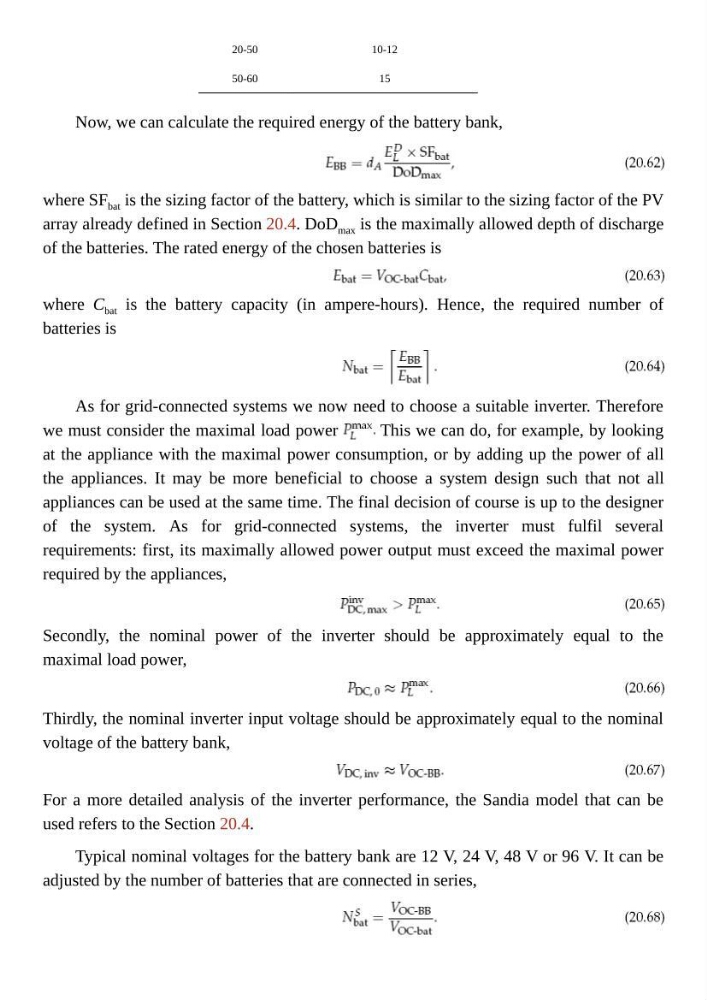
20-50
10-12
50-60
15
Now, we can calculate the required energy of the battery bank,
where SF bat is the sizing factor of the battery, which is similar to the sizing factor of the PV
array already defined in Section 20.4. DoD max is the maximally allowed depth of discharge
of the batteries. The rated energy of the chosen batteries is
where C bat is the battery capacity (in ampere-hours). Hence, the required number of
batteries is
As for grid-connected systems we now need to choose a suitable inverter. Therefore
we must consider the maximal load power
This we can do, for example, by looking
at the appliance with the maximal power consumption, or by adding up the power of all
the appliances. It may be more beneficial to choose a system design such that not all
appliances can be used at the same time. The final decision of course is up to the designer
of the system. As for grid-connected systems, the inverter must fulfil several
requirements: first, its maximally allowed power output must exceed the maximal power
required by the appliances,
Secondly, the nominal power of the inverter should be approximately equal to the
maximal load power,
Thirdly, the nominal inverter input voltage should be approximately equal to the nominal
voltage of the battery bank,
For a more detailed analysis of the inverter performance, the Sandia model that can be
used refers to the Section 20.4.
Typical nominal voltages for the battery bank are 12 V, 24 V, 48 V or 96 V. It can be
adjusted by the number of batteries that are connected in series,
10-12
50-60
15
Now, we can calculate the required energy of the battery bank,
where SF bat is the sizing factor of the battery, which is similar to the sizing factor of the PV
array already defined in Section 20.4. DoD max is the maximally allowed depth of discharge
of the batteries. The rated energy of the chosen batteries is
where C bat is the battery capacity (in ampere-hours). Hence, the required number of
batteries is
As for grid-connected systems we now need to choose a suitable inverter. Therefore
we must consider the maximal load power
This we can do, for example, by looking
at the appliance with the maximal power consumption, or by adding up the power of all
the appliances. It may be more beneficial to choose a system design such that not all
appliances can be used at the same time. The final decision of course is up to the designer
of the system. As for grid-connected systems, the inverter must fulfil several
requirements: first, its maximally allowed power output must exceed the maximal power
required by the appliances,
Secondly, the nominal power of the inverter should be approximately equal to the
maximal load power,
Thirdly, the nominal inverter input voltage should be approximately equal to the nominal
voltage of the battery bank,
For a more detailed analysis of the inverter performance, the Sandia model that can be
used refers to the Section 20.4.
Typical nominal voltages for the battery bank are 12 V, 24 V, 48 V or 96 V. It can be
adjusted by the number of batteries that are connected in series,