

20.5.2
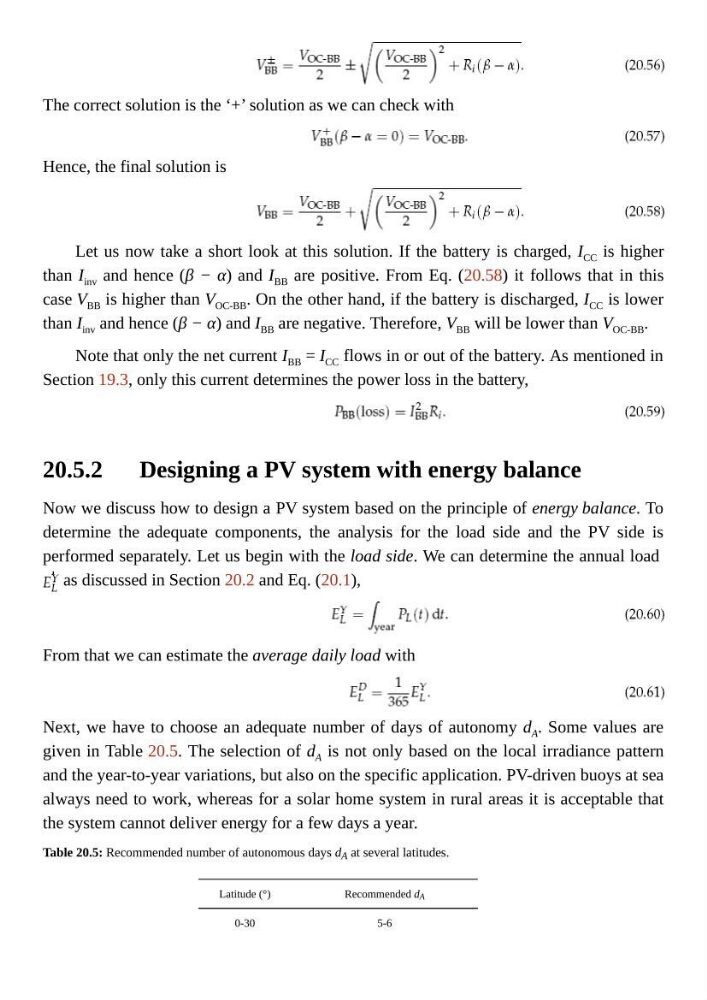
The correct solution is the ‘+’ solution as we can check with
Hence, the final solution is
Let us now take a short look at this solution. If the battery is charged, I CC is higher
than I inv and hence (β − α) and I BB are positive. From Eq. (20.58) it follows that in this
case V BB is higher than V OC-BB . On the other hand, if the battery is discharged, I CC is lower
than I inv and hence (β − α) and I BB are negative. Therefore, V BB will be lower than V OC-BB .
Note that only the net current I BB = I CC flows in or out of the battery. As mentioned in
Section 19.3, only this current determines the power loss in the battery,
Designing a PV system with energy balance
Now we discuss how to design a PV system based on the principle of energy balance. To
determine the adequate components, the analysis for the load side and the PV side is
performed separately. Let us begin with the load side. We can determine the annual load
as discussed in Section 20.2 and Eq. (20.1),
From that we can estimate the average daily load with
Next, we have to choose an adequate number of days of autonomy d A . Some values are
given in Table 20.5. The selection of d A is not only based on the local irradiance pattern
and the year-to-year variations, but also on the specific application. PV-driven buoys at sea
always need to work, whereas for a solar home system in rural areas it is acceptable that
the system cannot deliver energy for a few days a year.
Table 20.5: Recommended number of autonomous days d A at several latitudes.
Latitude (°)
Recommended d A
0-30
5-6
The correct solution is the ‘+’ solution as we can check with
Hence, the final solution is
Let us now take a short look at this solution. If the battery is charged, I CC is higher
than I inv and hence (β − α) and I BB are positive. From Eq. (20.58) it follows that in this
case V BB is higher than V OC-BB . On the other hand, if the battery is discharged, I CC is lower
than I inv and hence (β − α) and I BB are negative. Therefore, V BB will be lower than V OC-BB .
Note that only the net current I BB = I CC flows in or out of the battery. As mentioned in
Section 19.3, only this current determines the power loss in the battery,
Designing a PV system with energy balance
Now we discuss how to design a PV system based on the principle of energy balance. To
determine the adequate components, the analysis for the load side and the PV side is
performed separately. Let us begin with the load side. We can determine the annual load
as discussed in Section 20.2 and Eq. (20.1),
From that we can estimate the average daily load with
Next, we have to choose an adequate number of days of autonomy d A . Some values are
given in Table 20.5. The selection of d A is not only based on the local irradiance pattern
and the year-to-year variations, but also on the specific application. PV-driven buoys at sea
always need to work, whereas for a solar home system in rural areas it is acceptable that
the system cannot deliver energy for a few days a year.
Table 20.5: Recommended number of autonomous days d A at several latitudes.
Latitude (°)
Recommended d A
0-30
5-6