

20.4.2
account.
An additional decrease of 3% in the system performance can be considered to cover
losses caused by mismatch between modules (−1.5%), ohmic cable losses (−0.5%) and
soiling (−1%) [167], if the cable losses are not determined as described in Section 19.5.
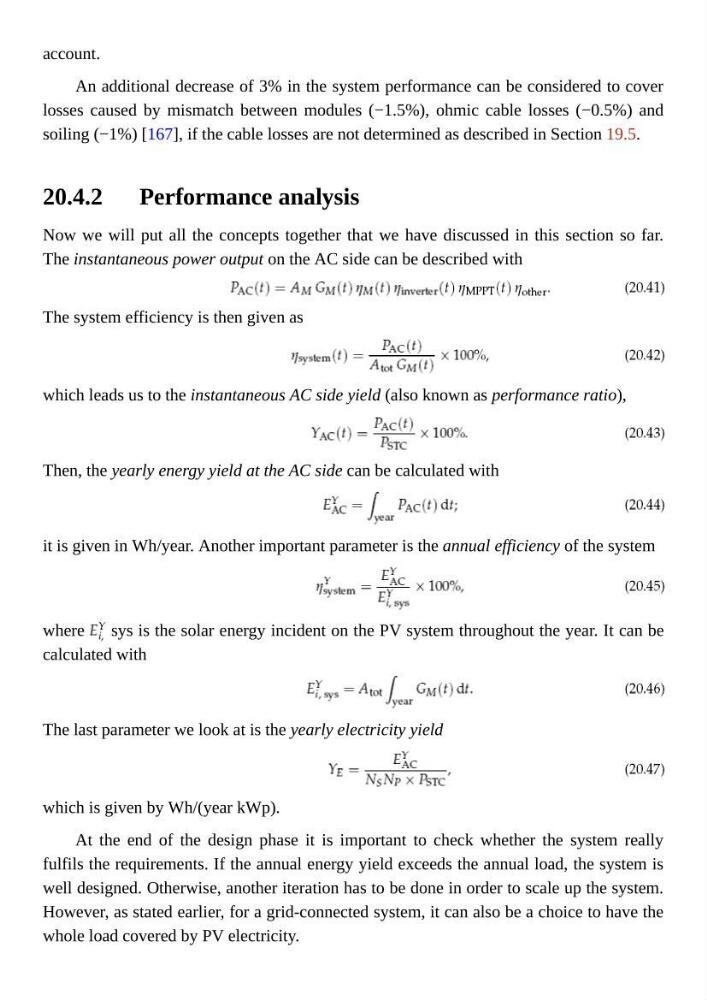
Performance analysis
Now we will put all the concepts together that we have discussed in this section so far.
The instantaneous power output on the AC side can be described with
The system efficiency is then given as
which leads us to the instantaneous AC side yield (also known as performance ratio),
Then, the yearly energy yield at the AC side can be calculated with
it is given in Wh/year. Another important parameter is the annual efficiency of the system
where sys is the solar energy incident on the PV system throughout the year. It can be
calculated with
The last parameter we look at is the yearly electricity yield
which is given by Wh/(year kWp).
At the end of the design phase it is important to check whether the system really
fulfils the requirements. If the annual energy yield exceeds the annual load, the system is
well designed. Otherwise, another iteration has to be done in order to scale up the system.
However, as stated earlier, for a grid-connected system, it can also be a choice to have the
whole load covered by PV electricity.
account.
An additional decrease of 3% in the system performance can be considered to cover
losses caused by mismatch between modules (−1.5%), ohmic cable losses (−0.5%) and
soiling (−1%) [167], if the cable losses are not determined as described in Section 19.5.
Performance analysis
Now we will put all the concepts together that we have discussed in this section so far.
The instantaneous power output on the AC side can be described with
The system efficiency is then given as
which leads us to the instantaneous AC side yield (also known as performance ratio),
Then, the yearly energy yield at the AC side can be calculated with
it is given in Wh/year. Another important parameter is the annual efficiency of the system
where sys is the solar energy incident on the PV system throughout the year. It can be
calculated with
The last parameter we look at is the yearly electricity yield
which is given by Wh/(year kWp).
At the end of the design phase it is important to check whether the system really
fulfils the requirements. If the annual energy yield exceeds the annual load, the system is
well designed. Otherwise, another iteration has to be done in order to scale up the system.
However, as stated earlier, for a grid-connected system, it can also be a choice to have the
whole load covered by PV electricity.