

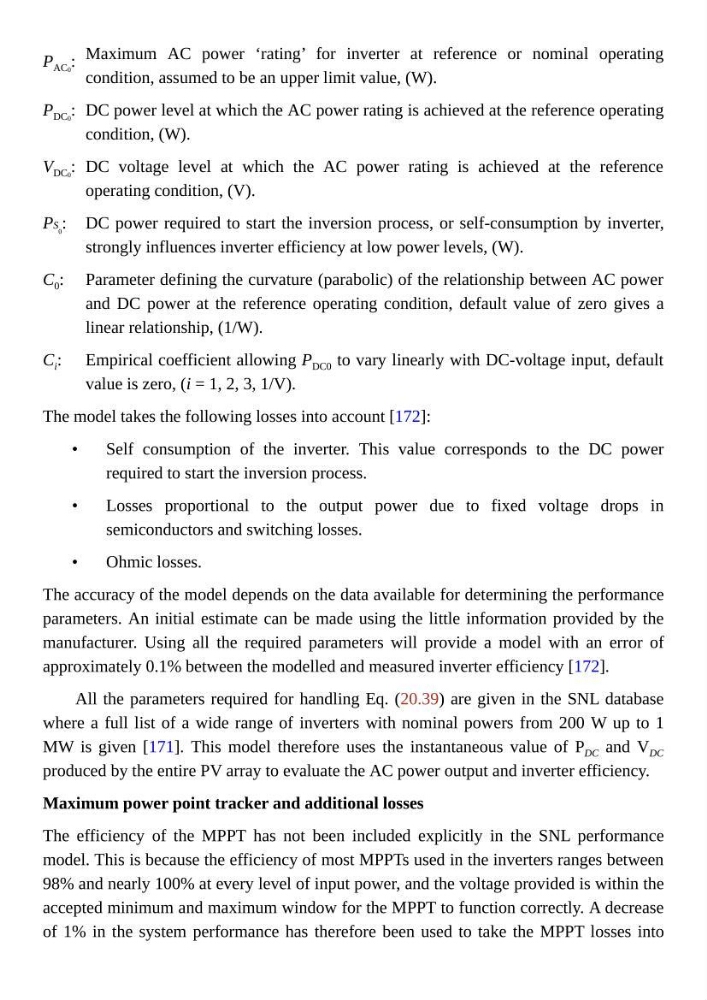
P AC0 :
P DC0 :
V DC0 :
PS
0
:
C 0 :
C i :
•
•
•
Maximum AC power ‘rating’ for inverter at reference or nominal operating
condition, assumed to be an upper limit value, (W).
DC power level at which the AC power rating is achieved at the reference operating
condition, (W).
DC voltage level at which the AC power rating is achieved at the reference
operating condition, (V).
DC power required to start the inversion process, or self-consumption by inverter,
strongly influences inverter efficiency at low power levels, (W).
Parameter defining the curvature (parabolic) of the relationship between AC power
and DC power at the reference operating condition, default value of zero gives a
linear relationship, (1/W).
Empirical coefficient allowing P DC0 to vary linearly with DC-voltage input, default
value is zero, (i = 1, 2, 3, 1/V).
The model takes the following losses into account [172]:
Self consumption of the inverter. This value corresponds to the DC power
required to start the inversion process.
Losses proportional to the output power due to fixed voltage drops in
semiconductors and switching losses.
Ohmic losses.
The accuracy of the model depends on the data available for determining the performance
parameters. An initial estimate can be made using the little information provided by the
manufacturer. Using all the required parameters will provide a model with an error of
approximately 0.1% between the modelled and measured inverter efficiency [172].
All the parameters required for handling Eq. (20.39) are given in the SNL database
where a full list of a wide range of inverters with nominal powers from 200 W up to 1
MW is given [171]. This model therefore uses the instantaneous value of P DC and V DC
produced by the entire PV array to evaluate the AC power output and inverter efficiency.
Maximum power point tracker and additional losses
The efficiency of the MPPT has not been included explicitly in the SNL performance
model. This is because the efficiency of most MPPTs used in the inverters ranges between
98% and nearly 100% at every level of input power, and the voltage provided is within the
accepted minimum and maximum window for the MPPT to function correctly. A decrease
of 1% in the system performance has therefore been used to take the MPPT losses into
P DC0 :
V DC0 :
PS
0
:
C 0 :
C i :
•
•
•
Maximum AC power ‘rating’ for inverter at reference or nominal operating
condition, assumed to be an upper limit value, (W).
DC power level at which the AC power rating is achieved at the reference operating
condition, (W).
DC voltage level at which the AC power rating is achieved at the reference
operating condition, (V).
DC power required to start the inversion process, or self-consumption by inverter,
strongly influences inverter efficiency at low power levels, (W).
Parameter defining the curvature (parabolic) of the relationship between AC power
and DC power at the reference operating condition, default value of zero gives a
linear relationship, (1/W).
Empirical coefficient allowing P DC0 to vary linearly with DC-voltage input, default
value is zero, (i = 1, 2, 3, 1/V).
The model takes the following losses into account [172]:
Self consumption of the inverter. This value corresponds to the DC power
required to start the inversion process.
Losses proportional to the output power due to fixed voltage drops in
semiconductors and switching losses.
Ohmic losses.
The accuracy of the model depends on the data available for determining the performance
parameters. An initial estimate can be made using the little information provided by the
manufacturer. Using all the required parameters will provide a model with an error of
approximately 0.1% between the modelled and measured inverter efficiency [172].
All the parameters required for handling Eq. (20.39) are given in the SNL database
where a full list of a wide range of inverters with nominal powers from 200 W up to 1
MW is given [171]. This model therefore uses the instantaneous value of P DC and V DC
produced by the entire PV array to evaluate the AC power output and inverter efficiency.
Maximum power point tracker and additional losses
The efficiency of the MPPT has not been included explicitly in the SNL performance
model. This is because the efficiency of most MPPTs used in the inverters ranges between
98% and nearly 100% at every level of input power, and the voltage provided is within the
accepted minimum and maximum window for the MPPT to function correctly. A decrease
of 1% in the system performance has therefore been used to take the MPPT losses into