

20.3.4
Overall module performance
By combining the two effects of temperature and light intensity, the final efficiency of the
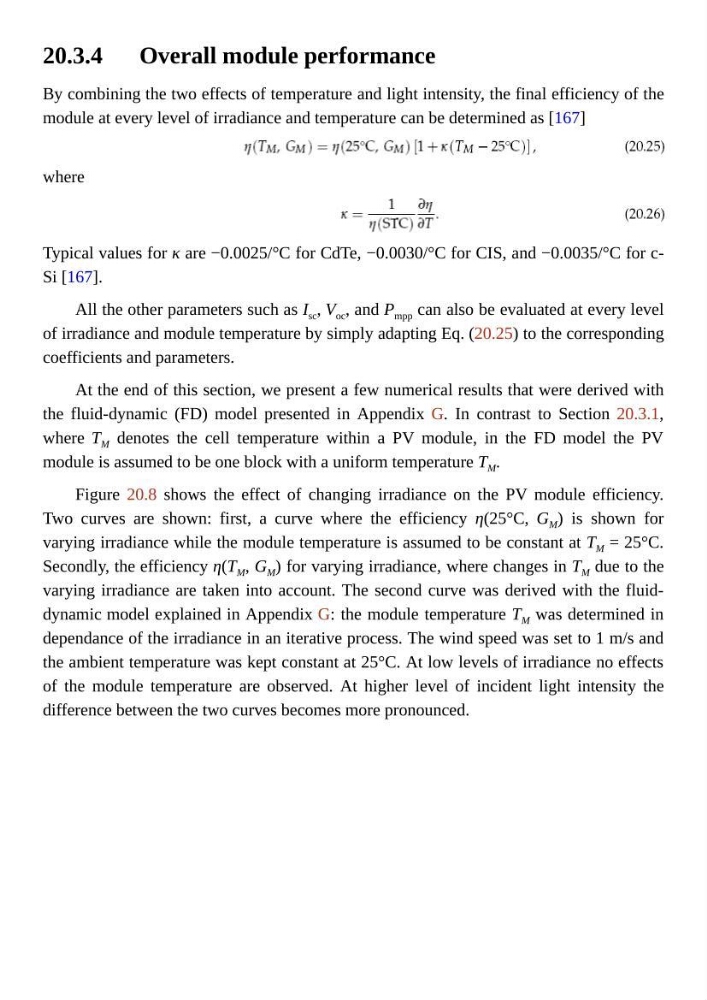
module at every level of irradiance and temperature can be determined as [167]
where
Typical values for κ are −0.0025/°C for CdTe, −0.0030/°C for CIS, and −0.0035/°C for cSi [167].
All the other parameters such as I sc , V oc , and P mpp can also be evaluated at every level
of irradiance and module temperature by simply adapting Eq. (20.25) to the corresponding
coefficients and parameters.
At the end of this section, we present a few numerical results that were derived with
the fluid-dynamic (FD) model presented in Appendix G. In contrast to Section 20.3.1,
where T M denotes the cell temperature within a PV module, in the FD model the PV
module is assumed to be one block with a uniform temperature T M .
Figure 20.8 shows the effect of changing irradiance on the PV module efficiency.
Two curves are shown: first, a curve where the efficiency η(25°C, G M ) is shown for
varying irradiance while the module temperature is assumed to be constant at T M = 25°C.
Secondly, the efficiency η(T M , G M ) for varying irradiance, where changes in T M due to the
varying irradiance are taken into account. The second curve was derived with the fluiddynamic model explained in Appendix G: the module temperature T M was determined in
dependance of the irradiance in an iterative process. The wind speed was set to 1 m/s and
the ambient temperature was kept constant at 25°C. At low levels of irradiance no effects
of the module temperature are observed. At higher level of incident light intensity the
difference between the two curves becomes more pronounced.
Overall module performance
By combining the two effects of temperature and light intensity, the final efficiency of the
module at every level of irradiance and temperature can be determined as [167]
where
Typical values for κ are −0.0025/°C for CdTe, −0.0030/°C for CIS, and −0.0035/°C for cSi [167].
All the other parameters such as I sc , V oc , and P mpp can also be evaluated at every level
of irradiance and module temperature by simply adapting Eq. (20.25) to the corresponding
coefficients and parameters.
At the end of this section, we present a few numerical results that were derived with
the fluid-dynamic (FD) model presented in Appendix G. In contrast to Section 20.3.1,
where T M denotes the cell temperature within a PV module, in the FD model the PV
module is assumed to be one block with a uniform temperature T M .
Figure 20.8 shows the effect of changing irradiance on the PV module efficiency.
Two curves are shown: first, a curve where the efficiency η(25°C, G M ) is shown for
varying irradiance while the module temperature is assumed to be constant at T M = 25°C.
Secondly, the efficiency η(T M , G M ) for varying irradiance, where changes in T M due to the
varying irradiance are taken into account. The second curve was derived with the fluiddynamic model explained in Appendix G: the module temperature T M was determined in
dependance of the irradiance in an iterative process. The wind speed was set to 1 m/s and
the ambient temperature was kept constant at 25°C. At low levels of irradiance no effects
of the module temperature are observed. At higher level of incident light intensity the
difference between the two curves becomes more pronounced.