

19.6
(a)
(b)
(c)
(d)
(i)
(ii)
(iii)
(iv)
19.7
(a)
(b)
(c)
(d)
(e)
19.8
(a)
(b)
(c)
(d)
19.9
(a)
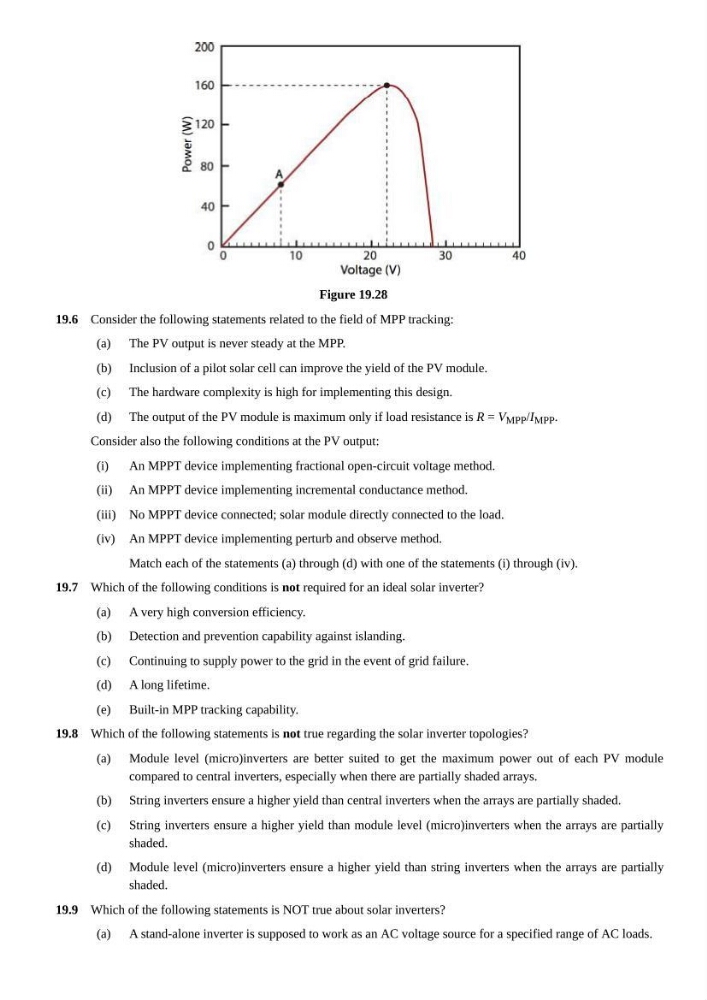
Figure 19.28
Consider the following statements related to the field of MPP tracking:
The PV output is never steady at the MPP.
Inclusion of a pilot solar cell can improve the yield of the PV module.
The hardware complexity is high for implementing this design.
The output of the PV module is maximum only if load resistance is R = V MPP /I MPP .
Consider also the following conditions at the PV output:
An MPPT device implementing fractional open-circuit voltage method.
An MPPT device implementing incremental conductance method.
No MPPT device connected; solar module directly connected to the load.
An MPPT device implementing perturb and observe method.
Match each of the statements (a) through (d) with one of the statements (i) through (iv).
Which of the following conditions is not required for an ideal solar inverter?
A very high conversion efficiency.
Detection and prevention capability against islanding.
Continuing to supply power to the grid in the event of grid failure.
A long lifetime.
Built-in MPP tracking capability.
Which of the following statements is not true regarding the solar inverter topologies?
Module level (micro)inverters are better suited to get the maximum power out of each PV module
compared to central inverters, especially when there are partially shaded arrays.
String inverters ensure a higher yield than central inverters when the arrays are partially shaded.
String inverters ensure a higher yield than module level (micro)inverters when the arrays are partially
shaded.
Module level (micro)inverters ensure a higher yield than string inverters when the arrays are partially
shaded.
Which of the following statements is NOT true about solar inverters?
A stand-alone inverter is supposed to work as an AC voltage source for a specified range of AC loads.
(a)
(b)
(c)
(d)
(i)
(ii)
(iii)
(iv)
19.7
(a)
(b)
(c)
(d)
(e)
19.8
(a)
(b)
(c)
(d)
19.9
(a)
Figure 19.28
Consider the following statements related to the field of MPP tracking:
The PV output is never steady at the MPP.
Inclusion of a pilot solar cell can improve the yield of the PV module.
The hardware complexity is high for implementing this design.
The output of the PV module is maximum only if load resistance is R = V MPP /I MPP .
Consider also the following conditions at the PV output:
An MPPT device implementing fractional open-circuit voltage method.
An MPPT device implementing incremental conductance method.
No MPPT device connected; solar module directly connected to the load.
An MPPT device implementing perturb and observe method.
Match each of the statements (a) through (d) with one of the statements (i) through (iv).
Which of the following conditions is not required for an ideal solar inverter?
A very high conversion efficiency.
Detection and prevention capability against islanding.
Continuing to supply power to the grid in the event of grid failure.
A long lifetime.
Built-in MPP tracking capability.
Which of the following statements is not true regarding the solar inverter topologies?
Module level (micro)inverters are better suited to get the maximum power out of each PV module
compared to central inverters, especially when there are partially shaded arrays.
String inverters ensure a higher yield than central inverters when the arrays are partially shaded.
String inverters ensure a higher yield than module level (micro)inverters when the arrays are partially
shaded.
Module level (micro)inverters ensure a higher yield than string inverters when the arrays are partially
shaded.
Which of the following statements is NOT true about solar inverters?
A stand-alone inverter is supposed to work as an AC voltage source for a specified range of AC loads.