

This efficiency covers the fact that the charging voltage is always a little above the rated
voltage in order to drive the reverse chemical (charging) reaction in the battery.
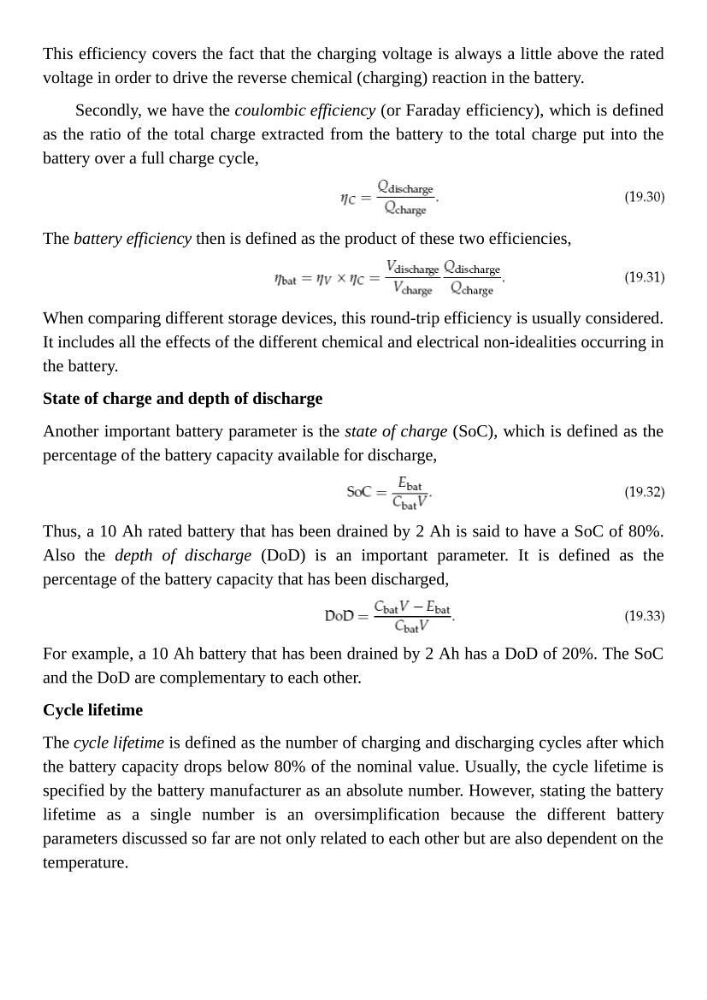
Secondly, we have the coulombic efficiency (or Faraday efficiency), which is defined
as the ratio of the total charge extracted from the battery to the total charge put into the
battery over a full charge cycle,
The battery efficiency then is defined as the product of these two efficiencies,
When comparing different storage devices, this round-trip efficiency is usually considered.
It includes all the effects of the different chemical and electrical non-idealities occurring in
the battery.
State of charge and depth of discharge
Another important battery parameter is the state of charge (SoC), which is defined as the
percentage of the battery capacity available for discharge,
Thus, a 10 Ah rated battery that has been drained by 2 Ah is said to have a SoC of 80%.
Also the depth of discharge (DoD) is an important parameter. It is defined as the
percentage of the battery capacity that has been discharged,
For example, a 10 Ah battery that has been drained by 2 Ah has a DoD of 20%. The SoC
and the DoD are complementary to each other.
Cycle lifetime
The cycle lifetime is defined as the number of charging and discharging cycles after which
the battery capacity drops below 80% of the nominal value. Usually, the cycle lifetime is
specified by the battery manufacturer as an absolute number. However, stating the battery
lifetime as a single number is an oversimplification because the different battery
parameters discussed so far are not only related to each other but are also dependent on the
temperature.
voltage in order to drive the reverse chemical (charging) reaction in the battery.
Secondly, we have the coulombic efficiency (or Faraday efficiency), which is defined
as the ratio of the total charge extracted from the battery to the total charge put into the
battery over a full charge cycle,
The battery efficiency then is defined as the product of these two efficiencies,
When comparing different storage devices, this round-trip efficiency is usually considered.
It includes all the effects of the different chemical and electrical non-idealities occurring in
the battery.
State of charge and depth of discharge
Another important battery parameter is the state of charge (SoC), which is defined as the
percentage of the battery capacity available for discharge,
Thus, a 10 Ah rated battery that has been drained by 2 Ah is said to have a SoC of 80%.
Also the depth of discharge (DoD) is an important parameter. It is defined as the
percentage of the battery capacity that has been discharged,
For example, a 10 Ah battery that has been drained by 2 Ah has a DoD of 20%. The SoC
and the DoD are complementary to each other.
Cycle lifetime
The cycle lifetime is defined as the number of charging and discharging cycles after which
the battery capacity drops below 80% of the nominal value. Usually, the cycle lifetime is
specified by the battery manufacturer as an absolute number. However, stating the battery
lifetime as a single number is an oversimplification because the different battery
parameters discussed so far are not only related to each other but are also dependent on the
temperature.