

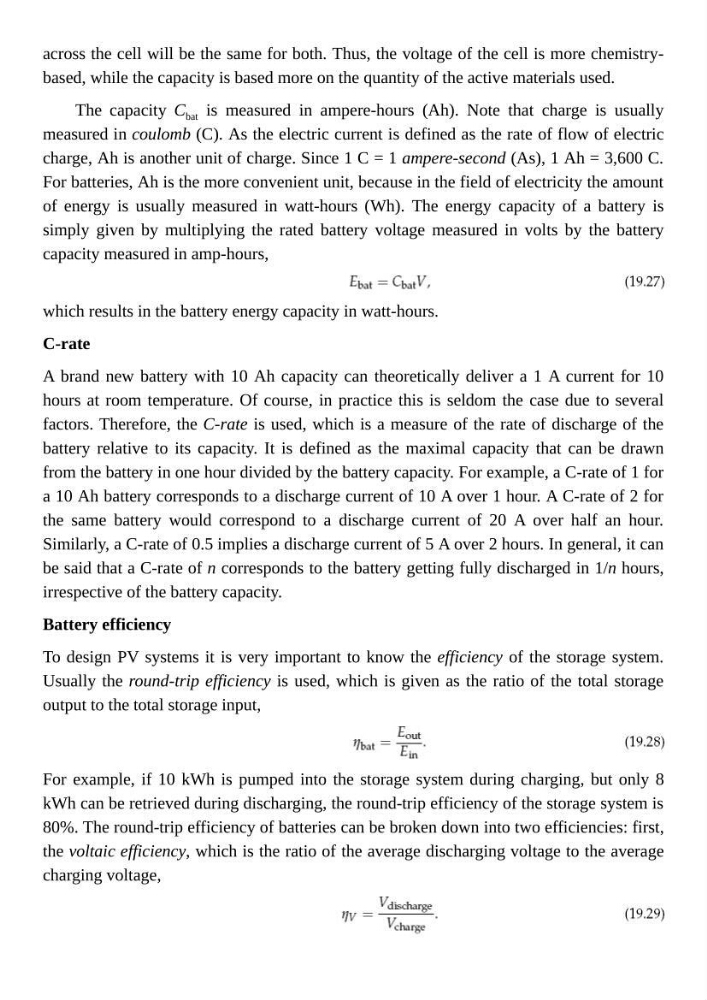
across the cell will be the same for both. Thus, the voltage of the cell is more chemistrybased, while the capacity is based more on the quantity of the active materials used.
The capacity C bat is measured in ampere-hours (Ah). Note that charge is usually
measured in coulomb (C). As the electric current is defined as the rate of flow of electric
charge, Ah is another unit of charge. Since 1 C = 1 ampere-second (As), 1 Ah = 3,600 C.
For batteries, Ah is the more convenient unit, because in the field of electricity the amount
of energy is usually measured in watt-hours (Wh). The energy capacity of a battery is
simply given by multiplying the rated battery voltage measured in volts by the battery
capacity measured in amp-hours,
which results in the battery energy capacity in watt-hours.
C-rate
A brand new battery with 10 Ah capacity can theoretically deliver a 1 A current for 10
hours at room temperature. Of course, in practice this is seldom the case due to several
factors. Therefore, the C-rate is used, which is a measure of the rate of discharge of the
battery relative to its capacity. It is defined as the maximal capacity that can be drawn
from the battery in one hour divided by the battery capacity. For example, a C-rate of 1 for
a 10 Ah battery corresponds to a discharge current of 10 A over 1 hour. A C-rate of 2 for
the same battery would correspond to a discharge current of 20 A over half an hour.
Similarly, a C-rate of 0.5 implies a discharge current of 5 A over 2 hours. In general, it can
be said that a C-rate of n corresponds to the battery getting fully discharged in 1/n hours,
irrespective of the battery capacity.
Battery efficiency
To design PV systems it is very important to know the efficiency of the storage system.
Usually the round-trip efficiency is used, which is given as the ratio of the total storage
output to the total storage input,
For example, if 10 kWh is pumped into the storage system during charging, but only 8
kWh can be retrieved during discharging, the round-trip efficiency of the storage system is
80%. The round-trip efficiency of batteries can be broken down into two efficiencies: first,
the voltaic efficiency, which is the ratio of the average discharging voltage to the average
charging voltage,
The capacity C bat is measured in ampere-hours (Ah). Note that charge is usually
measured in coulomb (C). As the electric current is defined as the rate of flow of electric
charge, Ah is another unit of charge. Since 1 C = 1 ampere-second (As), 1 Ah = 3,600 C.
For batteries, Ah is the more convenient unit, because in the field of electricity the amount
of energy is usually measured in watt-hours (Wh). The energy capacity of a battery is
simply given by multiplying the rated battery voltage measured in volts by the battery
capacity measured in amp-hours,
which results in the battery energy capacity in watt-hours.
C-rate
A brand new battery with 10 Ah capacity can theoretically deliver a 1 A current for 10
hours at room temperature. Of course, in practice this is seldom the case due to several
factors. Therefore, the C-rate is used, which is a measure of the rate of discharge of the
battery relative to its capacity. It is defined as the maximal capacity that can be drawn
from the battery in one hour divided by the battery capacity. For example, a C-rate of 1 for
a 10 Ah battery corresponds to a discharge current of 10 A over 1 hour. A C-rate of 2 for
the same battery would correspond to a discharge current of 20 A over half an hour.
Similarly, a C-rate of 0.5 implies a discharge current of 5 A over 2 hours. In general, it can
be said that a C-rate of n corresponds to the battery getting fully discharged in 1/n hours,
irrespective of the battery capacity.
Battery efficiency
To design PV systems it is very important to know the efficiency of the storage system.
Usually the round-trip efficiency is used, which is given as the ratio of the total storage
output to the total storage input,
For example, if 10 kWh is pumped into the storage system during charging, but only 8
kWh can be retrieved during discharging, the round-trip efficiency of the storage system is
80%. The round-trip efficiency of batteries can be broken down into two efficiencies: first,
the voltaic efficiency, which is the ratio of the average discharging voltage to the average
charging voltage,